
Most enterprise AI programmes have a slides problem. The strategy looks great at an all-hands. The use cases are compelling. The roadmap is ambitious. And then... not a lot actually changes for the people who have to do the work.
Opal U | AI Marketing University is built around a different premise. Less theory, more: here's a build environment, here's five hours over five days, make something useful. No coding required. No pitch at the end. Just a brief and a deadline.
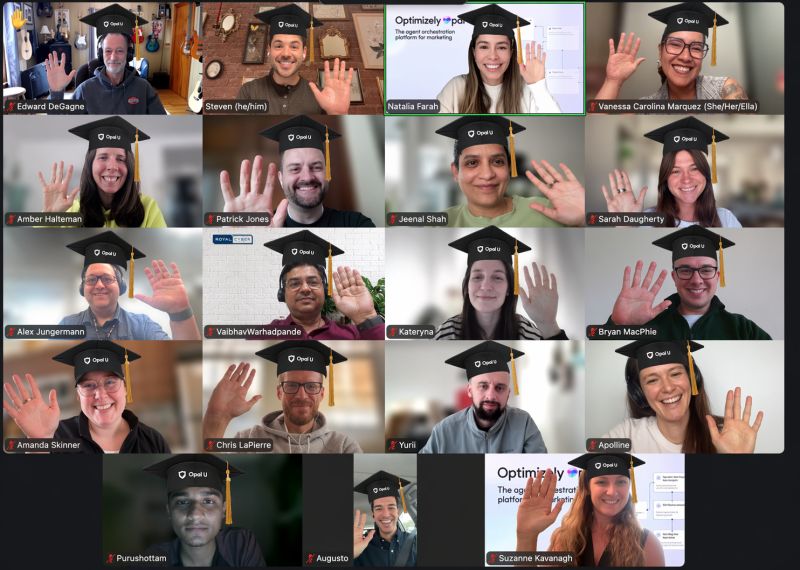
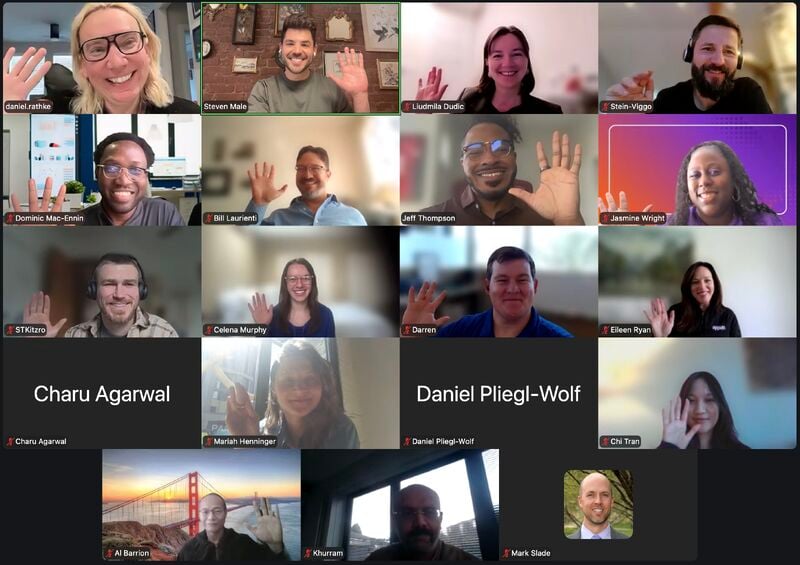
The March cohorts you're about to meet came from Zoom, Tory Burch, LG Electronics, KPMG, ASOS, Virgin Media O2, Lucid Motors, CompTIA, DocuSign, and 20-odd other companies. Between them, in each of their five day cohorts across March, they built a total of 215 agents.
Here are five of those agent-building stories.
The one that used to cost £10,000
Dom Graveson @ Director of Strategy, Netcel
Dom has spent 25 years doing UX research and financial services consulting. He knows what good work looks like, and he knows what it costs. So when he started building agents on day one, he wasn't really thinking about saving time. He was thinking about what his clients would actually pay for.
By day three he had built a FinServ Transparency & Fairness Assessor: an agent that reviews a financial services website against UK and EU consumer duty regulations, returns a compliance score, and attaches a confidence rating to every finding. By day four he had a Persona-Based UX Assessor running alongside it — the same website, but evaluated through synthetic customer personas, each with their own priorities and their own priorities action plan.
The kind of deliverable that, eighteen months ago, his agency would have quoted a client £10,000 for. A week's worth of work. Now it runs in seven minutes.
Time saved: A week's worth of consultancy work — previously ~£10,000 to commission — now takes 7 minutes to run.
“I've been kind of faking it till I'm making it. I feel like I've actually made something this week.”
For the record: Dom has done a lot of AI courses. His review of this one, unprompted, mid-session: "Basically the best course I've done in AI, and I've done a LOT of these."
The one where the content team stopped asking Siobhan for things
Siobhan Corley-Richards @ Zoom
Here's a problem Siobhan knows well: someone writes a really good long-form piece. A CX guide, a research report, a thought leadership asset. And then the requests start. Can you turn this into social posts? Can you write a carousel? What about an infographic? Can you do this for the EMEA version?
Each request is small. Together, they're a day's work. Minimum.
Siobhan built a Content Optimization Design Brief Generator. You give it a URL. It reads the content, applies your brand guidelines and social media rules, and produces a full asset brief — hooks, visual direction, text overlays, channel-by-channel format recommendations. Her team can now run it themselves for different products and target markets. No Siobhan required.
Time saved: "A day to two days" of work per campaign, automated. Per campaign. Every time.
“It's giving me more ideas — especially on the social side. This was not something I expected.”
She showed it to her husband the same day. (He's "super into AI and knows a ton more than me," in her words.) He was impressed. She was delighted.
The one that saved the social team 5 hours a month
Alyssa Schwabe @ VP, Digital Marketing, Johnson Financial Group
Alyssa manages a small digital marketing team at a financial services company. Which means she thinks a lot about what her team's time is actually worth, and what they're spending it on that they probably shouldn't be.
Social media calendar prep was one of those things. Every month: trawl the website for recent content, check financial awareness dates, scan for partnership mentions, find local Wisconsin events, format everything by platform. Useful work. Time-consuming work. Absolutely automatable work.
She built a Social Media Calendar Generator that does all of it in a single run. It pulls website content from the last month, cross-references financial awareness days, finds local events near their branch locations, and produces formatted posts for LinkedIn, Facebook, X, and Instagram — with reel suggestions and hashtag recommendations included. When she showed it to the social team, they asked if it could generate images too. It can.
Time saved: 3–5 hours per month, given back to the social team to do work that actually needs a human.
“They were pretty excited with the iteration I showed them — especially once I start working with that image generator.”
The one doing work that almost never got done
Lisa Scrofani @ Asst Director, Digital Content Strategy, Quinnipiac University
Lisa wanted to do competitive analysis on her university's programme landing pages. Compare them side-by-side against competitor pages. See where the messaging is sharper, where the CTAs are better placed, where there are accessibility issues nobody's noticed.
Good idea. Nobody ever has time for it.
She built a Competitor Homepage Analyzer that takes landing page URLs — hers and theirs — and produces a side-by-side evaluation. Messaging clarity, CTA placement, accessibility gaps, areas where competitors are winning, areas where Quinnipiac is. She even added a loop so she can run it across five competitors at once and get a consolidated analysis.
The kicker: during the build she discovered an accessibility issue on one of her own pages she hadn't known about. The agent caught it. That's the kind of thing that makes you stop and recalibrate what "useful" actually means.
Time saved: "At least an 8-hour day" of work that, realistically, was never going to happen otherwise. Now it does.
“I don't know that we really almost ever do it on a regular basis. This is bringing in the ability to do something like this.”
The one running experimentation governance in Google Sheets
Murali Krishna @ Furniture Village (UK)
If you run an experimentation programme, you probably have a version of Murali's problem. The backlog lives in a spreadsheet. Prioritisation is semi-educated guesswork. When two tests run at the same time and interfere with each other, you find out after the fact. And when it's time to write up results for stakeholders, that's another few hours of manually translating numbers into something a non-tester will actually read.
Murali built agents for all three. An Experiment Collision Reviewer that flags interference risks before tests launch. An Experimentation Prioritization Agent that scores the backlog by impact and effort. And an A/B Test Results Storyteller that takes raw test data and turns it into stakeholder-ready narratives.
During the graduation call, Tak Lee from Lucid Motors (watching Murali's demo) typed into the chat: "I'm prioritizing experiments and running collision analysis manually in Google Sheets right now. Such tedious work." He was taking notes, for reals.
“The A/B test results storytelling agent is on fire. This is often the hardest part of testing!” Allison Gillespie @ Optimizely, watching the demo
The other 25 agent builders
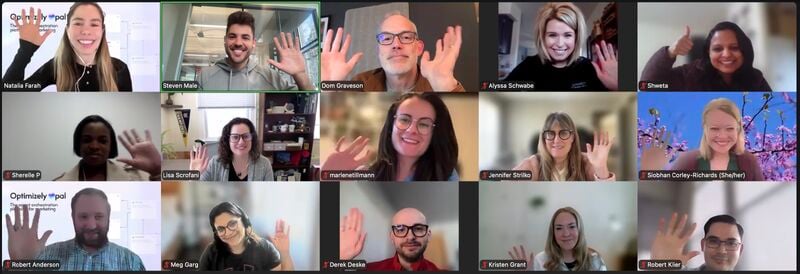
Five stories can't cover thirty graduates. Here's the full picture: 30 marketers from Zoom, Tory Burch, LG Electronics, DocuSign, KPMG, Virgin Media O2, ASOS, Global Payments, Federated Hermes, Lucid Motors, CompTIA, CommScope, Johnson Financial Group, Furniture Village, Alpine, Netcel, E.ON Next, PetMeds, Quinnipiac University, Drees Homes, Yell, Oshyn, Perficient, and Fifty Five and Five. Between them, 215 agents in each of their one-hour-for-five-day cohorts.
The use cases ranged from financial compliance review (Steven Kim, Federated Hermes) to AI search visibility monitoring (Ashish Rasal, CommScope) to a five-agent Reddit engagement workflow (Shweta Gupta, Fifty Five and Five) to a CMS blog creator that publishes directly to a live website (Robert Anderson, Optimizely). Every build was different. Every build solved something real.
Ready to close the AI enablement gap in your team? Apply to Opal U | AI Marketing University now.

Leah är Content Marketing Manager för lösningen Optimizely Content Marketing Platform (CMP). Hon har alltid varit intresserad av att skriva och har haft ett starkt...


- Last modified:2026-04-27 18:33:32