A CMS to do the impossible
What your website can do now that it couldn't two years ago, and the CMS architecture making it possible.



The CMS has spent the last decade quietly becoming the most strategically consequential piece of software most marketing teams own. It shapes who can create content, how fast, at what cost, and with how much governance risk. Today, it also determines whether AI can understand and reuse your content, whether personalization at scale is operationally feasible, and whether your website serves both the humans arriving with intent and the AI agents arriving before them.
Yet most CMS evaluations are still anchored to criteria built for a fundamentally different web.
Fewer than 30% of marketers feel they have the tools and systems needed to manage content effectively, while 77% of teams already struggle to keep up with content demands and 89% of enterprises expect content requirements to at least double over the coming years (Content Marketing Institute, 2025; Fast Company, 2024).
This article makes the case that the CMS category is shifting from an incrementally improving publishing system to a revolutionary experience execution platform. That shift was already underway when AI changed the content economics entirely. Three structural forces have now converged to make the old model genuinely costly to maintain: AI discovery systems have redefined visibility; new content economics have permanently altered the scale at which teams are expected to work; and 1:1 personalization has moved from aspiration to reality.
The businesses that recognize this shift and build accordingly will produce work that used to be operationally impossible two years ago. Not because they hired more people or bought more point solutions, but because they made a better infrastructure decision. Making that decision requires a clear-eyed look at what changed, what it costs to ignore that change, and what becomes possible when you build for the web as it is, not as it was.
Optimizely's advantage is architectural. It connects content management, campaign planning, digital asset management, audience data, experimentation, personalization, and AI into one experience lifecycle, so organizational intelligence travels with every brief, asset, and output. That is what makes Optimizely better suited to absorb the speed, complexity, and constant change of an AI-first market.
The CMS Category Shift
PART ONE: THE OLD WAY
What the web was for
Websites in the late 1990s and early 2000s were largely static collections of HTML pages maintained by developers. Marketers who wanted to publish new content, update a product description, or change a campaign headline had to file a request, wait in a queue, and hope the change made it through before the moment had passed.
The first generation of CMS tools gave marketers direct access to content without requiring developer involvement for every update. That was a genuine breakthrough. WYSIWYG editors, page trees, templates, approval workflows, and drag-and-drop functionality were not just cosmetic improvements. They represented a real transfer of capability from technical teams to content teams.
The model made sense because the web, at the time, operated in a fairly predictable way. Websites were a digital front door. Visitors arrived via search, ads, email, referrals, or direct traffic, browsed pages, read content, clicked links, and occasionally filled out forms. Content was created for human comprehension and navigation. Success meant having the right page, making it findable, and ensuring visitors could take the next step. Publishing was largely the end of the process.
Most modern CMS interfaces still sit on top of that logic.
Why that no longer works
The trouble began when the website's role expanded faster than the CMS model did.
Traditional CMSs turned good ideas into tickets. Marketers could know exactly what they wanted to launch and still be unable to ship it without developers, agencies, admins, or operations teams.
Enterprise websites evolved into business applications. The same system originally built to help a small team publish campaign pages was now expected to support lead generation, localization across multiple markets, compliance workflows, ABM journeys, logged-in customer experiences, calculators, and forms feeding directly into sales pipelines.
The CMS was never architecturally redesigned for that scope. Instead, organizations compensated with more headcount, workarounds, and additional point solutions. Those costs showed up as long onboarding cycles, late-stage compliance reviews, translation queues, metadata backlogs, manual duplication, and a developer dependency that more tooling never reduced.
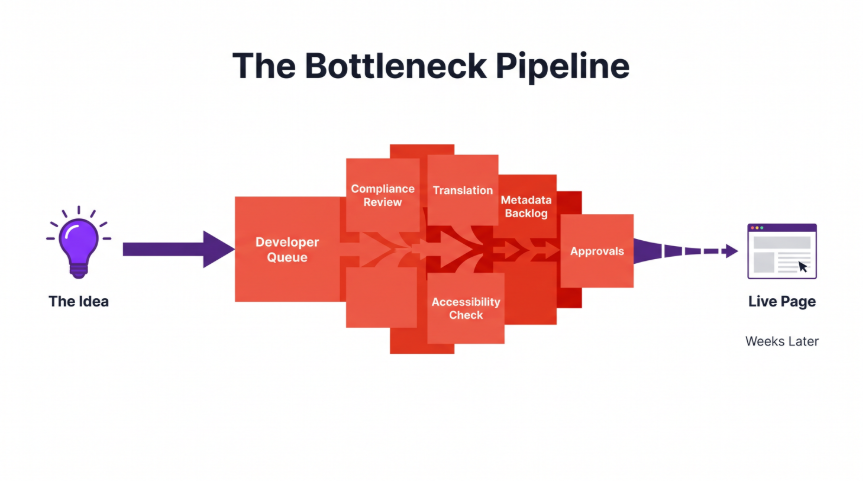
More resources did not fix it. The underlying issue was always structural: a publishing system asked to run an experience operation.
Those strains were uncomfortable but manageable. However, three structural shifts have now converged to make the old model genuinely untenable.
Three shifts that changed the equation
SHIFT 1: The website now serves AI agents as a first-class audience
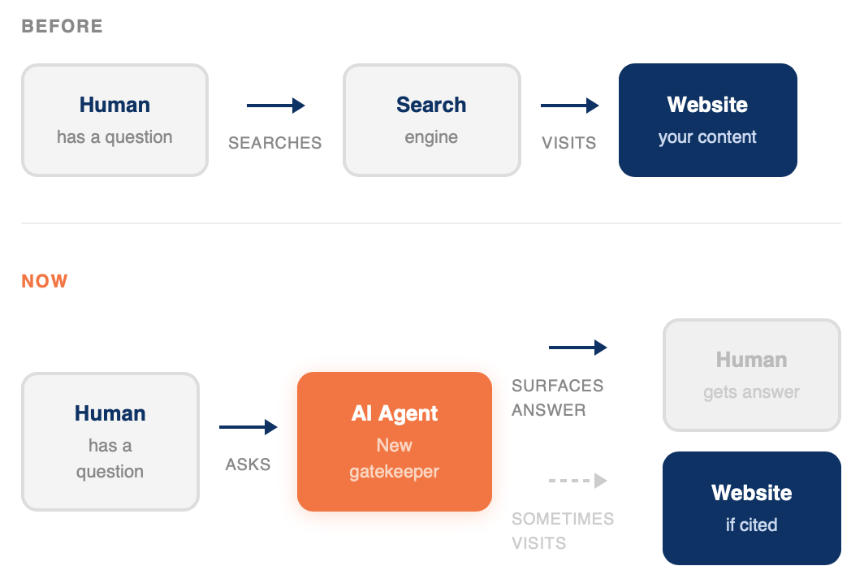
For most of the web’s history, the human visitor was the only audience that mattered. Now, a growing share of people never visit a website directly. Instead, they ask questions to AI agents, get synthesized answers, and often stop there. When they do click through, it is because an AI system has already evaluated and selected the most credible and well-structured source, so the user can now perform a more complex buyer journey. AI agents are the new gatekeepers, operating upstream.
"We have been building digital experiences for humans for a very, very long time. What is happening right now is that your human traffic is going down, and the reduced human traffic now expects a completely different digital experience."
— Nazanin Ramezani, VP Product, CMS, Optimizely
This means content must now serve two audiences simultaneously, and in many contexts the AI audience comes first. Human visitors still need useful, persuasive, well-designed experiences. But content that AI systems cannot parse, verify, or confidently cite does not get surfaced. A brand that loses visibility with AI agents loses visibility with the humans those agents serve. Structured, component-based, metadata-rich content is a visibility requirement for the AI era.
SHIFT 2: Content economics have fundamentally changed
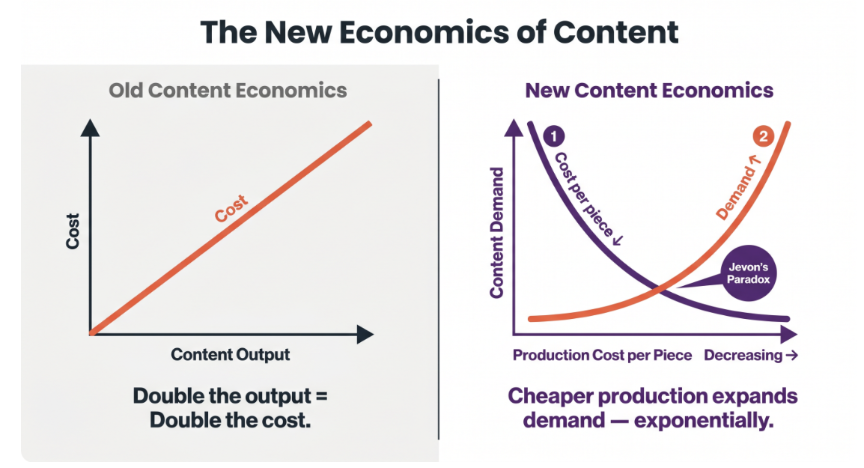
Historically, cheaper content meant lower-quality content. The relationship between quality and quantity was roughly inverse: you could have more content or better content, but producing both at scale required resources most organizations could not sustain. AI changes the equation when generation is grounded in enterprise context: approved data, brand standards, audience intelligence, and workflow governance. Production cost can fall without quality falling with it.
But as production cost drops, demand expands. The expectation is much more: more variants, more markets, more channels, more personalization. Teams will be expected to produce far more than they do today, with the same or smaller budgets. This is Jevons paradox applied to content: the principle that efficiency gains in production tend to increase overall demand rather than reduce overall effort. The bottleneck moves from creation to orchestration.
SHIFT 3: Personalization is being redefined
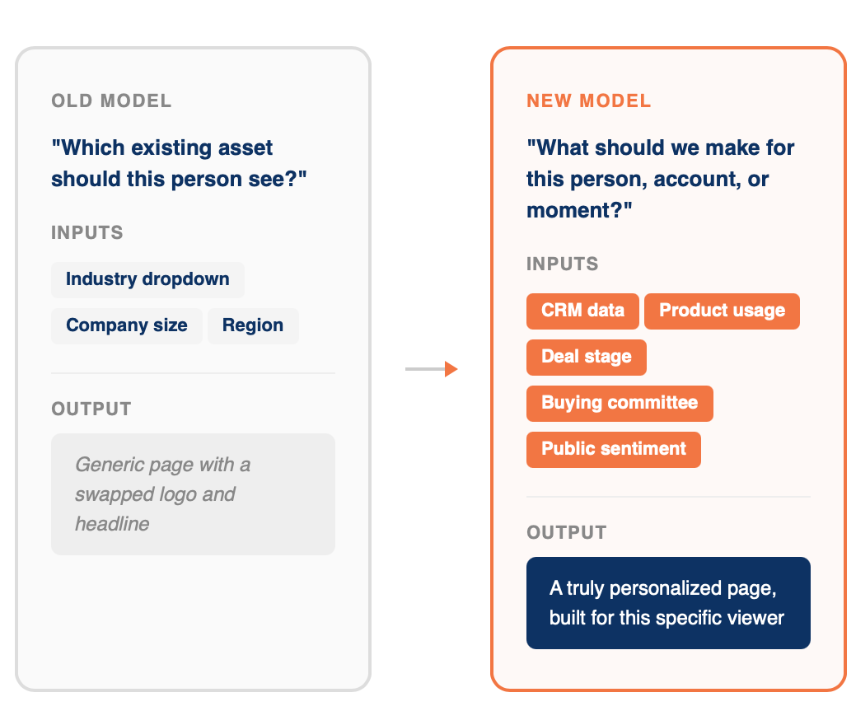
Personalization spent years as a promise organizations struggled to fulfill. Most "personalized" experiences were little more than industry swaps, logo replacements, and headline variations. The underlying content stayed generic. It was categorization pretending to be personalization.
The model is shifting from decisioning to creation. The old question was "which existing asset should this person see?" The new question is "what should we make for this person, account, or moment?" LLMs can now interpret account context, buying committee composition, deal stage, and historical behavior to generate experiences that reflect actual context rather than inferred categories. A page built on CRM data and product usage history reads like someone did the work before writing.
True 1:1 personalization is no longer operationally infeasible. But it requires a CMS that can connect audience intelligence to content generation and governed publishing in a single workflow.
The pressure multiplier: growth moments
These three shifts compound in the moments when organizations are growing fastest. Mergers and acquisitions require content and brand consolidation across websites that were never designed to work together. Geographic expansion requires localized experiences that reflect markets the original CMS was never configured for. New revenue streams require product pages, campaign assets, and supporting content that need to go live before the market window closes.
Every growth moment is, at its core, a content operations stress test that requires content and experiences to be created, adapted, governed, and launched faster than evolutionary workflows can support.
How CMS buying criteria has fallen behind
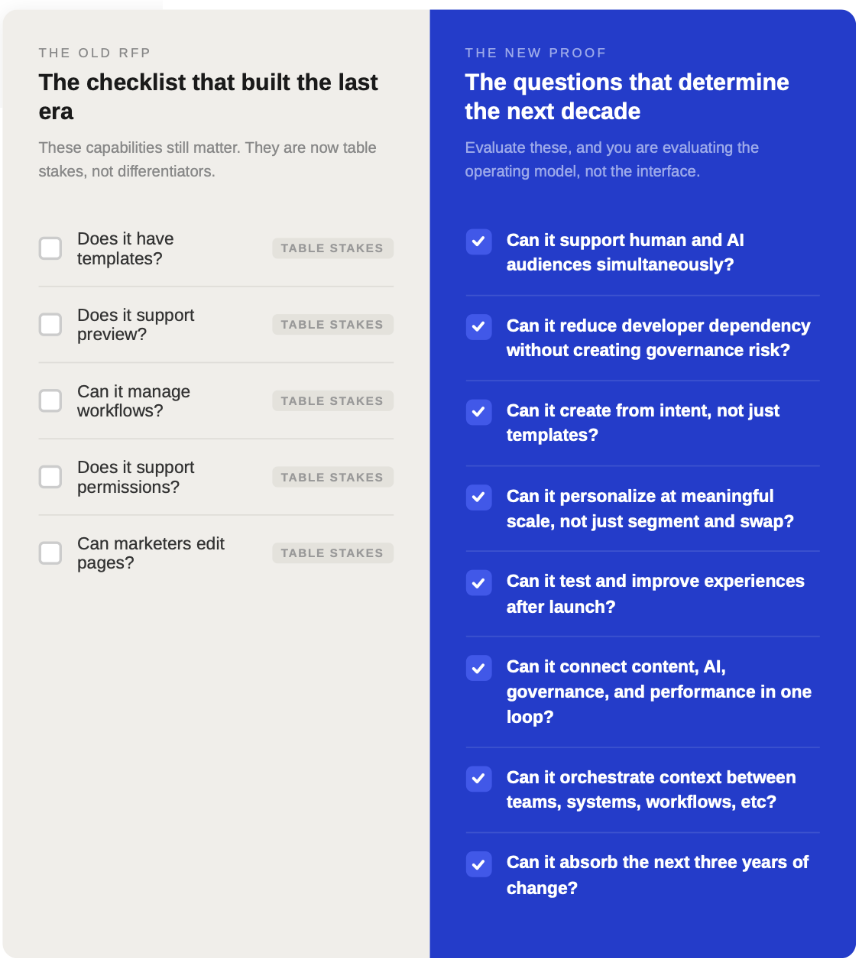
Many RFPs still over-index on drag-and-drop editing, preview fidelity, templates, and publishing workflows. Many of those RFPs are shaped by procurement teams or external consultants operating on evaluation frameworks built for a different era of the web. Those criteria still matter, but they are now table stakes, not differentiators. The organizations still evaluating CMSs on those terms risk falling deeply behind.
Buyers now need to evaluate whether a CMS can support AI-readiness, orchestration, governance, personalization, experimentation, and closed-loop performance. Most evaluation frameworks were not designed for it.
64% of marketing leaders cite an overcrowded technology stack with overlapping tools as their primary barrier to effectively using their own data. Yet only 15% of marketing leaders completely agree that low-value tasks are automated. — Capgemini Research Institute, CMO Playbook 2025
Analyst firm Mordor Intelligence projects headless CMS platforms growing at 18.85% CAGR through 2031. This signals that enterprises are actively replacing legacy stacks with architectures built for multi-channel, AI-native delivery. — Mordor Intelligence, Web Content Management Market Report, 2026
Not sure what to evaluate in a modern CMS? Our buying guide covers the questions that matter for the AI era.
PART 2 — THE NEW WAY
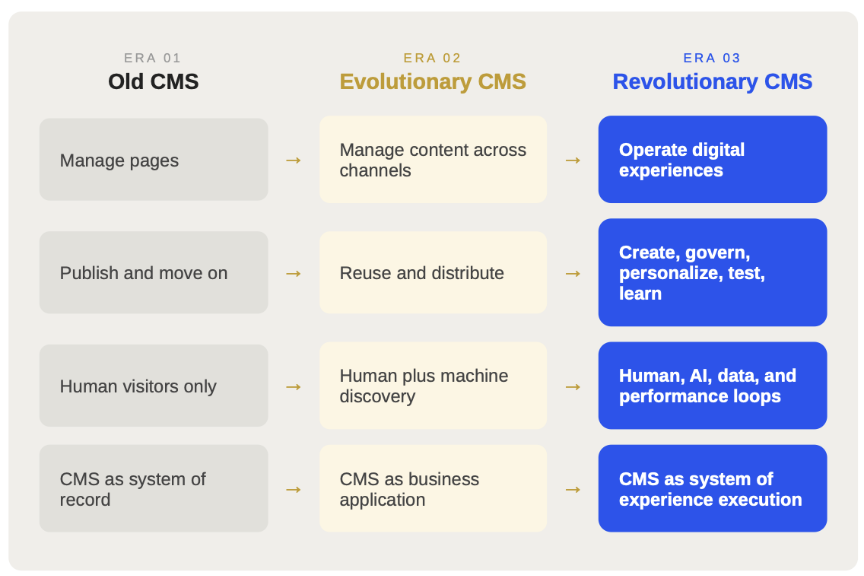
The new CMS model does not just make familiar work faster. It changes what is operationally realistic. The page is no longer the center of the system. It becomes one possible output from a larger layer of content, data, governance, and performance signals. Some of this is evolutionary: work that always felt slow finally moves at the speed teams needed. Some of it is genuinely new territory.
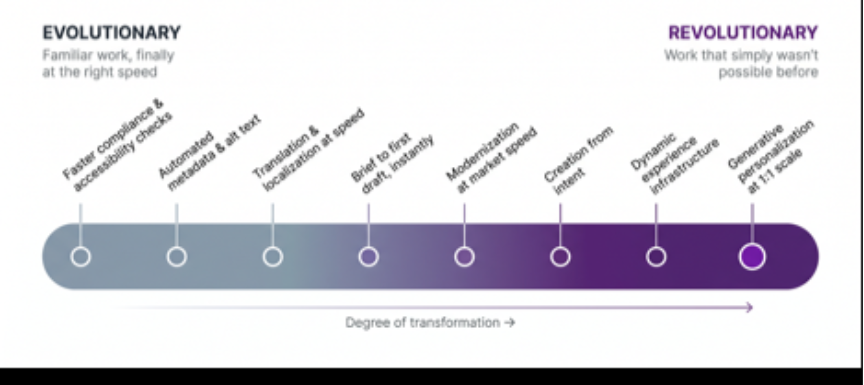
Of the many new things these shifts have unlocked, these four capabilities represent the clearest expression of what is now possible.
Four ‘impossible’ capabilities
01: Modernization at market speed
The traditional CMS migration was a multi-year, high-risk undertaking. Organizations would document every legacy rule, field, block, template, and exception before any new work could begin. The migration itself was mostly excavating years of accumulated decisions from a system whose original architects had often long since departed.
The new model works backward from the ideal outcome. Agents can analyze existing content, infer content models, identify structural gaps, and accelerate setup without requiring an exhaustive manual audit of what came before. Governance, accessibility, compliance, and brand standards can be embedded earlier in the process rather than appearing as late-stage blockers, which is where they tend to be most expensive.
For organizations managing M&A consolidations, brand refreshes, or new geographic launches, this changes the risk profile of the entire undertaking. Migration becomes a strategic lever rather than a constraint. A CMS architecture that can detect existing structure, preserve governance, and accelerate content migration lets teams modernize without putting growth on hold. This faster speed to market allows the business to shift to a more performant CMS, consolidate sites after an acquisition, launch in a new market, refresh a brand, or produce a new digital experience while the opportunity is still alive.
02 Creation from intent
The breakthrough in content creation is not a faster page builder. It is a different creation model entirely.
In the old model, marketers translated an idea into a brief, a brief into a ticket, a ticket into a design request, a design request into a content draft, and a draft into a publishing workflow. Every step depended on another team or another tool. “Sludge work” like alt text, metadata, accessibility checks, compliance review, translations, and routine content variations were necessary but never anyone's highest-value contribution.
In the new model, creation starts with intent: the audience, the objective, the message, the source material, the constraints, and the desired outcome. Agents trained on brand rules, approved messaging, content models, audience data, and performance history can produce structured first versions from a brief, a Figma file, a source page, a campaign plan, or an account list.
Human work shifts to the higher-value judgment that was always the real contribution: reviewing, refining, approving, and improving. A marketer supported by agents with genuine organizational context can do work that previously required multiple specialists. Developer dependency decreases because developers can focus on architecture, integrations, and complex components rather than routine ticket resolution.
03 Dynamic experience infrastructure
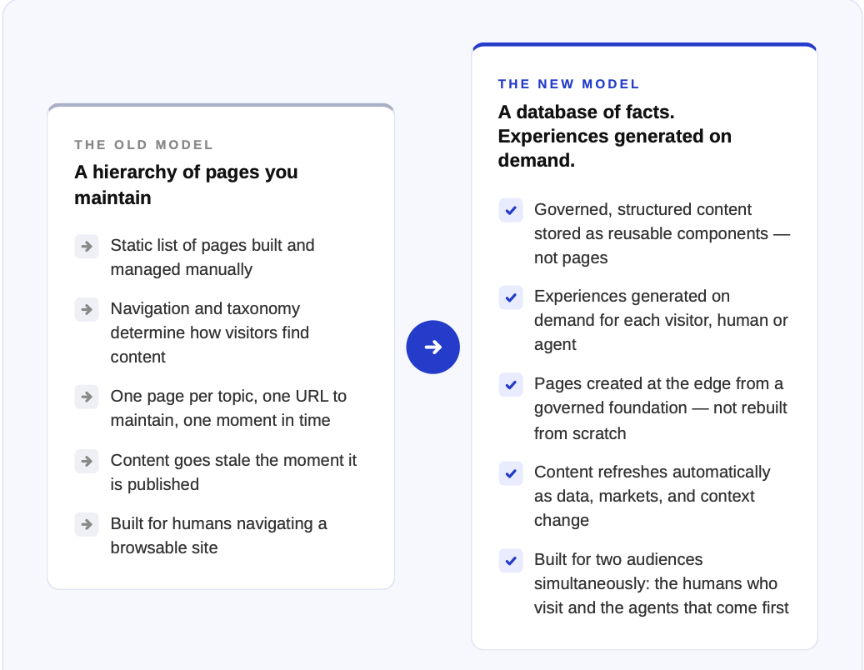
The static hierarchy of pages is giving way to something more useful: a governed foundation of facts, assets, rules, audience context, and performance signals from which experiences can be assembled and adapted without rebuilding from scratch.
Structured, component-based content is the enabling architecture. When content is broken into reusable, tagged, machine-readable elements rather than monolithic pages, it can serve multiple audiences and channels from a single governed source. The same approved content can power a product page, a personalized landing page, a chatbot response, a voice assistant answer, and an LLM-ready extract, without a separate production run for each.
This has immediate operational benefits, including fewer rebuilds, faster localization, and more consistent brand execution across markets. It also creates a structural advantage in AI-era discoverability.
This creates a new optimization frontier. Organizations that can see which AI agents return, what they extract, and whether that activity converts to qualified referrals have a signal most CMSs cannot generate, let alone act on. This can turn into a live performance lever, continuously analyzing how generative systems interpret and represent brand content.
04 Generative personalization
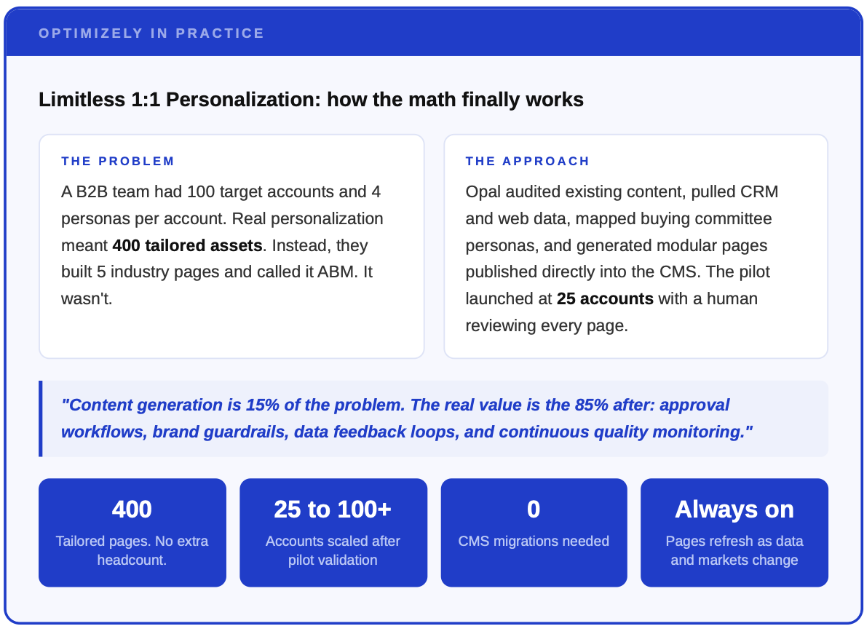
True 1:1 personalization has historically been operationally infeasible. If four buying committee personas across 100 target accounts equals 400 tailored mid-funnel assets, most organizations created five industry pages and called it ABM. The intent was sound, but the execution was a shortcut. Broad segmentation in lieu of personalization.
AI changes the math. When structured audience intelligence from CRM history, product usage, event signals, and web research travels directly to the content creation layer, and generation operates inside governed CMS workflows with approved brand rules and content models, 400 pages becomes easy to execute.
Pages that emerge from this model are not templates with variables. They reflect actual context, public priorities, deal stage, and known pain points. More importantly, they stay accurate as the context changes. If the account moves stages, the market shifts, or new signals appear, the experience can be refreshed from the same governed foundation instead of rebuilt manually.
For the first time, 1:1 personalization is not just possible, but repeatable and governed from the start.
What changes for CMS teams
These shifts do not make people less important. They change where human judgment matters most.
Evolutionarily, teams get faster. Sludge work moves to agents, approval cycles compress, and production scales without proportional headcount growth. Those are real operational gains, the kind that justify a platform investment in the near term.
Revolutionarily, the role of the team changes. As agents take on more execution work, teams need clearer ownership of strategy, quality, governance, brand judgment, and performance interpretation. SEO and GEO work will increasingly move closer to content teams, because discoverability now depends on structure, clarity, and meaning as much as technical implementation. The organizations that win will have platforms that capture their best people's expertise, encode it into agents, and define where human judgment must remain in control.
PART THREE: HOW OPTIMIZELY FILLS THE GAP
The gap between the old model and the new one is not a product roadmap problem. It was determined by architectural decisions vendors made years ago, and none of those gaps can be retrofitted with a product release.
When teams feel CMS pain acutely, the instinct is often to reach for faster relief in the form of more headcount, specialist agencies, pure headless builds, page builders, point AI tools, or custom-coded solutions. Each can address specific symptoms. None addresses the operating model.
The shortcuts and their tradeoffs
More resources
Additional resources help teams produce more, but they also add handoffs, approvals, coordination overhead, and governance. Scaling a broken workflow with more people just scales the friction alongside the output.
Pure headless
Pure headless systems solved a real developer problem by separating content from delivery, making content easier to distribute across channels. But in an agentic world, that separation creates a tradeoff. The CMS can store and distribute content, but it often sits too far from the signals that make experiences better, including audience behavior, conversion data, experimentation results, personalization context, and AI crawl activity. Without those signals, the CMS becomes a content repository rather than a system that can learn from outcomes.
Bolt-on AI
Bolted-on AI features can accelerate individual tasks such as drafting a headline, summarizing a page, creating a variation, or generating metadata. Those are useful improvements, but they do not solve the operating model. If AI creates more parts without connecting those parts to planning, governance, publishing, personalization, experimentation, and measurement, the result is just a larger pile of disconnected assets. The team moves faster for a moment, then slows down again when someone has to assemble, approve, adapt, track, and improve the work manually.
Custom builds
AI-assisted custom builds (often referred to as “vibe coding“) have genuine utility for prototypes, landing pages, and fast experimentation. But enterprise content operations are not a one-off build. They require permissions, governance, localization, accessibility, compliance, analytics, integrations, ownership, and change management over time. You can vibe code a billboard. You cannot sustainably vibe code the operating infrastructure for a global digital business.
"Only 24% of organizations report that their technology platforms support consistent collaboration between business functions, and only 19% describe their business workflows as ‘highly integrated.’ The result: most marketing teams are operating in disconnected systems that can’t pass context, content, or performance signals between them." — IBM Institute for Business Value, The CMO Revolution, 2025
The pattern across all four shortcuts is the same. They optimize parts of the problem while leaving the operating model intact. The instinct is understandable. The cost is invisible at first, then compounding, then very hard to reverse.
What closes the gap is not a better tool for one part of the workflow. It is a platform where every part of the workflow is connected.
The Optimizely approach
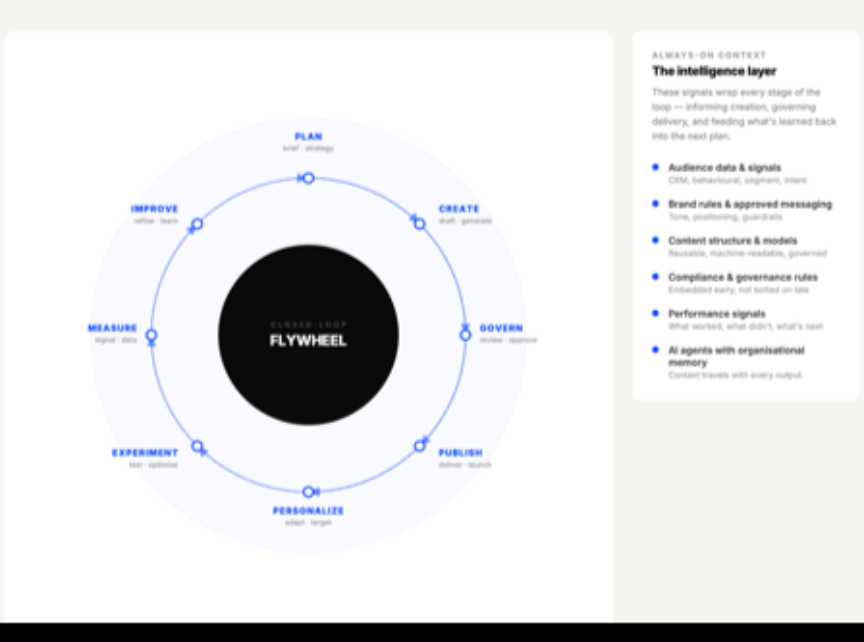
Optimizely is built around an architecture that integrates content, data, governance, AI, and performance learning. The four capabilities below are the direct result of that architecture.
-
Cross-product interoperability: CMS, CMP, DAM, ODP, Experimentation, Personalization, Analytics, and Opal work as one connected lifecycle. A campaign brief carries its strategic intent from planning through creation, publication, and performance measurement without manual re-entry at each step.
-
AI inside the workflow: Opal operates with full organizational context: brand rules, content models, assets, audience data, permissions, and performance history. Generation reflects what the organization actually knows, not just what is in the prompt.
-
Governance-first generation: AI outputs land inside approved CMS structures, with metadata, workflows, permissions, and review paths already in place. Most AI tools generate first and govern later, where compliance costs are highest. Progressive trust gives teams a practical path that starts with full human review, and increases automation as quality is demonstrated.
-
Closed performance loop: Teams can create, publish, personalize, test, measure, and improve without losing context between systems. The signal generated in one part of the platform informs the next decision in another.
-
Hybrid architecture: Headless where developers need it, visual editing where marketers need it, governed across both. Most enterprise organizations need both layers. Optimizely's hybrid architecture gives them both without forcing a tradeoff between developer flexibility and marketer autonomy.
-
Experimentation-native foundation: Content is not just published. It can be tested, optimized, and improved against real performance outcomes without leaving the platform or stitching in a separate tool.
-
Enterprise implementation knowledge: Years of implementation experience are embedded into partner delivery models, platform design, and workflow patterns, making fixed-scope modernization more achievable than most organizations have experienced.
Opal is not a series of AI tools we give you as part of your CMS. It is an end-to-end agent orchestration platform where you can bring your entire martech stack into one suite. Out of the box, Opal understands your digital experience, which sets it apart from many alternatives in the market today.
— Nazanin Ramezani, VP Product, CMS, Optimizely
Each of those properties compound. Together, they make the following capabilities not just technically possible, but real.
How the four capabilities are delivered in practice
01: Modernization at market speed
Most migration projects fail the same way: scope expands, timelines slip, and the business freezes while the infrastructure catches up. Optimizely is designed to help teams address this at business speed. Agents trained on existing content infer content models, flag structural debt, and help produce a migration plan with defined milestones. Governance, accessibility, and compliance requirements go into content types and workflows from day one. Partner delivery patterns built specifically around Optimizely’s architecture support fixed-scope engagement approaches where appropriate. For organizations navigating post-acquisition consolidation or a geographic launch, that distinction is strategically significant.
*Migration scope and timing depend on customer-specific factors and are agreed in the applicable Statement of Work.
02: Creation from intent
Context no longer gets lost between the brief and the page. CMP carries audience definition, messaging parameters, and campaign intent forward into every asset, so nothing has to be reconstructed at each handoff. Opal generates inside that context, drawing on the organization’s actual brand rules, approved claims, encoded expertise and performance history across the full platform. What arrives in the CMS is structured, model-compliant, metadata-tagged content already sitting inside the right review path, already traceable back to the brief it came from. Work that previously required a writer, a designer, a developer, and three approval cycles can be supported end-to-end by a marketing manager working alongside agents.
03: Dynamic experience infrastructure
Most content goes stale the moment it publishes. Optimizely’s CMS stores content as governed, versioned components connected to live audience data in ODP, so experiences can be generated, updated, and managed dynamically without rebuilding from scratch. That is the foundation that makes agent-managed experiences possible: not a one-time page build, but a system where content reflects the current state of an account, a market, or a moment. The same structure powers AI discoverability. Optimizely has partnered with Cloudflare to analyze log data and provide GEO intelligence to customers, giving teams visibility into how AI user agents are consuming content and with what intent. Log analytics are the most real source of truth and provide signals that few platforms surface today. The biggest value comes from a content layer that is always current, always governed, and always ready.
04: Generative personalization
Where many platforms stop at decisioning by routing a visitor to the best available asset, Optimizely is designed to go a step further and generate the asset itself. Audience intelligence feeds CRM history, behavioral data, and intent signals into Opal, which produces experiences grounded in actual account context and governed by CMS content models from the start. Pages publish as real, version-controlled CMS items. Native experimentation then runs on top, continuously testing and optimizing which content converts by persona, industry, and deal stage. Personalization becomes a scalable, governed capability rather than a campaign-by-campaign effort.
These four capabilities are not separate use cases. They are results of the same architectural shift. When content, data, governance, AI, and performance learning operate together, the CMS stops being the system teams work around and becomes the system that makes new work possible.
PART FOUR: THE MANIFESTO
Your CMS is not broken. It works exactly as it was designed to. That is the problem.
It was built for a web where people searched, clicked, browsed, and converted in mostly visible ways. That web has changed. AI agents now crawl, evaluate, cite, and summarize content before a human ever decides whether to visit. Buyers move through journeys shaped by systems your CMS may never see, interpret, or influence.
Most of the industry is responding by adding AI features to architectures built for an earlier era. That may make old workflows faster, but it does not necessarily make them fit for the work ahead. The cost of choosing an architecture not designed for this work tends to surface later, when teams discover the connections between content, context, governance, personalization, and performance are harder to retrofit than to build for from the start.
The buyers who get this right will not be the ones who compared editing interfaces and template libraries most carefully. They’ll be the buyers choosing between AI native infrastructure and legacy infrastructure with AI bolted on top. Fundamentally, the successful buyers will be the ones choosing between the past and the future.
"Optimizely truly has their finger on the pulse of the future of CMS. In a truly disrupted world, CMS is not immune from disruption. The people who are embracing the agentic future will be best positioned for what comes next."
— David Knipe, VP, Solution Architecture, Optimizely
The old question was whether teams could make enough content. That question has largely been answered. The harder question now is whether organizations can govern, personalize, measure, and improve all that content without losing brand consistency, team clarity, or strategic intent. Answering that question requires a different kind of infrastructure, one that connects content, data, governance, experimentation, and performance learning instead of treating them as separate parts of the workflow.
The revolutionary choice is not necessarily a bigger bet. It is a more honest assessment of what the business now needs the CMS to do. AI changes what is possible, not just what can be done faster. Experiences can be generated from intent, governed from the start, personalized to individual accounts or audiences, and improved based on real performance signals. These capabilities were not out of reach because teams lacked ambition, but because the infrastructure underneath them could not support the volume, context, governance, and feedback loops required.
The platform that makes this possible now is one where creation, governance, personalization, experimentation, and performance measurement operate as a connected system. It gets smarter over time because every experience creates a signal, and those signals can inform the next decision. Organizations that build on this kind of platform do more than move faster. They compound their advantage with every experience they create, test, and improve.
We believe the CMS has become the most consequential infrastructure decision a marketing organization can make, and the most consistently underestimated one. We believe AI should improve the quality and intelligence of the work, not just increase volume of output. More content faster is not the goal. The goal is better experiences, built on organizational intelligence that compounds over time. We believe the organizations that win the next era will be the ones that recognize that the model itself has to change and have the conviction to act on it.
The web has changed. The work has changed. The CMS has to change with it. Stop buying the evolutionary answer to a revolutionary shift.
SERVICES DESCRIPTION. THE FUNCTIONALITY, CAPABILITIES AND FEATURES OF EXPERIMENTATION ARE MORE FULLY DESCRIBED IN OPTIMIZELY’S SERVICES DESCRIPTION FOR ITS SOFTWARE SERVICES, PUBLISHED AT SOFTWARE SERVICE SERVICES DESCRIPTION, AS UPDATED FROM TO TIME.
DISCLOSURE AND SAFE HARBOR. ANY FUTURE FEATURES MENTIONED IN THIS PLAYBOOK IS INTENDED TO OUTLINE OPTIMIZELY’S GENERAL PRODUCT DIRECTION. IT IS INTENDED FOR INFORMATION PURPOSES ONLY. IT IS NOT INCORPORATED INTO ANY SOFTWARE SUBSCRIPTION AGREEMENT. IT IS NOT A COMMITMENT TO DELIVER ANY MATERIAL, CODE, OR FUNCTIONALITY, AND SHOULD NOT BE RELIED UPON IN MAKING PURCHASING DECISIONS. CUSTOMERS WHO PURCHASE (A) INDUSTRY BENCHMARK FIGURES, (B) ROI WORKED EXAMPLES (SECTION 08), (C) CUSTOMER ANECDOTES (SECTION 05), (D) OPERATIONAL THRESHOLDS PRESENTED AS BEST PRACTICE. BENCHMARK FIGURES, INDUSTRY STATISTICS, AND CUSTOMER EXAMPLES REFERENCED IN THIS PLAYBOOK ARE ILLUSTRATIVE AND BASED ON GENERAL MARKET OBSERVATION OR SELECTED CUSTOMER ENGAGEMENTS. THEY ARE NOT COMMITMENTS, GUARANTEES, OR FORECASTS OF ANY INDIVIDUAL CUSTOMER'S RESULTS. CALCULATIONS AND WORKED EXAMPLES ARE PROVIDED FOR ILLUSTRATION ONLY AND REQUIRE VALIDATION AGAINST THE CUSTOMER'S OWN DATA AND CIRCUMSTANCES. OPTIMIZELY’S SOFTWARE SERVICE SHOULD MAKE THEIR PURCHASE DECISIONS BASED UPON FEATURES AND FUNCTIONS THAT ARE CURRENTLY AVAILABLE. ANY UNRELEASED SERVICES, FEATURES, FUNCTIONALITY, OR ENHANCEMENTS REFERENCED IN ANY DOCUMENT, ROADMAP, BLOG, WEBSITE, PRESS RELEASE, OR PUBLIC STATEMENT THAT ARE NOT CURRENTLY AVAILABLE ARE SUBJECT TO CHANGE AT OPTIMIZELY’S DISCRETION AND MAY NOT BE DELIVERED AS PLANNED OR AT ALL. THE DEVELOPMENT, RELEASE, AND TIMING OF ANY FEATURES OR FUNCTIONALITY REMAINS AT THE SOLE DISCRETION OF OPTIMIZELY.
A CMS to do the impossible. Version 2026 – Published 04 June 2026. © 2026 Optimizely. Optimizely Confidential Information