I put my career on the line to make a murder mystery for B2B

Julianne DeVincenzoJulianne DeVincenzo
30. Okt. 2026

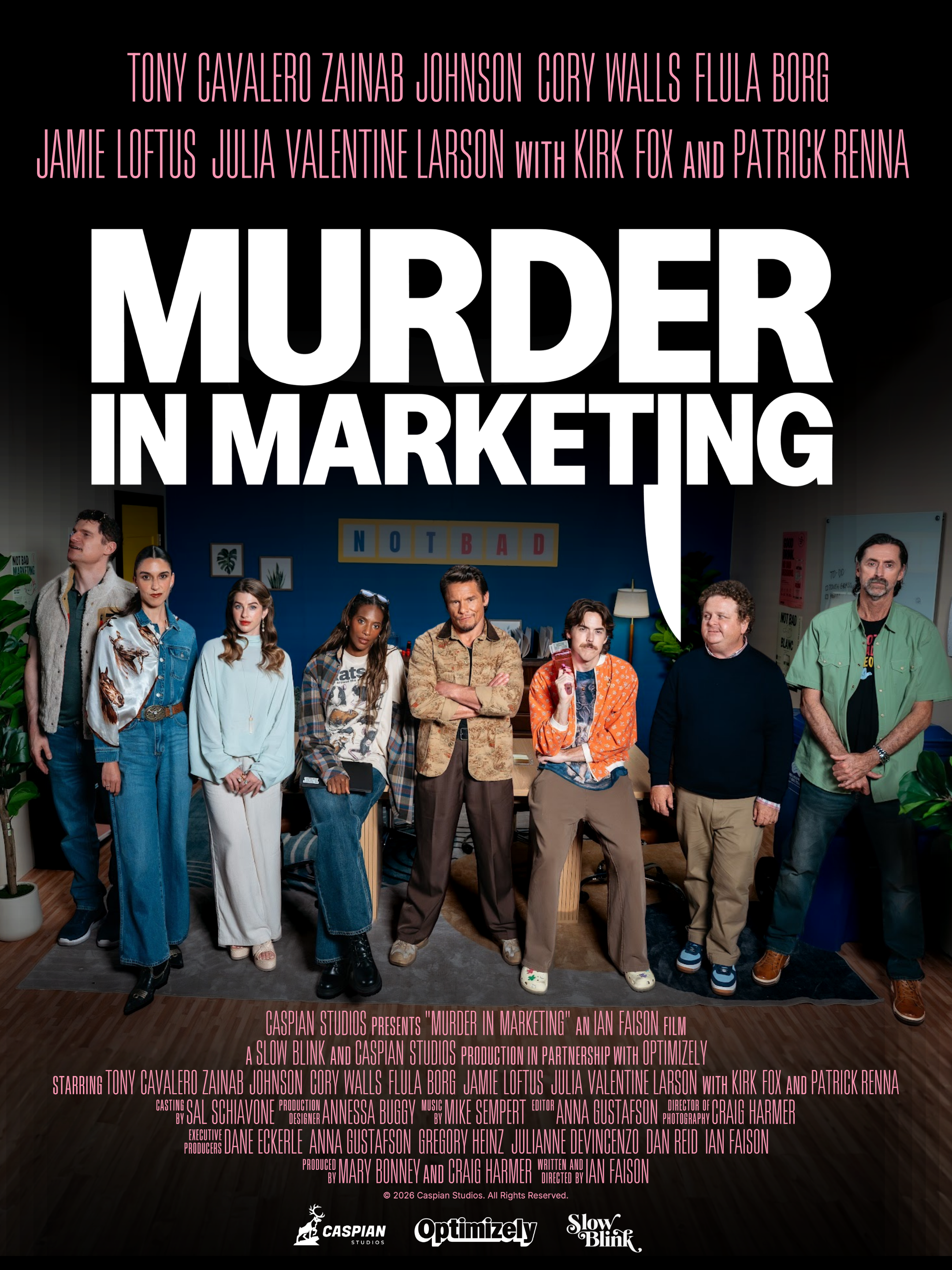
For years, I lived inside respectable B2B content. Then I bet everything on Murder in Marketing, a 36-episode dark comedy about a dead executive and a dysfunctional marketing team. Glory comes in two forms, and both get carved in stone: a Hollywood star or a tombstone. The critics are still out on which one is mine.


On my first Hollywood set, I spent a week laughing beside Dan Reid in a ninety-degree warehouse where we had to turn off the air conditioning every time the cameras rolled, and by the end of each twelve-plus-hour day my cheeks hurt from smiling. I had spent months worrying about scripts, production decisions, and the enormous creative bet I had asked people to take with me, and there I was, watching actors improvise inside a world that had once existed only in my head, discovering a career goal I had never known I wanted until I was living it. 

A year ago, I told Tara Corey, Optimizely’s SVP of Marketing, that she could fire me if I failed to make a difference: I wanted to grow our content program, shake up the way we told stories, and make something people might remember after they closed the tab. I had just stepped into a new role, we were in the middle of a rebrand, we had not yet hired anyone for social, and I was proposing a murder mystery for a B2B software company, with a dead executive at its center and my own credibility somewhere among the suspects. I knew how much I was asking of the people around me, and I had reached a point in my career where making something forgettable felt like a risk of its own. 

The aftertaste of "not bad"

I have spent most of my career making content, some of it good, some beautifully effective, and most of it excruciatingly boring, gathering cobwebs behind a form field until a stranger surrendered an email address in exchange for twelve pages about a problem they may not even have. I know the routine by heart: briefs, personas, campaign calendars, deadlines, and the careful little phrases we reach for when something is technically right and nobody feels much of anything about it. 

“Not bad” has become one of the most quietly damning reviews in a creative profession, a phrase suited to a hotel breakfast you cannot remember eating or a presentation you stopped thinking about before the meeting ended. Marketing got very good at making work that passed through a room without causing trouble, and AI has made it possible to make that work faster and at a scale that should thrill us while keeping us awake. When a hundred forgettable things can be made before lunch, I find myself asking what I want all that making to mean, and whether the work might leave a trace after its metrics have finished moving. 

Fragrance has always felt like a form of time travel to me: it arrives on your skin, in a hallway, through the open window of a car, and years later one familiar note can return you to a person, a place, a summer you thought you had misplaced, keeping an entire memory warm with something invisible. I wanted my work to have that kind of afterlife, to leave a feeling someone could return to after the campaign had ended and the calendar had filled with something else. That desire began to shape the question I asked of every creative decision: would a person care enough to carry any of this with them? 

The Tuesday night test 

I gave that ambition a practical test: would someone choose to watch this on a Tuesday night because they wanted to know what happened next? I pictured a person at home, a phone in their hand, with an entire internet competing for the next ninety seconds, and asked whether the story could earn their attention through its characters, humor, and the pleasure of recognizing something from their own life. 

The Tuesday Night Test became my standard as Murder in Marketing took shape as a 36-episode vertical dark comedy, designed for the small spaces between everything else in a person’s day. I wanted someone to watch episode two, argue about the suspects, send a clip to a colleague, recognize their boss in a character, and immediately deny having done so; the marketers would be the heart of the story, with Optimizely giving this experiment a place to happen. Forrester’s research on microdramas says: viewers are “loyal to the next episode.” B2B marketers are starting to pay attention, and so was I. 

Champagne, murder, and a very good motive 

The murder mystery began, as some of my better decisions do, with champagne: the little report of the cork, the bubbles dancing on your tongue like tiny stars or Pop Rocks for grown-ups, the ceremony of letting an ordinary evening become an occasion. I am fascinated by the women behind its history, especially Madame Clicquot, who took over a champagne house as a young widow and transformed it through ingenuity, stubbornness, and what seems to have been a refusal to accept the limits other people had arranged for her. 

Ian Faison, founder of Caspian Studios and creator of the Webby-winning podcast Murder in HR, wanted a beverage company at the center of the story, a fictional brand we could use to play with the clickbait-style ads and viral videos he has always found funny. You will have to watch to find out how far we took it. But, I couldn’t fathom any drink at the heart of it other than champagne, and champagne comes with a lifetime supply of campaign puns.  

As I say very often, ‘The only kind of pain I like is champagne…and the most pain I am ever in is caused by campaigns…’  

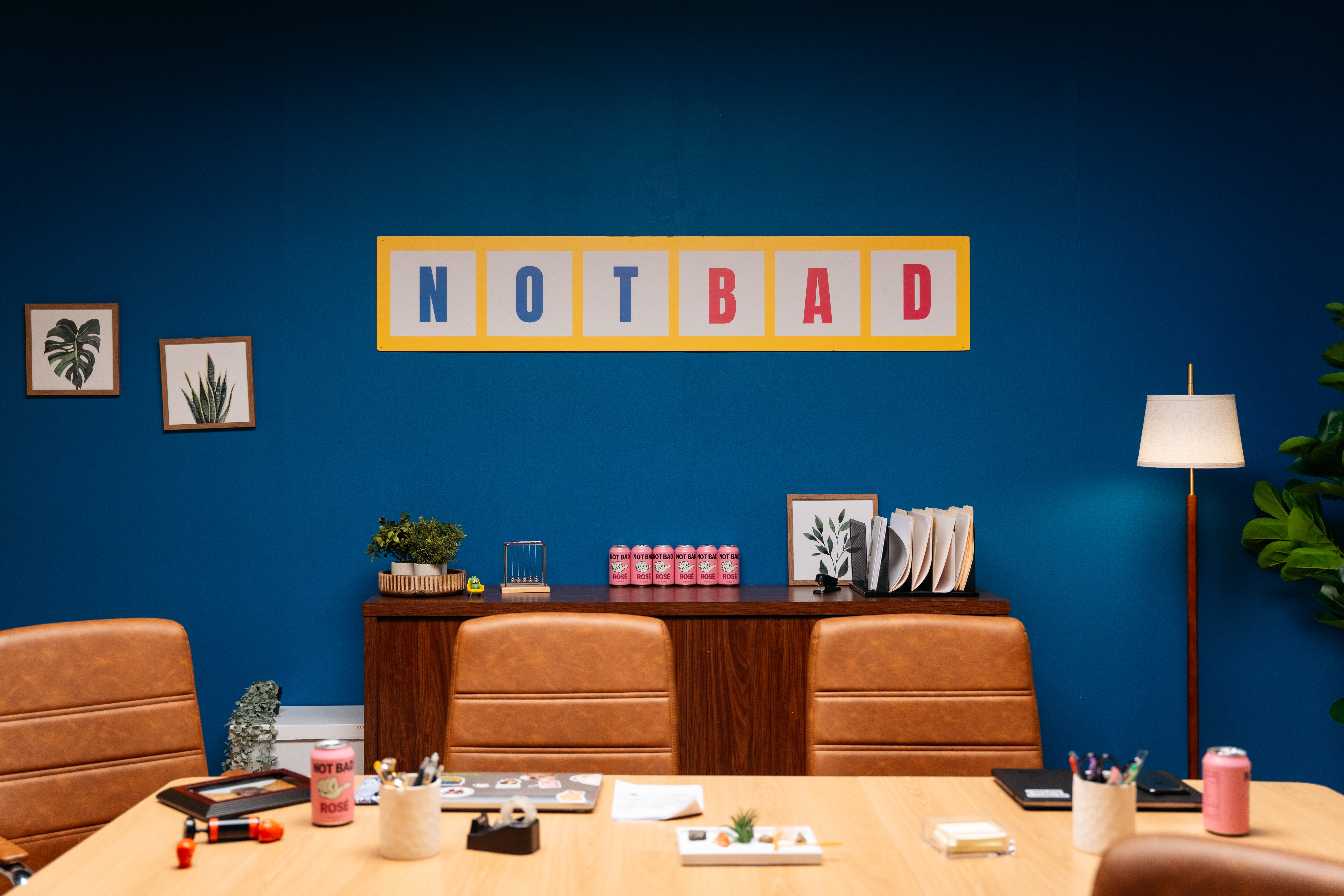
And that is where the crime came in. If someone took traditional champagne, removed the alcohol, and put it in a can, there would naturally be a murder and it might have been me at the top of the suspect list and Madame Clicquot would certainly be rolling over in her grave. We called the company NOT BAD, a fitting name for a brand selling a product of questionable distinction and for the creative mediocrity I was trying to leave behind, while the word campaign, after a little champagne and a deeply unserious sense of humor, became “cannpagne,” a joke that delighted me far more than it probably should have. 

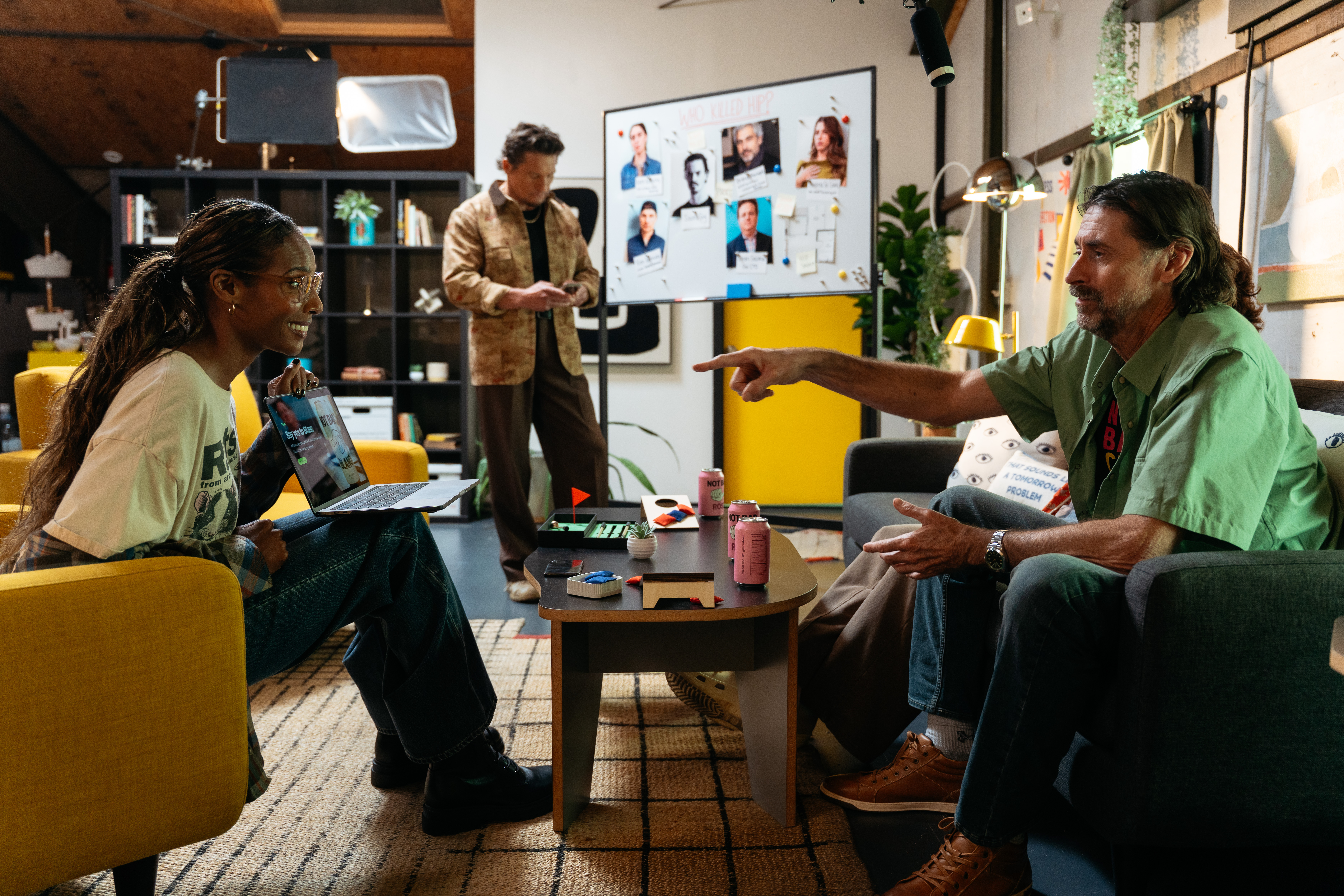
Our fictional company needed a marketing team: ambitious, insecure, overconfident and very well dressed humans who could turn an ordinary business problem into a full-blown existential crisis, people I had spent years observing in their natural habitat. There is the executive rewriting website copy on a napkin at midnight, the colleague whose “quick sync” has a beginning and no discernible end, the agency saying “love it” while reconsidering every decision that brought them into the room, and the person asking about ROI before an idea has had the chance to exist; I recognized all of them, including myself, and gave their already-absurd world a dead body. 

But, I couldn’t fathom any drink at the heart of it other than champagne, and champagne comes with a lifetime supply of campaign puns.  

Julianne DeVincenzo

Head of Content Marketing, Optimizely

 
The risk had to leave my inbox 

The idea arrived just before midnight in an email to Ian. I told him I had some crazy ideas, and because Ian had already made a murder-mystery podcast called Murder in HR, he may have imagined another podcast taking shape in my head; I was picturing actors, a real set, a fictional company full of people behaving very badly, and a story built for the vertical screen, one episode at a time. 

A midnight email is intoxicating, while the morning after brings the calendar, the budget, the production plan, and all the smart people who will have to help an idea become real. Greg Heinz, Optimizelys Senior Director of Brand & Digital Experience, joined me the next morning with with joy, excitement, and the support to help me work through the budget. We were signing up for ten months of seriously fun and seriously challenging work. When we signed the paperwork, we were in the middle of a rebrand, I had just taken on a new role, social had no team yet, and every ordinary responsibility kept arriving across time zones, from Europe to the East Coast to the West Coast. Alongside those daily duties, I was learning how to work with a studio, understand casting and Screen Actors Guild requirements, make decisions about scripts and sets, and trust Ian as he prepared for his directorial debut.

Tara gave me room to try, and Shafqat Islam, our president, supported the project; I brought in Greg and Dan, Director of Brand & Creative, because I knew the idea needed people with judgment, taste, generosity, and creative nerve around it. Ian wrote and directed, while Greg, Dan, and I wrote and edited alongside him through months of changes we all spoke every day about how to refine the scripts and think through how this peculiar little world would meet its audience; Dan created the logo and prop graphics, including the details that made our fictional canned champagne feel as though it could exist beyond my imagination. 

The ten months were hard, and I had signed up for them before I fully understood how many unfamiliar decisions the project would ask us to make. Dan and Greg carried that weight with me through revisions, creative disagreements, heated conversations with production, and the work of finding our way back to a shared purpose; everyone cared deeply about the outcome, and sometimes that care arrived in the room with sharp tongues. Each decision asked me to hold onto the ambition while making room for the judgment of the people who had agreed to help build it. 

When the idea grew a pulse 

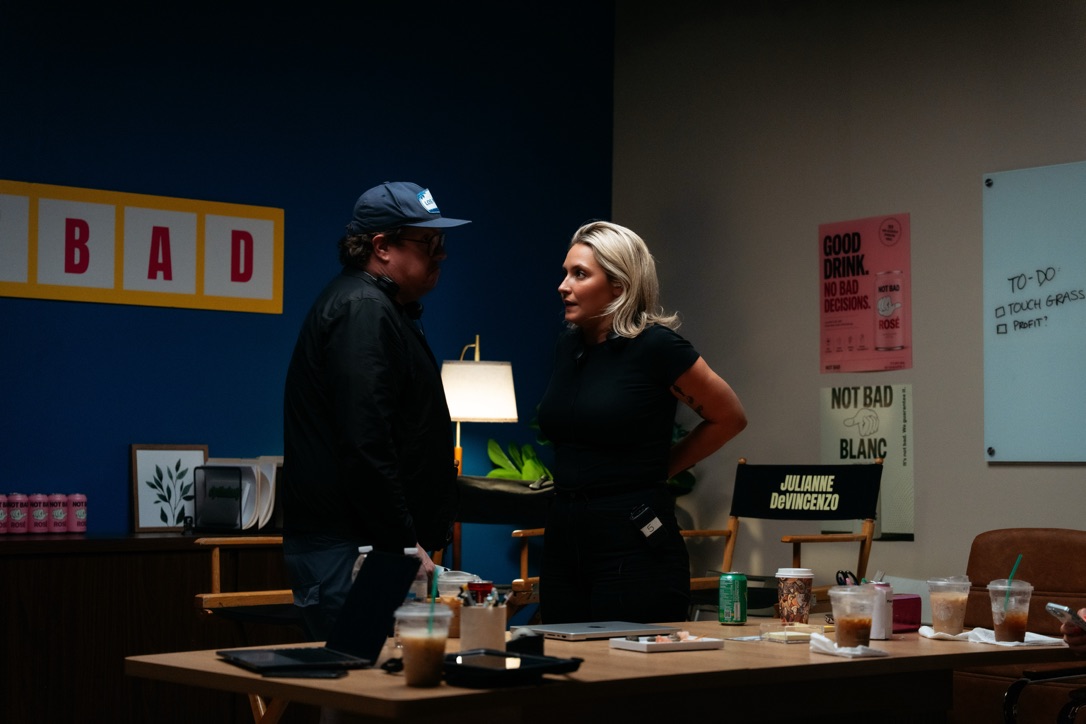
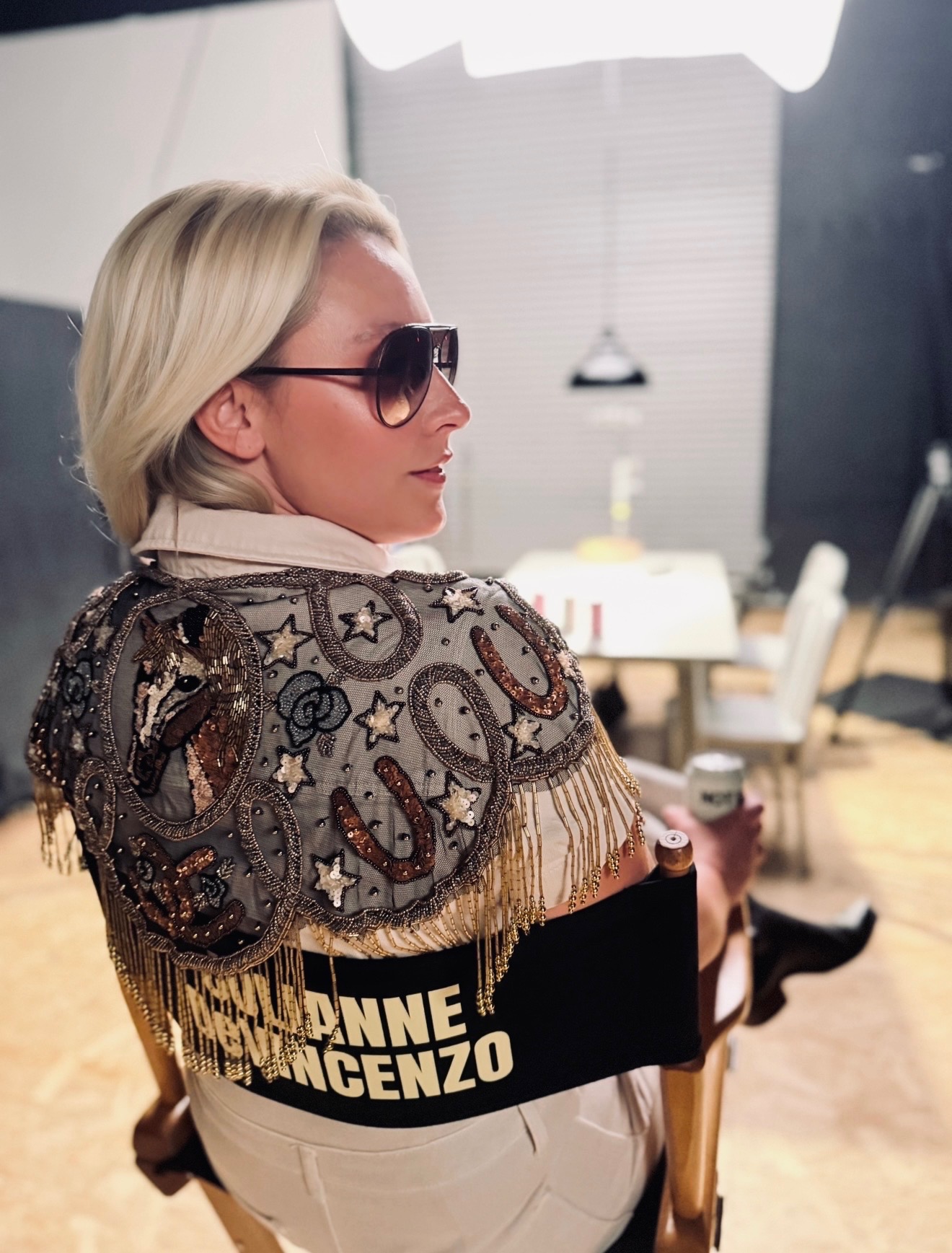
When I finally arrived on set in Hollywood with Dan, I could see what all those decisions had been building toward: actors, cameras, wardrobe, props, and a fictional company taking up physical space around me. August heat settled over the warehouse as the days stretched past twelve hours, and the air conditioning went off during filming to keep its noise out of the takes; the people around me kept treating each other with kindness, even as the room grew hotter, and that generosity became part of what made the week feel so special. 

I loved getting to weigh in on pieces of the wardrobe and meeting the cast and crew I would spend those long days beside, learning their rhythms as we moved from one setup to the next. On one day, someone mistook me for an agent, perhaps because of my Luchese cowboy boots, and later the person coordinating everyone’s movements waved me toward hair and makeup with the urgency of a schedule in motion; I followed, amused by the invitation, until he realized I was not one of the actors, and I told him, “No, bro, it’s Thursday. I’ve been here all week.” The laughter that followed belonged to the easy, affectionate kind that grows when people have been sharing a hot warehouse, a headset, a early morning call stimes, and twelve hours of each other’s company. 

I arrived knowing how to tell a story and left knowing the beginnings of a set’s private vocabulary: continuity, craft services (the all-day snack table), the village (on-set monitor station), the call sheets, the sides, and the different versions of a script that traveled through the day in actors’ hands. I learned that a headset and a seat near the cameras could mean you had reached the "VIP" status and I learned this only on my last day, when the small ceremony of being invited to sit there suddenly made sense. I loved watching the paper pages become a living scene, especially the sides that found their way into the episodes as props, carrying a trace of the long process that had brought us there. 

For months, Greg, Dan, Ian, and I had written, rewritten, added jokes, worried about rhythm, and tried to feel the flow of a story before anyone could see it; on set, the actors met those pages with instincts and timing that made the improv feel like a door opening into a room we had only sketched. A raised eyebrow, a pause, or an unexpected line could make a character suddenly real, and I kept finding myself doubled over with laughter at something I had supposedly helped write. Working with Dan on my first Hollywood set raised the bar for every set I may ever step onto again, and I still talk to people I met there, carrying the friendships and the surprise of that week into the work that followed. 

... on set, the actors met those pages with instincts and timing that made the improv feel like a door opening into a room we had only sketched. 

The story finds its audience 

Back inside Optimizely, the story began to change shape again. Colleagues could finally see the cast, watch a clip, and meet the world that had lived for months in scripts and emails. I noticed a sparkle in people's eyes when they recognized a familiar workplace absurdity or a character who reminded them of someone they knew, and I began to see the feeling I'd hoped to create traveling beyond the people who made the series.

The first trailer brought the story in front of an audience, and people laughed, asked what happened next, and started imagining where the series might go; some wanted to see it in a theater, while others began casting streaming services in the roles of future champions. I kept those reactions close because, for a moment, people were talking about the story as a story, and the questions had shifted toward the characters and the mystery they were carrying. Their curiosity felt like a spark traveling across a room, reassuring me that the work could meet people somewhere human and terrifying me in the same instant, because the next thing I had to do was deliver. 

0:00 / 0:00

I began carrying the story everywhere the work took me. In April, in Copenhagen, I first said out loud what I wanted to make, long before there was a cast, a set, or a frame of footage to show anyone. By September, I was onstage at Opticon in New York, talking about it with a little more proof. In October, I was in London, speaking with customers and prospects about the murder mystery and the other content plans taking shape for 2026. The whole thing had started to feel like my own little press tour, carrying a story from room to room and waiting to see where it would land.

London, after the long day 

After a long day in London, when I was ready to crawl home, a woman approached me. She had been in the audience at a keynote I gave back in April, where I talked about how important it is do the work you dreamed of.   

She said, “Julianne, I thought you were pretty crazy when you told us about this murder mystery and all your other content plans for 2026, and I can’t believe you did it. I can’t wait to watch it.”  

I could feel myself getting close to tears as her words went through me like a live wire, bringing back all the months I had spent explaining something people could barely picture, asking them to trust an idea before there were faces, scenes, or a trailer to show them. 

She had heard the possibility in Copenhagen and was standing in front of me in London ready to watch it, and the distance between those two moments made the whole long stretch of work feel suddenly visible. I thought about Greg and Dan, the decisions we had argued over, the regular work we had kept doing across time zones, Ian directing for the first time, and the cast and crew bringing their care to that warehouse; the story I had asked all of them to believe in was beginning to find people who wanted it for themselves. 

The part no one can promise 

I still don't know whether Murder in Marketing will become the thing I hope it becomes, whether people will watch all 36 episodes, fall in love with the characters, guess the murderer, or stop me at a conference to complain about the ending, a possibility I would absolutely adore. I will measure views, engagement, audience growth, and the conversations that follow because I am responsible for the business behind this creative experiment. And the woman in London gave me another question to carry into that work: could the anticipation I saw in her become a feeling people wanted to return to? 

My mother has a saying that has followed me around for years: “If you don’t have haters, you’re doing something wrong,” and recently Freddie Öst of SNASK, someone I admire deeply and hope to work with, said onstage, “I’d rather make enemies than gain raving fans.” I hear permission in those words to have a real point of view, to make something with enough conviction that people can respond to it, and I know that pushing the boundary has gotten me into trouble before. If the series fails, if someone hates it, even if I get fired, I will carry what I learned into the next thing I make, with more nerve and a clearer understanding of what the work asks of me. 

I have always believed that if you are not growing, you are dying, and this project asked me to grow in ways I could never have put into a career plan. It asked me to become a beginner in rooms full of experts, bring people into a risk that would take months of their lives, and keep making decisions while the outcome remained uncertain; I have the highest expectations of myself and other people, which may be a fatal flaw, a gift, or some troublesome combination of both, and I felt the weight of those expectations throughout the making of this. Go big or stay home; if I am going to put on my shoes, do my makeup, and step into the world asking people to believe in something, I owe it the full force of my effort. 

Some of that growth felt like finding my way back to the curiosity I had before I learned which ideas were too strange to explain in a meeting, before every possibility arrived with a list of reasons to make it smaller. I wanted to bring that unedited wonder into the rooms where I build plans and decide what is worth risking, and a year after I told Tara she could fire me if I failed to make a difference, the series is ready to meet its audience as the most elaborate performance review of my career. 

Picture a marketer closing a laptop, opening TikTok, and finding a funny video featuring a fictional non-alcoholic sparkling-wine company with a dead executive and a range of suspects; maybe she stays for ninety seconds, then gives me another ninety, then sends the series to a colleague with a message that says, “This is you.” Marketing is hard, life is hard, working across the globe is hard, and AI has made the unknown feel even larger, so if she recognizes herself, laughs, and feels the small warmth of being understood, the story has earned a place in her day. Maybe a character or a line will find her again later, the way a fragrance returns you to a person or a room, carrying the feeling long after the first encounter. 

Maybe, the dead executive will get his tombstone, the camPAIN will certainly earn its own place in those weird history books about chronic pain mysteries, and I will keep the memory of that warehouse with me: August heat, the silence, the lack of air conditioning, Dan beside me on my first Hollywood set, a room full of people laughing through twelve-hour days, and my cheeks still aching when we wrapped. 

I bet my career on someone choosing ninety seconds. Spend them with me

Murder in Marketing is live today, October 30, with the first 12 vertical episodes on YouTube Shorts, TikTok, and Instagram. Episdoes 13-24  land November 2, and the killer is revealed with episodes 25 to 36 on November 5.

On November 13, the full widescreen cut arrives on YouTube, with extra scenes and my favorite improv from those magickal days on set. 

Glory comes in two forms, and tonight one of them is a tombstone.
 
Bring your own champagne. Someone's about to take the blame for the campaign.