The most sophisticated programs don't treat experimentation as a stage-specific activity. They create continuous loops. Each test makes the next one smarter.
For continuous loops, try the experiment review agent.
7. An idea is not a test-ready hypothesis
There's a clear difference between an idea and a test-ready hypothesis.
An idea is: "make checkout faster."
A test-ready hypothesis is: "If we reduce checkout from four steps to two, we'll increase purchase completion rate for mobile users, because session recordings show 40% of mobile abandonment happens at step three."
A test-ready hypothesis answers four questions:
What are we changing, and for whom?
What outcome do we expect, and why?
How will we measure success?
What are the guardrail metrics we're making sure we don't accidentally damage?
The "because" clause is the most important part. It forces the team to articulate the assumption being tested. That assumption is what the program learns, whether the test wins or loses. A hypothesis without a "because" is an instruction, not a scientific question.
The single most impactful thing an experimentation program can do is establish and maintain a clear standard for what a good hypothesis looks like. Without it, test quality varies by team, by individual, and by how much time someone had that week.
8. Every team needs a different conversation
Every team will ask the same question in different ways. What does this do for us? Bringing them in requires a different conversation each time.
Product teams need experimentation built into the sprint cycle. Hypothesis writing as part of story definition, not a separate workstream. Developer capacity that's planned in, not negotiated every time. Metrics tied to product OKRs, not generic conversion rates.
If you're struggling with developer capacity, use the variation development agent to generate experiment variations without any dependency on developers.
Content and campaign marketing teams need a lightweight intake process. They can't use the same heavyweight brief format as a product experiment. Metrics that reflect what they care about: engagement rate, time on page, email open and click rates. Results in plain language. Message performance, not p-values.
Customer service and operations teams need analytical support upfront to design the right measurement approach. Self-serve metrics aren't enough for this work. Operational tests are different from web tests and shouldn't be squeezed into the same template.
Data science teams sit at the edge of the program's orbit. They need access to the stats engine for warehouse-level analysis, not just platform-run experiments. A governance model that respects how they work, not a one-size-fits-all approach.
9. How a program responds to losing tests tells you everything
If your program is producing wins at a significantly higher rate than the 12% industry average, one of three things is true. You're running unusually good tests. You're only running safe tests. Or you're calling tests incorrectly. The third is most common.
A healthy win rate is 10 to 30%. A healthy conclusive rate, wins and losses combined, is 35 to 40%.
The clearest indicator of a genuine testing culture is how the organization responds to negative results. In cultures where testing is valued, a negative result is information. It saves you from shipping something that would have made things worse. It's worth exactly the same as a positive result.
In programs where testing is performative, negative results are problematic. They create pressure to reframe the metric, find a different audience, or run the test again until it produces a win.
10. Measure individual experiments and the program itself
Measuring program impact is different from measuring experiment results.
An individual test tells you whether a specific change improved a specific metric. Program measurement tells you whether the program itself is delivering value.
Two approaches:

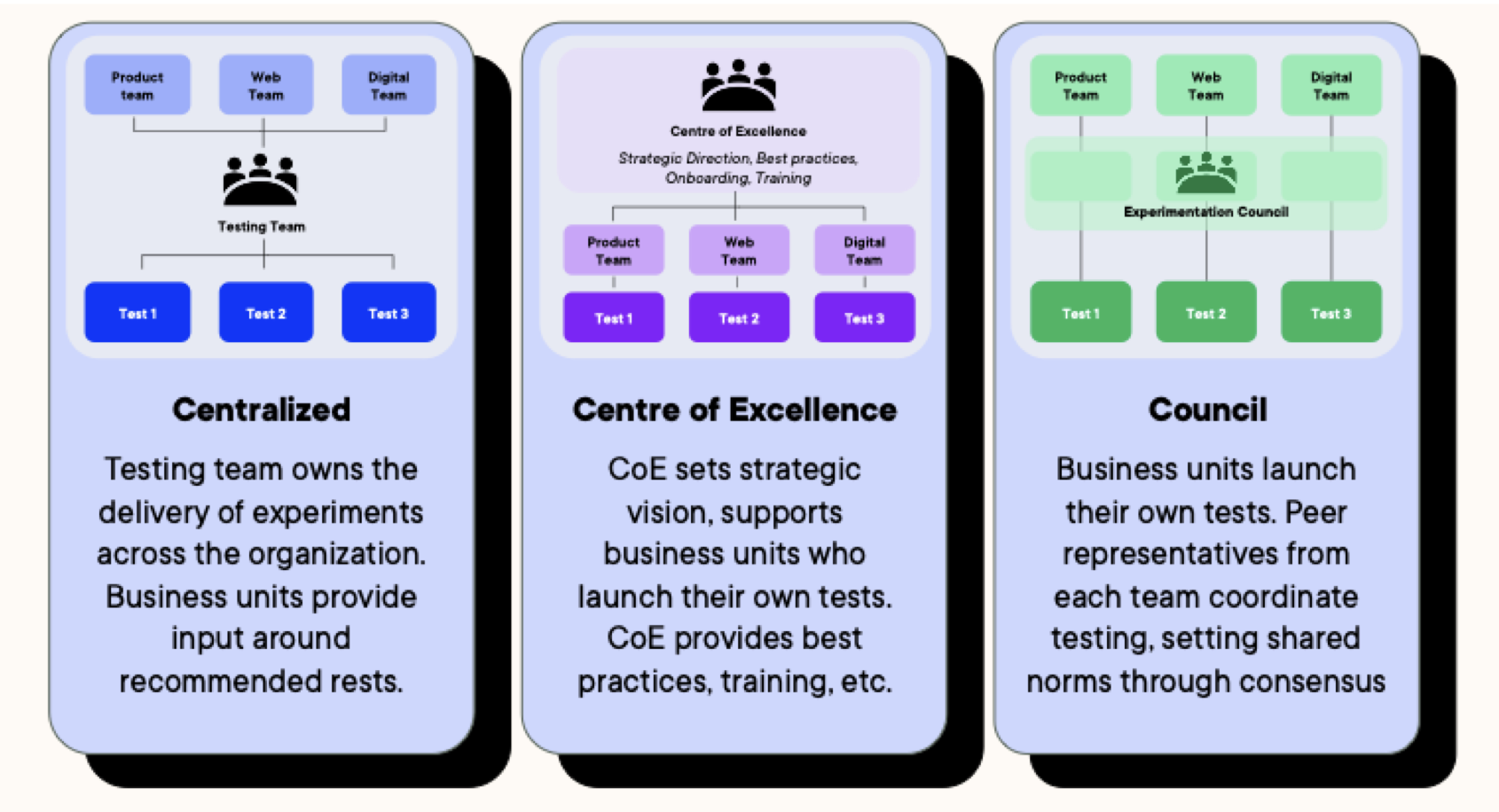 Image source: Optimizely