Somewhere in your organization, there's a document of audience segments. Someone built it. Someone maintains it. A tab for targeting rules. A tab for content mapping. A column nobody's touched since the last site redesign.
That's what personalization looks like at most companies, no matter what the strategy deck says.
Personalization cannot scale if every experience has to be built by hand.
Fewer visits, higher stakes
Customers increasingly expect experiences that feel relevant to them, while brands have fewer opportunities to earn attention and convert the traffic they do get.
Discovery increasingly happens somewhere else, in an AI answer or a summary that resolves the question before anyone clicks anything. The traffic that does land on your site has already been filtered. Fewer visits, each one carrying more weight.
The mechanism most teams use to meet that pressure hasn't changed in years.
The math isn't mathing
Personalization today is predefined, rule-based, segment-led, and labor-intensive. Those four things are connected. Because it's:
- Predefined, everything has to be built in advance.
- Rule-based, every branch needs someone to write and maintain the logic.
- Segment-led, precision caps out at whatever resolution the segments have.
- Manual, it means the whole thing is expensive to expand.
Every new market, persona, or buying stage means more content, more variants, more rules, and never-ending upkeep. No matter how many experiences you build, you can't manually account for every visitor, need, question, or journey.
The problem was never that brands didn't want to personalize more. It's that personalization has been impossible to scale to the individual.
Example: think about who actually shows up in a given hour. A security engineer evaluating three vendors. A CFO who needs a number for a board deck by Thursday. Someone who clicked a paid ad and isn't yet sure what the product does. A returning customer seeking a specific document. Each gets sorted into whichever prebuilt bucket sits closest, and each receives an experience designed for the average of a group they happen to resemble.
Why more segments won't fix it
The industry has spent years trying to make personalization more sophisticated by adding more data, more segments, and more rules.
That is the wrong direction.
You can get very good at identifying that someone is a mid-market technical evaluator in financial services and then hand them an experience assembled last quarter for the general idea of that person. Here you're improving prediction, not individual experiences.
The goal should not be to get better at predicting which prebuilt experience someone belongs in. The goal should be to let the experience adapt around what that person actually needs.
That shifts personalization:
- From predefined to generated
- From segments to individuals
- From reactive to proactive
- From journeys designed in advance to experiences created in the moment
What a website should actually be able to do
A website should be able to understand the context a visitor arrives with, learn from what they do, let them express what they need in their own words, and shape the experience accordingly.
That might mean a technical buyer immediately seeing a product demo, while an executive sees business outcomes and proof points. Neither experience had to be manually mapped as a separate journey.
And critically, this can start from the very first visit, rather than waiting for a long behavioral history to build up.
The role of Dynamic Experiences
Most of what gets called AI personalization is still a better algorithm picking from the same fixed library someone built last quarter. Other tools add a chatbot in the corner that answers a question in a text box while the page behind it staysidentical for everyone.
That's what we're changing with Dynamic Experiences.
Dynamic Experiences assemble the right content into a personalized front-end experience for each visitor on the fly. Marketers guide the content, intent, and guardrails. AI handles the decisioning and experience creation.
Each experience forms around the individual rather than a segment, so precision is no longer capped by how many audiences someone has time to define. It runs from the first visitor, with no wait for statistical significance to accumulate. It acts on available context before anyone types a word. And the manual build burden drops, because the rules and branches that used to eat weeks of setup no longer have to exist up front.
Those visitor requests also add up to something. Questions that keep coming up without an answer, and what people want that the site doesn't offer, are the signals that expose your content gaps. Analytics tell you what happened on the pages you built. This tells you what visitors came looking for and didn't find.
Still... there is plenty left for the marketer.
Marketers ensure that every claim is defensible, proof points carry weight, the brand represents what the company stands behind, and the boundaries hold. They still decide what the brand sounds like. They own the content and the intent behind it.
The future isn't more variations...
Audience segments have to be finished before anyone arrives. Visitors keep showing up with needs nobody wrote a row for.
The future of personalization is not more variations. It is a website that creates the right experience when the visitor arrives.


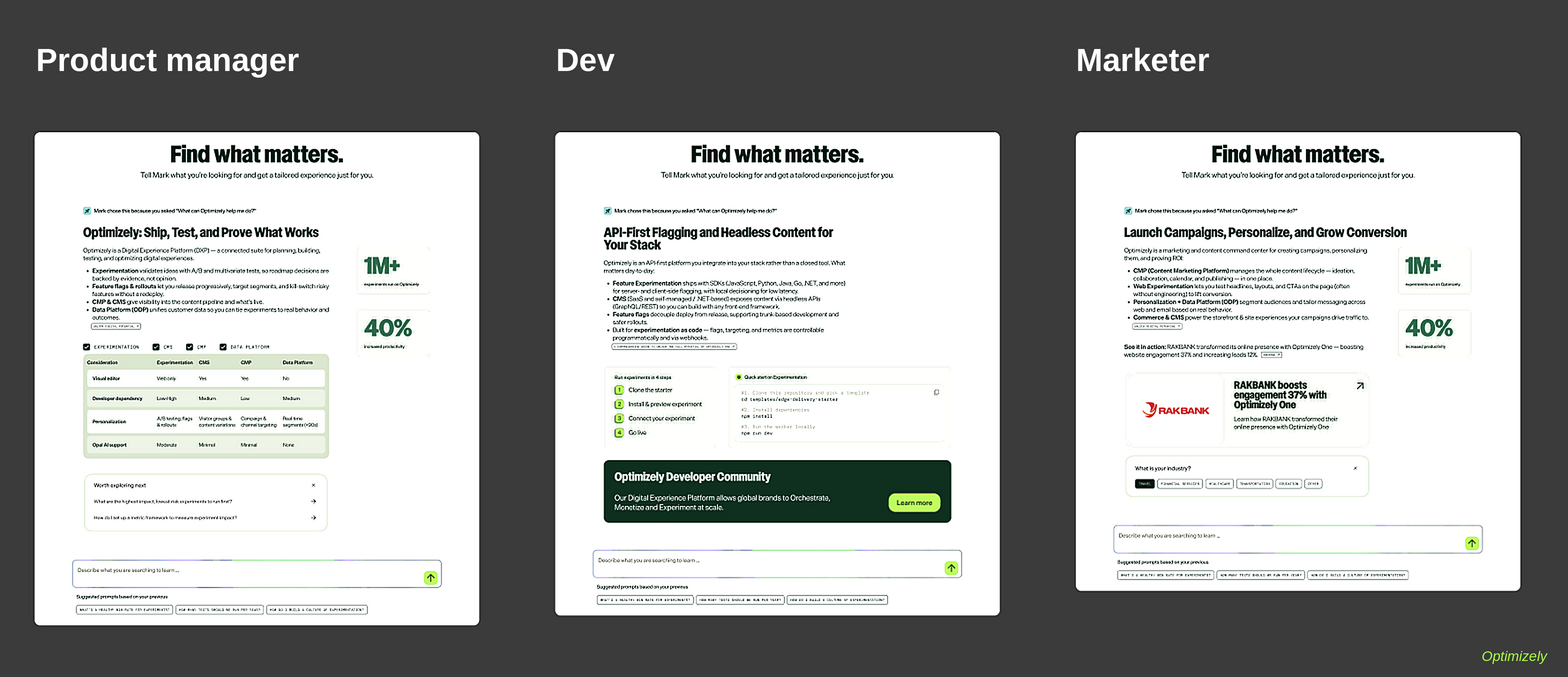
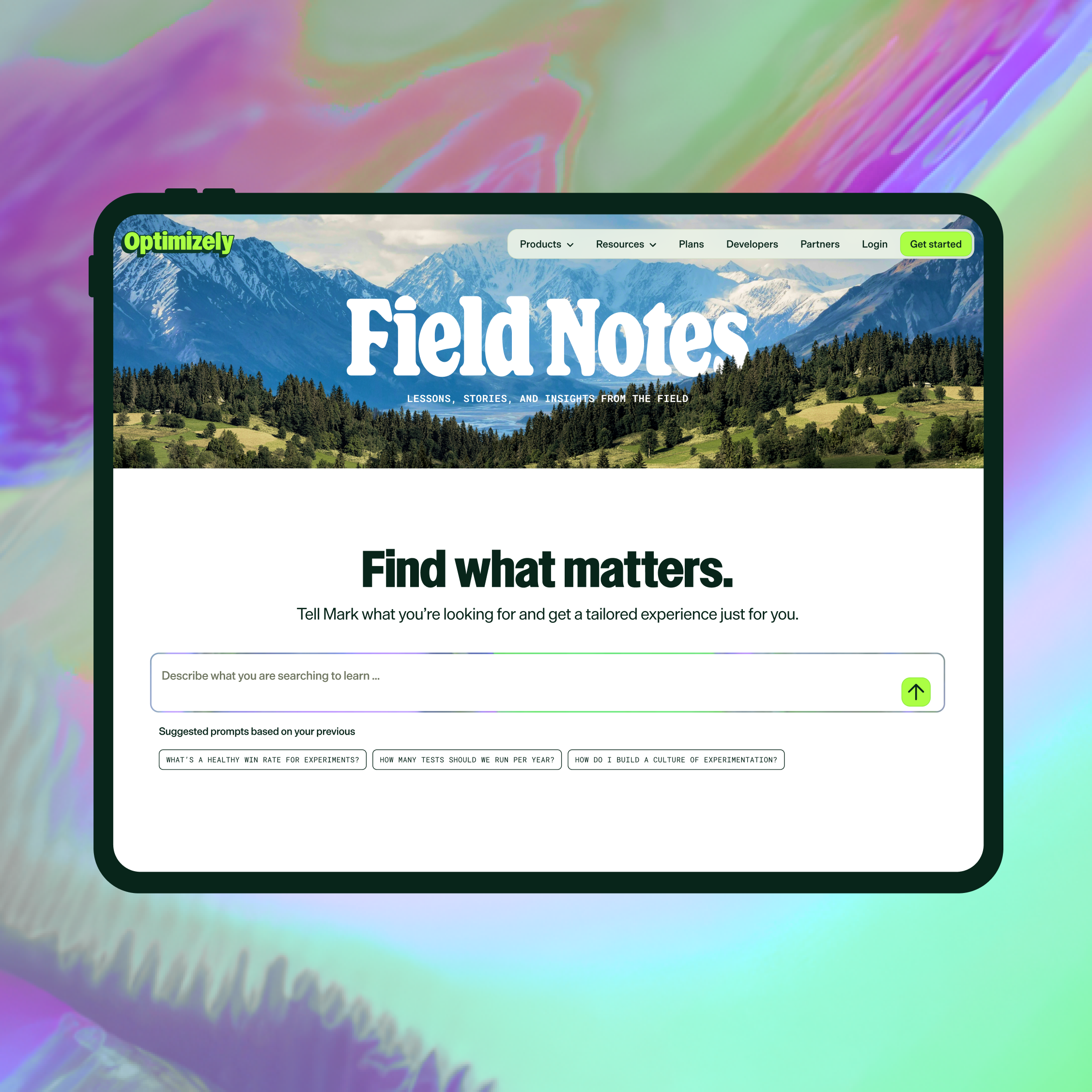 Image source: Optimizely