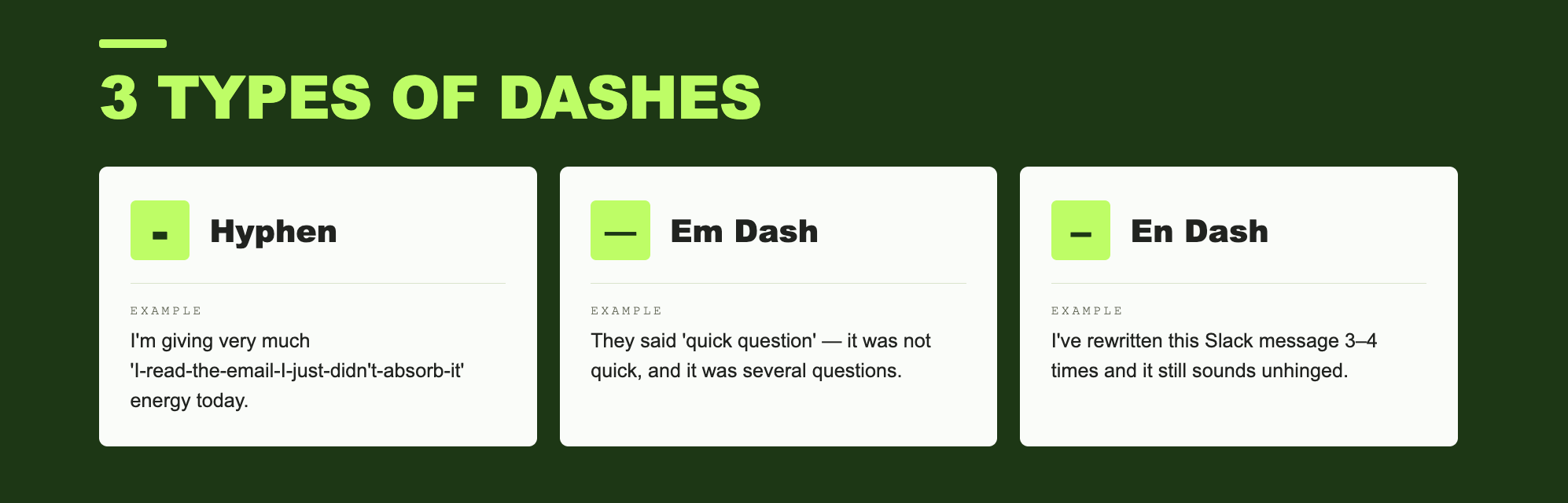
Someone on LinkedIn has assembled a lineup. A list of words and phrases that are apparently dead giveaways for AI writing. I won't dignify the whole list, but the greatest hits include: starting a sentence with "picture this," using a colon to set up a neat little list, ending a paragraph on a one-line gut punch, and — obviously, predictably, the reason we're all here — the em dash.
None of this is new. The em dash has been on trial for a while now, and I've been annoyed about it for just as long. What's both new and s h o c k i n g is how just far it's escalated (spoiler: it's the grammatically-incorrect Wild West out there, guys).
Because really, none of these are AI tells. They're just language. It's not like AI invented a well-placed colon, that oh-so-sweet-and-innocent em dash, or the satisfyingly snappy sentence after a short one. It learned all of that from us; decades of writers doing what writers do. AI tools made a grab for them, then got good at reproducing the pattern without any of the reasons the pattern existed in the first place.
But now — instead of realising that — we're accusing the original writers of impersonating the impersonator? Make it make sense.
It really is the world's most confused trial.
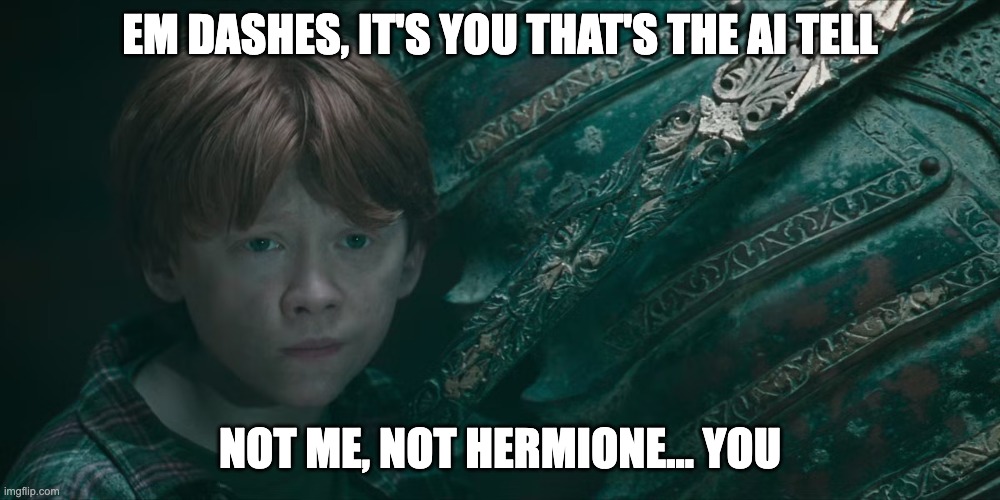
Pleading guilty of writing like a real-life person
I use the em dash constantly. I used it before I'd ever typed a prompt into anything. When I trained Optimizely Opal on my own voice, it picked up my em dash habit within about a paragraph, because apparently it's load-bearing for how I think. So now I've got an AI that sounds like me, and a LinkedIn post telling me that sounding like me is suspicious.
Make of that what you will. I've made my peace with it by getting annoyed on the internet/posting it on a company blog instead, which is more fun anyway. (We all love a bit of creative freedom, don't we?).
Emily Dickinson ran on em dashes. Jane Austen too. Neither of them, to my knowledge, was quietly running a language model out of a quaint cottage. The em dash isn't evidence of anything except a writer who wanted a sentence to breathe a lil bit.
The em dash witch hunt got a sequel
Here's the part that's actually fresh on the ol' newsfeeds, and the part that tipped me over from 'mildly annoyed' to writing this ranty post. So yes, the em dash panic has been simmering, but what's escalated is what people are doing about it.
People are leaving typos in posts on purpose.
Why? Because a clean, well-turned sentence gets side-eyed these days. And apparently the only accepted proof of humanity is making a mistake on purpose, which is a small (/huge) tragedy if you think about it for more than five seconds. We've reached the point where imperfection is a costume you put on for the reader, and I'm really not about that life.
Actually, no one who works — or who has EVER worked — in or with content is about that life. And that means we are seeing a flip side start to show up. More and more content people are pushing back on the idea that any of this is a real signal of anything... and they're pushing back loudly too.
Because, judge, using punctuation is not guilt.
What we're actually reacting to
The feeling people are chasing when they flag these words is real, I'll give them that. There's a specific texture to bad AI writing — the over-polished, no-opinions-were-harmed-in-the-making-of-this-sentence quality, the sense that you're reading something that got everything right and said nothing. That's a real phenomenon. It has a name, more or less: the Great Flattening. Everything converging toward the average, because the average is what the model is optimizing for.
But treating individual words as contraband doesn't fix that. It just means we're now all writing slightly worse, slightly more anxiously, and checking our own sentences for evidence before we've even finished the thought.
It's like we are constantly writing under surveillance, and that doesn't feel super creative now, does it?
The real test of "did a human write this?"
If you're trying to figure out whether a piece of writing has a person behind it, here's what I'd check instead of running a word search:
Does it take a position you could actually disagree with? AI content tends to describe a situation and hand you a tidy list of 'considerations.' A real writer picks a side, and sometimes that side is spicy (I'm a big fan of that). Is there a detail that could only have come from one specific life? Not "many marketers report," but the actual thing that happened to the actual person. Does it sound like it was written by someone with a body — tired, caffeinated, mid-argument with themselves? Could this sentence run in any publication, under any byline, and nobody would notice? If yes, that's your tell. Not the punctuation. The absence of an actual person that has actual thoughts.
A lot of writing has lost its willingness to sound like somebody in particular, and swapping out correctly-used em dashes for parentheses (or IMO, worse: a short, little hyphen) isn't going to fix that.
So what do we actually do
Stop auditing sentences for contraband words or punctuation, and start auditing whether you actually believe what you wrote. That's what you've gotta do. We know AI can write competent, but it can't write "this is what I, specifically, think, and I'm willing to be wrong about it in public." That part's still yours, and no amount of punctuation policing is going to make writers with something to say sound less like themselves.
So yeah, no surprises here but I am keeping the em dash, and encourage the rest of you to spend less time running your drafts through a metal detector and more time making sure there's actually a person on the other end of them. And my goodness, I really hope everyone gives up the fake typos soon.
If you're looking for an AI tool that is built for marketers (and the sorrowful things they see on a daily basis), Optimizely Agent Platform is worth a looksie.
PS. If any spelling mistakes or grammatical errors were made in this post, they were not on purpose and merely in the heat of the rant.