The Gym Group banks over £6m from 15 winning tests

£6m

Incremental annualized revenue from winning tests

15

Winning experiments

14.5%

Website conversion rate

Every Gym Group membership is bought through a digital journey. After the pandemic, a major rebrand, and a website replatform, the business went looking for its next generation of digital growth drivers. The chose to partner with Optimizely. More than 50 Web and Feature Experimentation tests later, the team have generated more than £6m in incremental annualized revenue.

  • The Gym Group rebuilt its experimentation program from scratch in 2023 around a clear commercial commitment: £5.0m of incremental revenue value within three years. The program exceeded that target within two and a half years.
  • More than 50 experiments produced more than 15 winners, contributing over £6.0m in incremental annualized revenue and a 120bps uplift in conversion rate against the pre-program period.
  • Value compounds in a subscription business. A change implemented in 2024 was still converting prospects in 2025, and winners from 2026 will pay out into 2027 and beyond.
  • The capability has now expanded into The Gym Group’s mobile app and in-life member journeys, where it will optimize for goals like retention and experience.
Industry
Sports
Products used
Feature ExperimentationWeb Experimentation

Time to take testing seriously

The Gym Group operates more than 260 gyms and, as of this year, has passed a million members in their latest H1 statement. It is a fully digital business: every member joins through the website, the app, or a kiosk in the gym itself. Memberships are low cost and carry no contract, so a member might join in January, leave in May, and rejoin in September. That flexibility creates a lot of acquisition and re-acquisition journeys to get right, and with millions of visitors a year, even a one percent improvement carries real commercial weight.

The shop window is also the till. Discovery, click-through, and conversion all have to be worked on at once.

The Gym Group had used experimentation software before 2020. The surrounding technical, analytical, and governance capability was not yet mature enough to produce reliable results: around 90% of tests were inconclusive, and simultaneous changes made cause and effect hard to isolate.

So they stopped. The program paused entirely, not because experimentation was wrong for the business, but because the foundations underneath it couldn’t hold a program up. There were more fundamental priorities to deal with first, including the 2022 website replatform.

“Experimentation needs more than just enthusiasm,” says Seanpaul Walsh, Digital Trading Director. “You need strong governance, reliable measurement, critical thinking and software like Optimizely that you can trust plus strong air traffic control with other testing in the business. By 2023, we had built the foundations and maturity to do it properly.”


The £5 million promise

Walsh built the business case. It funded three things: Optimizely Web Experimentation and Feature Experimentation, a dedicated CRO manager, and standing development, UX, and sprint capacity so tests could actually ship independently rather than sit behind other roadmap work.

“Experimentation can easily just become a buzzword or box ticking exercise when it has no clear overarching objective,” Walsh says. “We had a very clear unambiguous goal: £5.0m of incremental value from acquisition journey optimization. Protected capacity and skills came with it, but so did business accountability for delivering that number.”

Committing to a figure is what separates a program from a pastime.

The CRO function sits inside e-commerce, under Walsh in the commercial and marketing org. It works closely with UX to develop concepts, and with revenue management and analytics to vet every result, making sure a test isn’t quietly double-counting an uplift some other initiative already claimed. In a business running promotions, price changes, and gym openings simultaneously, that vetting is what keeps the reported numbers defensible.

Heavy metal and the fast lane

More than fifty experiments over two and a half years produced more than 15 winners. “We’ve been on streaks of losing tests where it’s hard to find what works,” Walsh says. “But losing tests are a critical part of the process. They prevent us from implementing the wrong changes that hurt the business, and the learnings very often shape the next tests that go on to be sizable winners.”

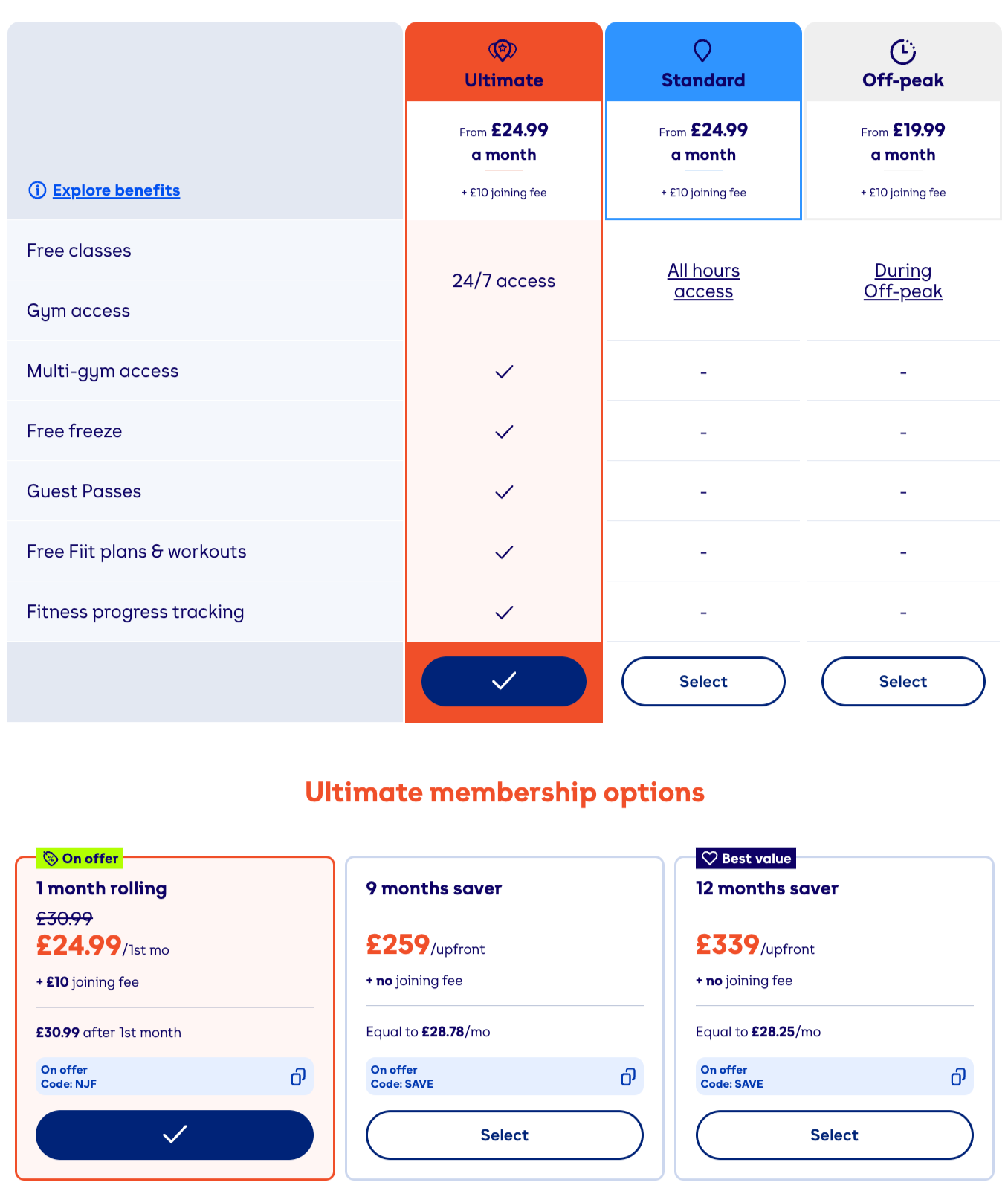
The largest winner was a redesigned membership comparison table, shown on every gym page. Earlier tests had repeatedly pointed to the same things: compact mobile layouts, clear decision hierarchy, less scrolling to compare. The previous vertical stack pushed the choice down the page, and as Walsh puts it, “it took important information below the fold.” The new design presented the full comparison in a single view and followed the customer’s decision sequence: choose a membership, select its duration, continue to payment. The team also tested permutations of tier and tenure ordering, lowest to highest and back again, to find the most commercially optimal layouts inside and outside promotional windows, and put nudging badges under test rather than assuming which messages would perform.

The second major win came from a much smaller visual change. At the basket stage of the joining journey, the team changed the displayed promotional saving from standard text color to red when a code was applied. Making the saving legible as a saving improved progression at exactly the point where intent is most fragile. It was worth more than half a million pounds in incremental annualized revenue.

“Our big hitters, the ones that have made us the most revenue, were both FX tests too,” Walsh says. Feature Experimentation handles what the team calls the heavy metal tests: the deeper, structural work in the dynamic components and join journey, where changes go further into the stack. Those tests need more thinking time and development, so where possible the team breaks parts of them into smaller Web Experimentation modules to learn faster.

Web Experimentation runs the other lane. “It’s allowed us to change more of the static elements,” he says. “It’s a quick and fast lane of learning where we can do a higher quantity of tests, because there’s less development time required, and we can release and learn alongside the more complex tests in FX.”

Those faster tests generate focused behavioral insights that feed the bigger structural ones. Two themes surfaced repeatedly: reduce mobile page length, and use color and framing to draw attention to key information. Both went on to shape the two largest winners.

"We couldn't have done this without a reliable tool that works. There are a lot of tools out there that say they do certain things, but truthfully, they often just don't."

Seanpaul Walsh, Digital Trading Director

Stable traffic, more members

Between 2022 and 2026, non-member traffic to The Gym Group’s site stayed broadly stable once growth in the gym estate is accounted for. Over the same period, website conversion rose from 11.5% in 2022 to 13.5% in 2025, and kept climbing through the first half of 2026 to exceed 14.5%. Measured against its late 2023 baseline, the experimentation program accounts for a 120 basis point improvement: materially more members from a comparable volume of traffic, alongside improvements in membership yield.

More than 15 winning experiments have generated over £6.0m in incremental annualized revenue. Because a winning change stays live, the returns accumulate across 12 months and the subscriptions they win keep recurring after that. A table redesign shipped in 2025 is still converting prospects today, and the members it wins keep paying long after the test itself is closed.

“You’ve basically got this focused activity in one year that pays out over the next two years. As you continue to build on that with 2025 and 2026 activity, we now have impact banked that will pay out in 2027, 2028 as a result of the improvements we’ve made.”

Seanpaul Walsh|Digital Trading Director

By mid 2026, two and a half years into a three-year case, the program had delivered £5.3m in incremental annualized revenue from the testing years themselves. The continuing value of winning changes has since taken the total above £6.0m, with further benefit expected in 2027 and beyond from tests already completed.

Experimentation is now expanding into the mobile app and in-life member journeys: freezing memberships, booking classes and personal trainers, changing gyms, and buying add-ons. Measurement will differ from acquisition. Join journeys carry large transaction volumes and a direct first-transaction revenue outcome, while member journeys are more likely to be judged on retention, engagement, and experience. With around a million members, small improvements still add up.

“The size of prize is less in those because it’s more experience-based,” Walsh says, “but it’s still the same principle.”

What transfers is the capability itself. Walsh is unsentimental about what made it possible. “We couldn’t have done this without a reliable tool that works,” he says. “There’s a lot of tools out there that say they do certain things that truthfully they often just don’t.” But the thing he’s proudest of isn’t the software.

His final words are not a pun, but they show the confidence The Gym Group has in its experimentation program now. “We’ve got this muscle now,” he says. “It’s raised this next question of how do we bottle this type of thing and apply it to our app, apply it to our in-life journeys.”

£500k

From one color change during checkout

Let's talk Experimentation