Introduction
According to McKinsey, 78% of organizations now use generative AI in at least one business function. But as adoption (and general AI overwhelm) rises, we’re all asking ourselves three key questions:
 Maisara Khan
Explore AI's impact on marketing in Optimizely's report. Balance AI with creativity for genuine personalization. Read insights from marketers & consumers now!
According to McKinsey, 78% of organizations now use generative AI in at least one business function. But as adoption (and general AI overwhelm) rises, we’re all asking ourselves three key questions:
This report offers insight into how Optimizely Opal is being used across our customer base and what benefits those customers are getting. With three months of usage data from nearly 900 companies, insights from early adopters, and the latest industry research, we explore how AI is actually being used and what benefits adopters are getting from usage.
Find out what’s working, what’s evolving, and what best-in-class AI marketing practices look like today.
Our insights are drawn from three primary data sources:
To ensure statistical rigor and a clean, understandable output, this analysis employed a methodology with a few key components:
We used a Difference-in-Differences approach to accurately measure Optimizely Opal’s impact. This method compares changes in key performance metrics between two groups:
For each Optimizely Opal customer, we analyze two periods:
For non-Optimizely Opal users, performance is measured over identical pre- and post-periods matched to each Optimizely Opal customer’s timeline. In other words, each Optimizely Opal user is compared to a group of every non-Optimizely Opal user (the control group) in the period exactly matching the Optimizely Opal user’s usage, ensuring direct comparability.
For each Optimizely Opal customer, we calculated:
Optimizely Opal uplift (net impact) = Change for Optimizely Opal user − Change for non- Optimizely Opal users
Subtracting the control group’s improvement removes background trends—such as product enhancements, seasonal effects, or broader market changes—yielding a conservative estimate of Optimizely Opal’s true contribution.
To produce the headline benchmark for each metric, we calculated a weighted average of all Optimizely Opal customers’ DiD uplifts. Each customer’s uplift was weighted by their pre- Optimizely Opal activity level (e.g., number of experiments in the pre-period). This prevents the “average of averages” problem and ensures that customers with more substantial baseline data have proportional influence on the final result.
This approach provides a robust, reliable measure of Optimizely Opal’s net impact.
Companies across industries are achieving unprecedented gains by integrating AI into their core workflows.

Today’s marketers are expected to do more than ever—most of the time with fragmented systems, limited (or messy) integrations, and increasing pressure to deliver. At Optimizely, we believe there’s a better, less disconnected, and more integrated way.
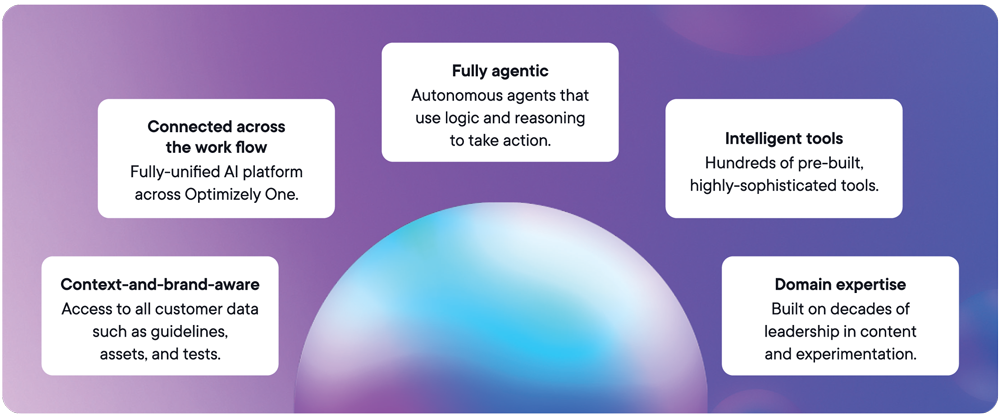
Optimizely Opal is more than just another AI assistant or chatbot: it's an extension of your workforce, enabling marketing and digital teams to effortlessly scale the way they work and redefine what’s possible.
From ideation to optimization to analysis—and every step of the marketing lifecycle in between—Optimizely Opal is your agentic, fully-autonomous, and infinitely-scalable AI specialist, helping you complete any marketing and digital job to be done.
Optimizely Opal unlocks infinite scale by working both with you and for you: automating tasks on your behalf, offering proactive insights and suggestions for optimization, creating brand-specific content, and solving your bottlenecks with custom guardrails and control.
Since its launch in May 2025, nearly 900 companies have adopted Optimizely Opal to embed AI throughout their marketing workflows. Top adopters include Diligent, Robinson Club, Elite Hotels of Sweden, and Road Scholar, representing over $2B in annual revenue.
Industry Analysts are taking notice. Optimizely was named a Leader in the 2025 Gartner® Magic Quadrant™ for Content Marketing Platforms. The report states “Optimizely evolved its stand-alone AI-enabled features into a network of AI agents automating the entire content production and delivery process. It reduced potential AI risks by enhancing its compliance and security features with role-based access control, which is ideal for large enterprises.”
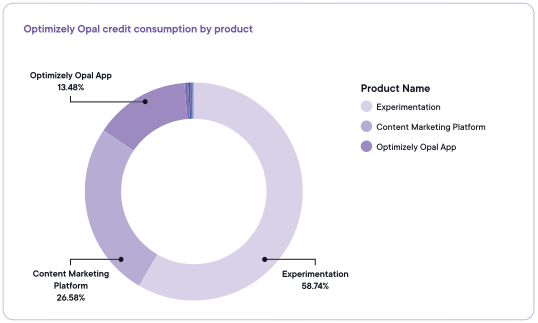
Experimentation accounts for 58.74% of credit usage, with Content Marketing Platform (CMP) representing 26.58%. The remaining 14.68% is distributed across additional workflows including Optimizely Opal itself, CMS, Data Platform, and Configured Commerce. This distribution shows that approximately 85% of all Optimizely Opal credits are concentrated in just two primary use cases: experimentation workflows and content marketing activities.
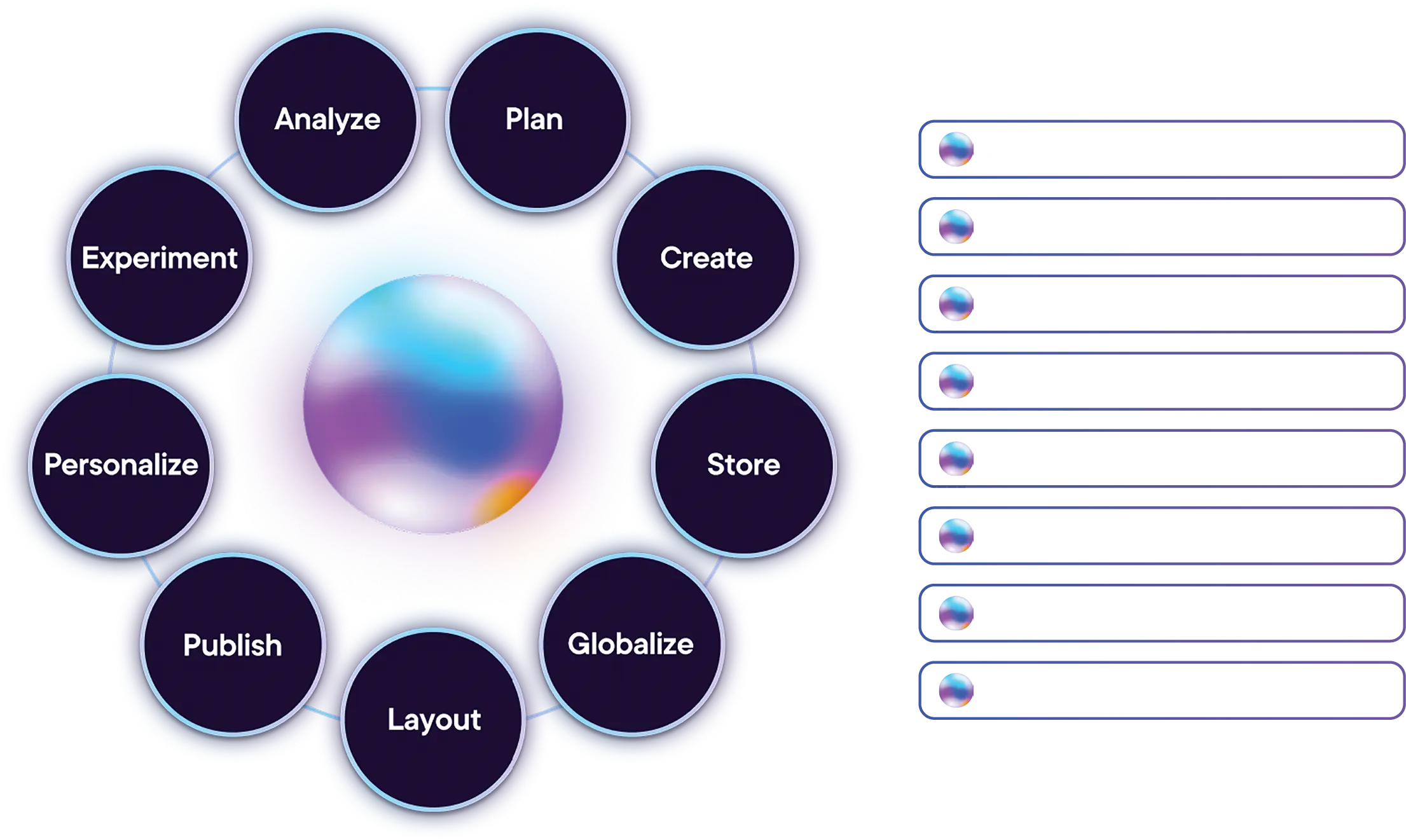
From ideation to analysis, Optimizely Opal optimizes the experimentation lifecycle:
AI-powered, on-brand content tailored to specific industries, campaigns, and languages:
Optimizely Opal isn't siloed. Instead, it's woven throughout Optimizely One:
I think I’m in love 🥰 … It’s an embedded, interconnected tool that improves content management, data analysis, experimentation, workflows—and much more.Digital Agency
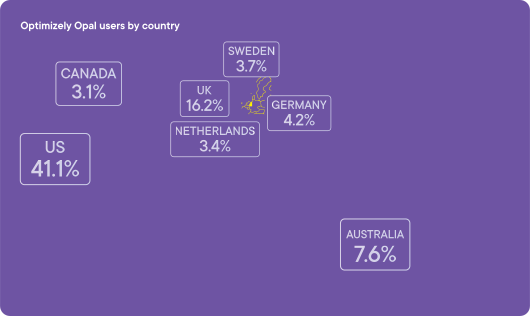
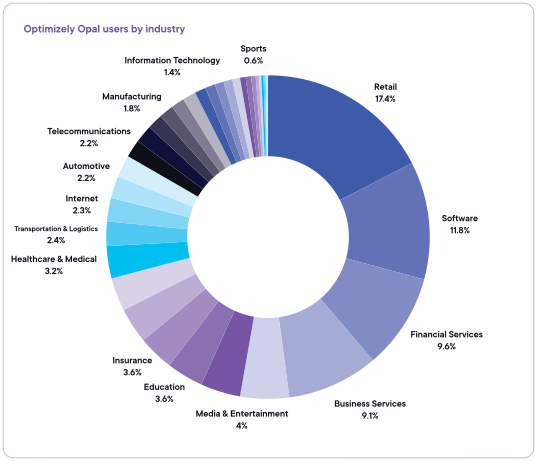
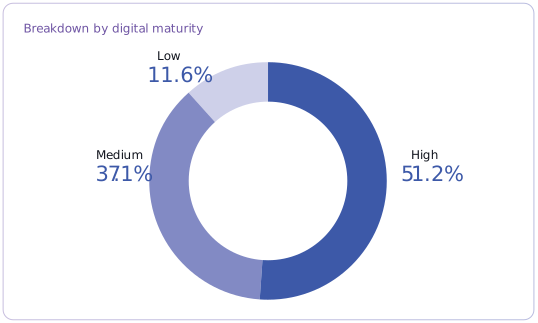
Understanding who is using Optimizely Opal—not just which companies, but which roles and teams—provides crucial context for its impact on marketing organizations. Our data reveals an adoption pattern that defies traditional technology rollout models, with usage spreading horizontally across roles rather than remaining confined within specialized teams.
Not all users are equal. Some users are finding significantly more use cases and generating significantly more value than others.
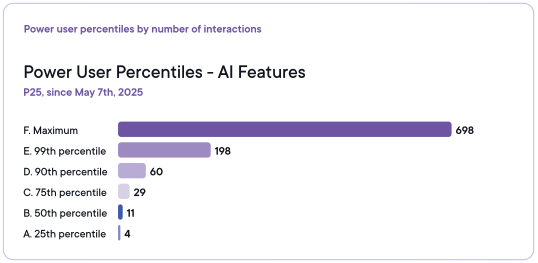
In a month, these top users typically:
The most popular Optimizely Opal features for Optimizely's Experimentation are summarizing experiment results and getting test ideas.
The most popular Optimizely Opal features for Optimizely's Content Marketing Platform (CMP) are accessing text generation and generating images.
To understand Optimizely Opal's true impact, we analyzed performance data from early adopters using a Difference-in-Differences methodology. The results show clear performance improvements that scale with both usage frequency and depth of engagement across optimization and content marketing functions.
Experimentation programs benefit fundamentally from either more or better experiments. The DiD analysis revealed improvements across both vectors in the headline benchmarks:
+ 78.66% created experiments
+ 2.38% concluded experiments
+ 24.05% created personalization campaigns
+ 11.97% concluded personalization campaigns
+ 9.26% win rate
+ 1.38% conclusive rate
The gap between creation and concluded uplift may stem from the limited reporting window or from early adopters using Optimizely Opal mainly for idea generation, though further analysis suggests that greater engagement leads to more concluded experiments.
Win rate and conclusive rate also rise, signaling modest quality gains. Average uplift dips slightly—a natural effect of higher velocity—but is far outweighed by the surge in volume.
As a one-person team, every hour matters. Optimizely Opal doesn’t just save me time—she delivers valuable insights within minutes. Using our frameworks, she provides ideas and recommendations that align perfectly with our experimentation goals.Michael Richter, Manager Conversion Optimization & UX | E-Commerce TUI Hotel brands
Analysis of usage and funnel data shows that the best users of experimentation use Optimizely Opal throughout the entire experimentation lifecycle:
Optimizely Opal has been a phenomenal help so far. I use it for test idea validation, deep dives on experiment results, speculative causality analysis—and much more.Global beauty company
The analysis found that not only was there an uplift in nearly all major experimentation metrics and strong usage throughout the experimentation lifecycle, but also the higher the usage, the greater the uplift.
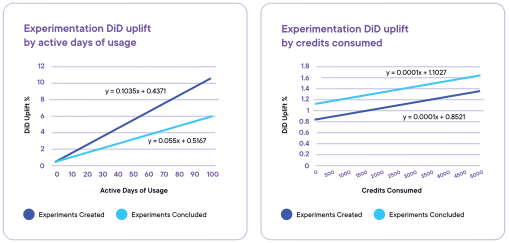
Users can calculate the exact projected uplift of their programs using the equations below, where ‘y’ (the dependent variable) is the expected uplift and ‘x’ (the independent variable) is active days of usage or credit consumed.
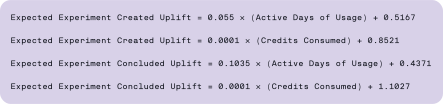
One Fortune 500 financial services company dramatically accelerated their experimentation program after adopting Optimizely Opal. In the year before adoption, their experimentation volume was modest due to switching systems. But in the following year— with access to Optimizely’s advanced experimentation platform and the added power of Optimizely Opal AI—their team increased experiment velocity by nearly 80x.
This rapid ramp-up showcases how combining robust experimentation infrastructure with AI-driven acceleration unlocks scale and impact that simply wasn’t possible before.
Similar to experimentation programs, content marketers create more value by either producing more or better revenue-generating content. Companies can also realize value by time or labor savings when marketers become more efficient. The DiD analysis shows benefit across all three of those value drivers:
The sharp reduction in campaign and task completion times—paired with higher output volumes—shows that Optimizely's Content Marketing Platform (CMP) users are achieving genuine workflow acceleration, not just working faster. At the same time, increased engagement time suggests teams are using Optimizely Opal to produce higher-quality content that holds visitors’ attention and delivers greater value.
I provided Optimizely Opal a blog post and asked for a content brief. It took seconds and gave me all sorts of new ideas on how to structure the content differently. The result was very, very close to my brand's voice. I also fed Optimizely Opal my AI notes from Zoom and asked it to create a brief and then create tasks—it did that all for me and was pretty amazing.Nonprofit education organization
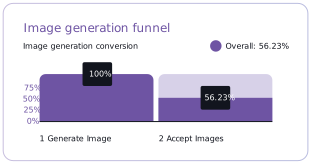
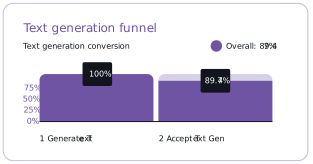
We found these same trends reflected in the funnel data. Content created by Optimizely Opal is getting used by marketers more often than not:
We implemented our new CMP for over 70 people in marketing, migrating from a previous platform with very different terminology. To help with adoption, we maintained a glossary of terms and fed it into the AI. Knowing that advanced AI capabilities were on the horizon was one of the main reasons we chose this platform. It’s been a huge game changer—giving us the confidence and tools to now bring other teams outside marketing into the CMP.B2B technology company
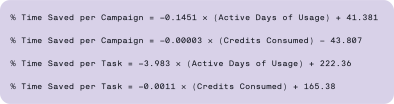
Like with experimentation, the productivity benefits of Optimizely Opal usage in content marketing scale with usage:
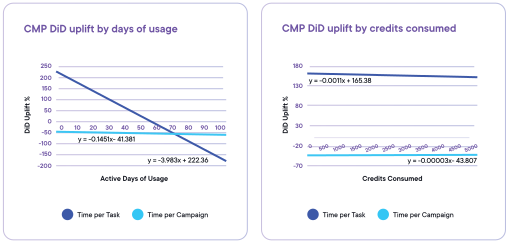
Users can calculate the exact projected uplift of their programs using the equations below, where ‘y’ (the dependent variable) is the expected uplift and ‘x’ (the independent variable) is active days of usage or credit consumed.
We’re building a content inventory agent that we’re excited about where people can go and ask for all the articles about XYZ or show everything that this user has written for X—this whole process will be much faster with the agent and big help for the team.Enterprise technology company
A leading financial services organization rapidly accelerated its content operations after adopting Optimizely’s Content Marketing Platform (CMP) with Optimizely Opal AI. In the period before adoption, campaign creation and completion were modest. But in the following months—powered by AI-driven workflow acceleration—the team achieved a 43.22% uplift in campaigns created and an over 3× increase in campaigns concluded.
This surge demonstrates how combining a unified content platform with AI can unlock new levels of scale and efficiency, enabling teams to deliver more high-quality campaigns in less time.
The benefits of an integrated AI approach are clear, but not everyone is seeing the same level of success. It’s not quite as simple as switching a new tool on and watching the dollars pour in—it requires a transformation in how teams work.
Here are the best practices that separate AI leaders from everyone else:
AI will make good marketers great, but great marketers irreplaceable, and the difference will be largely in how well they implement AI best practices. The key is making it feel natural, not forced—an extension of what you already do well, just amplified.
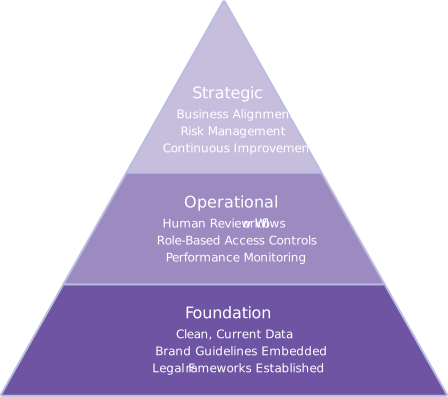
Without clear frameworks, teams face inconsistent outputs, brand risks, and compliance gaps that can quickly derail AI initiatives.
Here’s what to establish up front, along with a governance framework you can follow:
A little groundwork upfront can go a long way to improving the long-term outcomes of AI usage. Here are some of the recommended first steps:
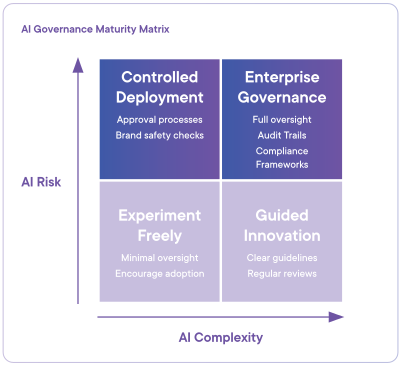
There’s no one-size-fits-all AI governance model. Here are key factors to consider when designing the optimal governance model for your business:
While it’s already hard to imagine a world without it, AI is only going to get better from here. Here are our predictions for how AI will continue to shape marketing work, how Optimizely plans to stay ahead of those trends, and how you can be ready to take advantage of the change.
Short-term (2025):
Currently, companies are rapidly embedding AI throughout their marketing stack, moving beyond experimentation to operational deployment. Marketers now leverage AI for efficiency gains, content optimization, and workflow automation, liberating teams to focus on the creative and strategic work that drives real business impact.
Mid-term (2026-2027):
In the mid-term, simple AI assistants are beginning to evolve into multi-agent systems orchestrating complex marketing workflows. Rather than one chatbot doing it all, specialized AI agents collaborate: one might analyze customer data, another generates personalized content, and another optimizes the delivery timing. Platforms like Optimizely Opal are already pioneering this approach, enabling multiple AI agents to work in concert with robust governance frameworks.
Long-term (2028 and beyond):
Further into the future, marketing will evolve into a highly personalized, automated experience at every touchpoint. AI agents will dynamically adjust user experiences in real-time across digital platforms, while the concept of "marketing to AI"—where strategies target AI agents rather than human consumers directly—becomes mainstream. This fundamental shift will require marketers to craft messaging that resonates with both human and AI-driven decision-makers.
This report has validated what most Optimizely Opal users already know from experience: that adoption is rapid and broad, that AI results in real, measurable improvements in productivity, output, and quality, and that there are ways to make AI usage more effective.
Here are our most actionable takeaways from this Optimizely Opal study:
Many Optimizely customers are already putting these insights into practice and seeing the benefits. As a leader in AI innovation, we’ll continue expanding our capabilities and reporting how best to use them in future analyses.
Key Definitions
| Experiments / personalization campaigns created | The number of new experiments or personalization campaigns initiated within the reporting period. |
| Experiments / personalization campaigns concluded | The number of experiments or personalization campaigns that have reached a definitive outcome in the reporting period. |
| Win rate | The percentage of experiments that result in a statistically significant improvement over the control. |
| Conclusive rate | The percentage of experiments that reach a statistically significant conclusion. |
| Campaigns | Coordinated sets of marketing or content activities aimed at achieving a specific goal, often spanning multiple channels and assets. |
| Tasks | Individual pieces of work (e.g., write, review, edit) assigned to users within a CMP workflow. |
| Engagement time | Duration a visitor actively interacts with a page—measured when the page is in focus and the user scrolls or moves the cursor, plus a 5-second grace period after activity stops. |
| Credits | Optimizely Opal usage is measured in credits, consumed whenever an Optimizely Opal feature calls an AI model. Credit use varies by task complexity. |