
We handed marketers an impossible equation
Every marketing leader I talk to is being graded on two things that pull in opposite directions.
Be good. Consistently, on brand, at volume, and please don't ship slop. Then be cheap, because someone in finance is watching the token bill climb and asking what exactly we're getting for it.
Both asks are fair, but neither one is a marketing problem. And yet they've both landed on the marketer's desk, as if the person writing the campaign brief should also be the one deciding which model runs it, at what price, with what guardrails. That isn't part of the job description, and more like... a trap.
I have a front row seat to this from both sides. I oversee the product and engineering teams building this stuff, and I'm on the hook for the pipeline number that depends on it working. When our own marketing team hits a wall with AI, I don't hear about it in a QBR. I hear about it that afternoon.
So, that's the equation we spent this year trying to take off your desk. Here's what we shipped, and why I think it matters more than the announcement list suggests.
What you already did with it
We launched the Agent Platform a year ago. Since then you've run more than 500,000 agent executions, and we're on track to consume a trillion tokens.
Volume is a vanity metric on its own, but what customers tell us is the part I care really about:
-
One marketing workflow, cut by 97%. Not trimmed. Almost entirely gone
-
Campaigns live in market in minutes, reacting to real-time news, where the old cycle was weeks
-
Agents running first-pass brand and legal review, which pushed output velocity up 30%
That last one is the sleeper. Nobody puts "compliance review" on a keynote slide because it isn't glamorous. But it's also where most marketing teams can easily lose a week.
Quality first, because cheap and bad is still bad
Quality in marketing is genuinely hard to define. Is the work good? Is it consistent? Doing something well once is easy. Doing it well two hundred times is the actual job, and marketing is as much art as science, so 'good' resists a clean rubric.
There's no silver bullet here. It takes a lot of unglamorous things working together, which is what Kevin and the team have been heads-down on: memory, so agents remember what worked and improve. Guardrails, so they stay inside the lines. Evals, so you can coach them like you'd coach a new hire.
And underneath all of it, context. I've been saying for a while that context is king for AI agents. If your content and your context aren't stored somewhere governed and connected, you won't get great AI. And that's not because the model is broken; it's because it's just guessing.
The most powerful model isn't always the one you need
Everyone's doing tokenomics math right now, and mostly doing it wrong.
Frontier models are remarkable: They're also a Ferrari you're driving to the grocery store. Why pay for a model that knows nineteenth-century literature and protein folding when what you need is a model that knows how to write a press release?
The smart move is model routing: Cheapest model for the simple work, premium intelligence reserved for the hard jobs, only when the job earns it. Right model, right job, every time. That's the only way the economics of agentic marketing hold up at scale.
So, we built an AI lab for marketing and started post-training open-weight models for the most common agentic marketing tasks. Internally, we're seeing 10x better cost efficiency than frontier models on the same work. Not 10 percent. Ten times. And quality went up about 7%, not down.
If you've built your own agent on your own data, we'll train a model tuned to your patterns. You can own your intelligence. And that right there? Is a sentence I did not expect to be able to write a year ago.
We built the benchmark because nobody else had
Software engineering has coding benchmarks. Legal has one, Harvey built it. Support has one, Fin built it. Marketing had opinions and vendor slides.
So we built the AI Benchmark for Marketing. Think of it as the SATs for models. 285 tasks across 15 marketing functions, from press releases to social posts to email copy. 6,523 expert-written rubric criteria. Every run scored against a golden set by two independent LLM judges.
It's open source, and we're inviting the rest of the industry in.
I'll be honest about why that matters to me. Publishing a benchmark you might lose on next quarter is the only version of this that's credible. We ran our Agent Platform against Claude Code across dozens of models. We scored 58%, they scored 52%, and we were 2.1x cheaper doing it. Good result. But the number I'd defend harder is the fact that anyone can now check our work. No marketing our marketing.
Opal is becoming Mark
A year ago Opal was an in-app assistant. Today we're talking about a marketing AI lab, post-trained model families, and a benchmark. The name stopped matching the ambition.
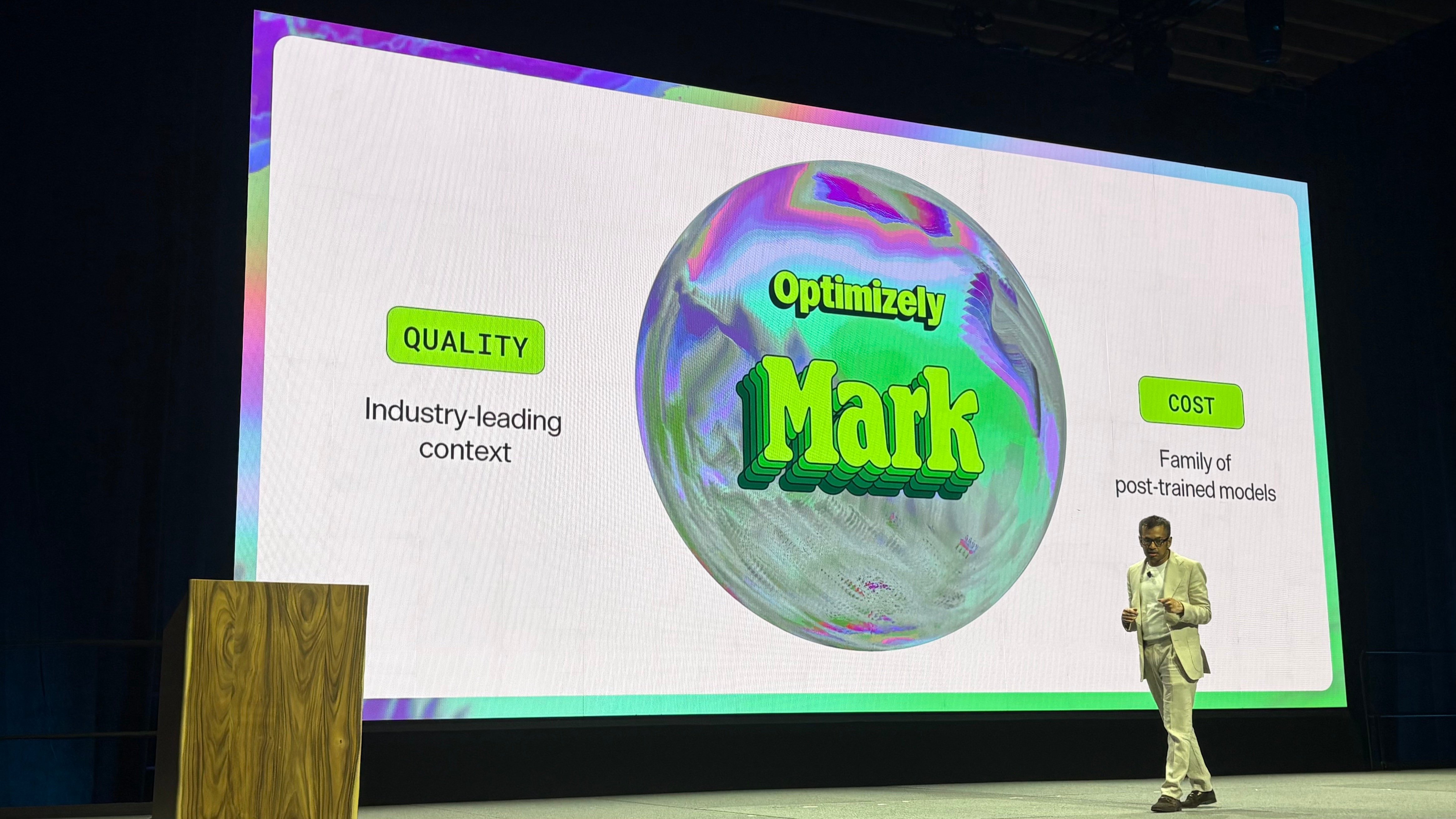
So Opal becomes Mark: Mark IQ, the data and context layer, and Mark-1, a family of purpose-built, post-trained models. Together they give you the right model, producing the best output, at the lowest sensible cost, every time.
Three trails, one platform
This is how we are plotting our routes with Optimizely:
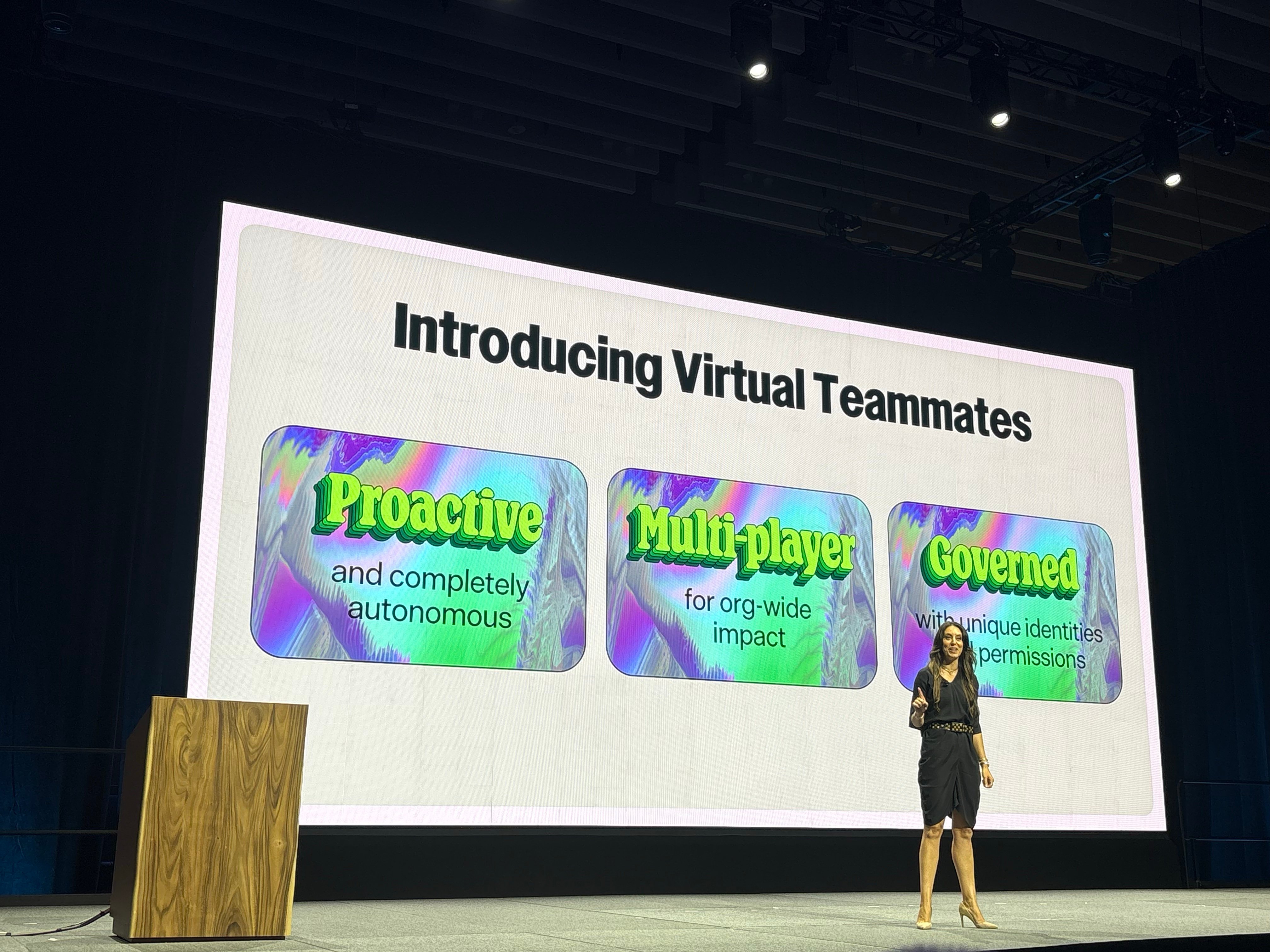
Marketer experience (MX): Lauren Hammarstedt launched Virtual Teammates. Today's AI is reactive and terrible at collaboration. You go to it, you prompt it, you babysit it on top of the three jobs you already have. Virtual Teammates flip that. They have their own email, identity, access, and personality. They reach out to you. Five are 'hireable' right now: Chief of Staff, SEO & AI Search Analyst, Marketing Analyst, Personalization Strategist, CRO Manager. I've had a Chief of Staff teammate for a month and it has made me better at my job, which is a strange and slightly humbling thing to admit publicly.
Customer experience (CX): Michiel Dorjee showed three: Limitless 1:1 Personalization, available now and already powering our own ABM. Autonomous Optimization, which is the biggest thing we've launched since Opal itself. And Dynamic Experiences, journeys assembled on the fly from real intent.
Agent experience (AX): Naz Ramezani made the point that should reorganize your 2027 plan: 60% of web visits are now AI referral traffic and crawlers. Your primary audience is no longer human. Most of the market answers that with another dashboard. A dashboard doesn't fill a content gap. So we shipped Agent Visibility with Conductor, generally available today, plus Agent-Ready Experiences that make your site something agents can actually act on.
The test we set for ourselves
Here's the commitment I'll be judged on. Our marketing team is going to double pipeline in 2027 without adding headcount. Same people, more output, better work. If our own platform can't do that for us, you shouldn't believe it'll do it for you.
That's what an infinite workforce really means. AI specialists working alongside your team at near-zero marginal cost, so the humans get their time back for the work that made them want to be marketers in the first place.
I've watched our team get creative with this. Get weird with it. Occasionally get unhinged with it. Always get better. That's the part worth building for.