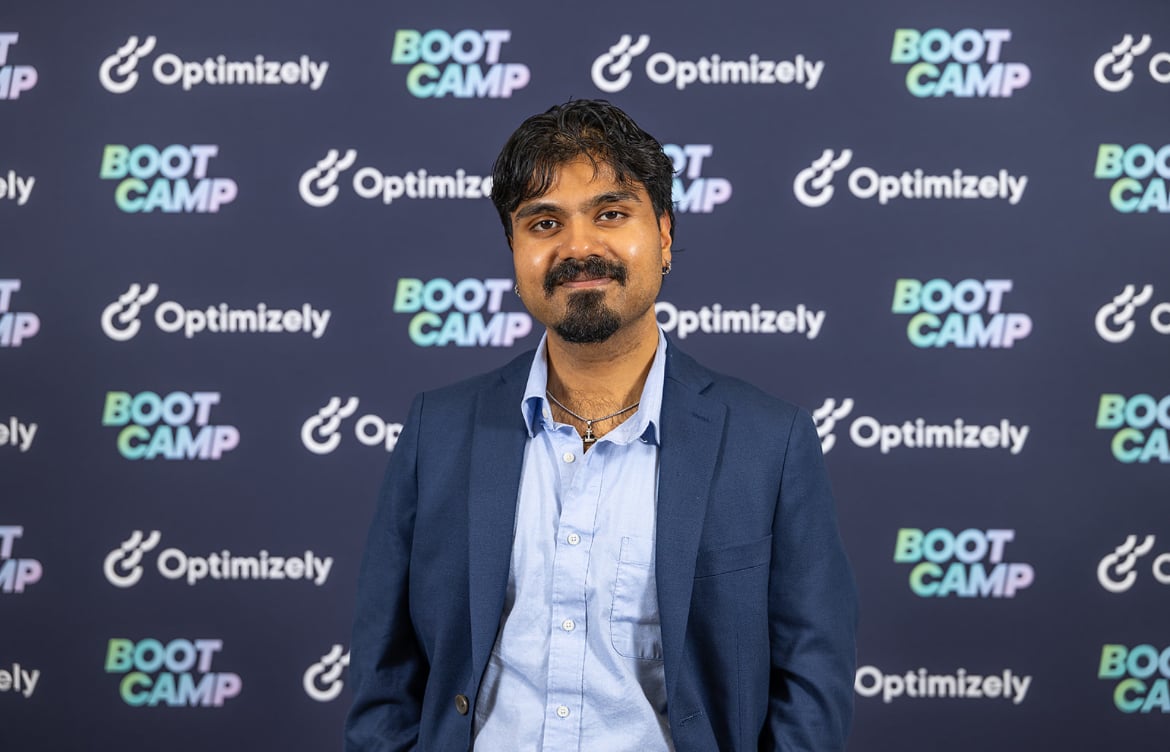
I read competitive copy the way I used to read college research papers.
Let me preface this with a bit of context. I was a management information systems major in college, and I had a side hustle helping peers edit research papers. ChatGPT came out during the final semester of my senior year, and I think most of my MIS classmates probably associate that period with using AI to pass advanced Python.
But my strongest memory of that semester isn't an AI tool. It's a library table. I spent hours parked there, reading essays on Cold War infrastructure and relational databases and pharmaceutical pricing ethics and whether social media was making people lonelier, leaving countless comments on verbiage, tone, intent, filler, fluff. Everything that 22-year-old Chinmay felt was standing in the way of his peers' quests to earn an A in the subjects they'd been studying for all of twelve weeks.
It's funny to look back on it now; everyone around me was moving toward automation, and I was still doing the most manual version of editing imaginable.
I think this kind of experience is a total remnant of the past now. Imagine being in school and having a classmate review your papers for you in this world of agentic toolkits and specialized startups that will use copilots to grade and revise your copy — what a ludicrous idea! It's a completely archaic practice that, for some reason, much of LinkedIn has decided no longer belongs at the heart of every profession that sells with words.
The thing is, the work I was doing at that library table didn't go away when I graduated. It just changed shape.
These days, as a compete professional, I've traded academic research for buyer intelligence: earnings calls, 10-K forms, practitioner blogs, product demos, Reddit threads, Discord servers, everything. And every day I see something new, I realize that we're losing sight of why the buyer even cares at all.
...and why should they?
I've always thought of myself as an academic at heart who just happened to find his way into tech. I was never a science whiz or numbers guru. But I love rigor and I love methodology, and that instinct is what makes compete feel so familiar to me. There's a concept in research called operationalization: the idea that before you can measure something, you have to define it precisely enough that two different people would measure it the same way. You can't just say "customer satisfaction" and wave your hands. You have to say what you mean, how you'd observe it, what counts and what doesn't.
Compete is a lot like academia in that way, even in a world where AI has democratized intelligence that used to take days to gather. Because collecting info isn’t the tricky part — communicating it is.
Your buyer does not care about your buzzwords, the same way your professors didn't
When I was sitting in that library marking up research papers, the single most common comment I left was some variation of: what does this actually mean? A student would write something like "this study provides a comprehensive framework for understanding the multifaceted implications of..." and I'd write in the margin: what are the implications? What makes them "multifaceted?" Name them. Be specific. Because the moment you strip the padding away from a sentence like that, you find out real fast whether the writer had something to say or was just filling space.
It’s the same reflex I see now when I read competitive copy.
I'll pull up a landing page and it'll say something like "a robust, enterprise-grade platform built for scale." And my first instinct (the same one I had at that library table) is: what does that mean?
Robust how? What makes it "enterprise-grade?" Built for whose scale? These aren't rhetorical questions. I need to know the answers to do my job, and most of the time, the answers aren't on the page. They're buried in a GitHub repo, or a support forum, or a G2 review, or a throwaway comment on a Hacker News thread.
The actual information (e.g. anything that would help a buyer make a real decision) is almost never in the marketing copy. It's everywhere else.
And when I finally find it, after digging through a thread and stumbling upon a developer explaining, in plain language, exactly how something works and where it breaks, there's a version of that same satisfaction I used to feel at the library table. The real thing, underneath all the fluff.
This is a recurring trope across the entire SaaS landscape: on slideware, SDR outreach templates, FAQs, feature comparisons. Everyone is describing their solutions as "enterprise-grade," "production-ready," "turnkey," "future-proof."
You can now generate an entire website's worth of positioning copy in an afternoon, and every word of it will sound polished, professional, yet will say absolutely nothing.
I get it. I've been there. And I still catch myself doing it in the first couple drafts of a messaging doc, reaching for a word that sounds authoritative before I've figured out what I really want to say. It's a deeply human reflex, cosmeticizing something when you're not quite sure how to say it plainly. It's the same impulse that made my classmates pad their thesis statements. It's the same one I'm fighting right now, writing this. The instinct to sound like you know more than you do is one of the most universal things about being a person who works with words. The difference now is that there are tools that will dress it up for you automatically, and the result is a lot of copy that sounds like it was written by someone, but you can't tell who, or whether they had a particular opinion about anything.
When a company describes its product in specific, concrete terms ("marketers can run an A/B test on a landing page without looping in a developer"), that tells me they know what their product does and who it's for. When a company describes its product as "an innovative, AI-powered solution that empowers modern teams to deliver personalized experiences at scale," I don't know what to do with that. I can't turn it into a compelling asset or brief a sales rep on it. There's nothing to grab onto.
The tomato test
Human beings, as much as they may try to pretend otherwise, are incredibly pragmatic. When you're at the grocery store looking for tomatoes, you're not going to read the note on the packaging about where they were picked and call it a day. You're going to pick them up and look for blemishes yourself. No adjective is going to override what you can see with your own eyes.
Buyers do the exact same thing. I listen to sales calls. I break down win/loss interviews. I see the questions buyers ask when they're seriously evaluating software, and I can tell you that no one has ever, in the thousands of recordings I've seen and transcripts I've read, asked "but is it enterprise-grade?" They ask things like: how long does implementation take? What does the migration path look like from my current vendor? Can I see a demo with my actual data? Will this work with the tools I already have?
These are blemish-check questions. They're trying to find out if the tomato is good, regardless of what the packaging says. And when every competitor in a category uses the same adjectives and phrases, the buyer's job gets harder, not easier. They can't differentiate on language because the language is identical. So they go around the language. To reviews, community forums, analysts, the person on their team who's used the software at a previous job and will tell them, “Sheesh, that tool really sucked,” free of any pretense.
Every claim needs support
When I was editing papers, I lived by the idea that every claim needs support. You can't just say something is significant; you have to show the data. You can't just say something is widely accepted; you have to cite who accepts it and why. The entire structure of academic writing exists to prevent people from passing off vibes as facts.
B2B marketing has no such structure.
You can call your product "enterprise-grade" without defining what that means, showing evidence, or even pointing to a single customer that would vouch for you.
Nobody's really checking, right? There's no peer review committee for landing pages, right?
Except, there kind of is — it's just not formalized. It's the buyer doing their own research. It's your PMM industry peers pulling apart your messaging to refine their own. It's the rep at a rival company reading your case study and knowing which parts are exaggerated because they're selling into the same accounts.
The peer review is happening. It just happens after you publish, by people who aren't reading charitably. Because they're not supposed to. They're trying to understand whether they can trust you to help them.
I'm still at that library table
A significant chunk of my day-to-day amounts to translation; converting buzzwords into plain statements about what a product really does and who it's really built for. I cross-reference the LinkedIn post with the webinar Q&A. I compare the press release with the changelog. I look at what customers say when they think no one is reading. It's peer review. The same work I did at that library table, just with higher stakes and slightly worse formatting.
And I still love every minute of it. The same way I loved it when I was twenty-two, getting paid in thank-yous and the occasional dining hall favor, crossing out filler and watching the real argument emerge. The circumstances changed. The feeling didn't.
To be clear, AI has helped me cut down massively on the time I used to spend on manual research. At Optimizely, I've used Opal and MCP connectors to build CI agents that handle the work that used to eat up my mornings. Whether it’s a feature verifier agent that takes a claim and checks it against documentation, or a pricing intel agent that pulls competitor pricing from a knowledge base, matches it against our own pricing data, and returns a structured comparison in one query – these agents handle the parts of my job that used to take a lot of time. And I won’t lie, they're damn good at it.
But that’s not the hard part. The hard part is telling the rest of the company, our sellers, our product teams, and our customers why they should care. AI has gotten so good at telling you what happened that reporting isn't a moat anymore...
...but understanding why something matters to this buyer, in this deal, right now? That's still a profoundly human affair.
Sometimes I think about the version of me at that library table, doing everything the long way, and I wonder what he'd make of all this. I think he'd be impressed by the agents. But I think what he'd care about most is something he figured out at twenty-two that still hasn't stopped being true: everybody has something real to say. The best papers I read were never the fanciest. They were the ones where someone figured out what they meant and just said it. The job was never to write it for them; it was to help the truth come through.
I keep looking for that in the stuff I read now. I find it less often than I'd like.
When I do find it, though — a landing page that tells me exactly what the thing does, a case study with real numbers, a blog post where someone explains how they solved a problem with zero fluff — it's a breath of fresh air. That kind of lucidity is rare enough now that it almost feels like a competitive advantage on its own. The kind of paper that would get an enterprise-grade-A.