AI in product development: How to speed up innovation without disrupting your workflow

Sathya NarayananSathya Narayanan
Mar 25, 2025

Discover how AI simplifies product development, enhances testing, and accelerates time-to-market without disrupting your current processes.

Building a product is no small feat. It takes countless hours of planning, ideating, and collaborating to bring an idea to life. And even after all that effort, the real challenge begins: making sure that what you've built truly resonates with your users.

Well, that's where the real challenge begins.

According to Userpilot, top-performing companies observe that 65% of users who complete important actions see a product's value within days of signing up.

Building a great product with perfect market fit is everyone’s goal but let's be real—it's harder than it sounds.

Still, understanding potential users, getting deeper insights from customer data, and turning those insights into features that actually matter is where the magic happens.

Some products hit the market with little brainstorming while others roll out too late. According to a report by Undo, debugging software failures costs a whopping $61 billion annually.

And here's how.

0:00 / 0:00

AI is not the solution itself

Yes, AI cannot do everything for you.

AI GIF

Image source: Giphy

AI tools are there to help you build better features and products faster, but they won’t do an end-to-end job for you.

Involving AI doesn't make the process much different from a standard one. The key difference? AI handles the heavy lifting of data analysis, pattern recognition, and repetitive tasks, freeing your team to focus on strategic decisions and creative problem-solving.

AI as your strategic partner across the product development lifecycle

Calculators didn’t replace mathematicians, and AI won’t replace your team. It will make them faster, sharper, and more impactful.

1. Ideation and problem definition

Imagine trying to analyze thousands of customer feedback points manually. AI makes this instant.

  • AI analyzes market trends and processes customer feedback to surface unmet needs.
  • Generate potential hypotheses based on defined parameters.
  • Evaluate ideas against pre-defined success criteria.
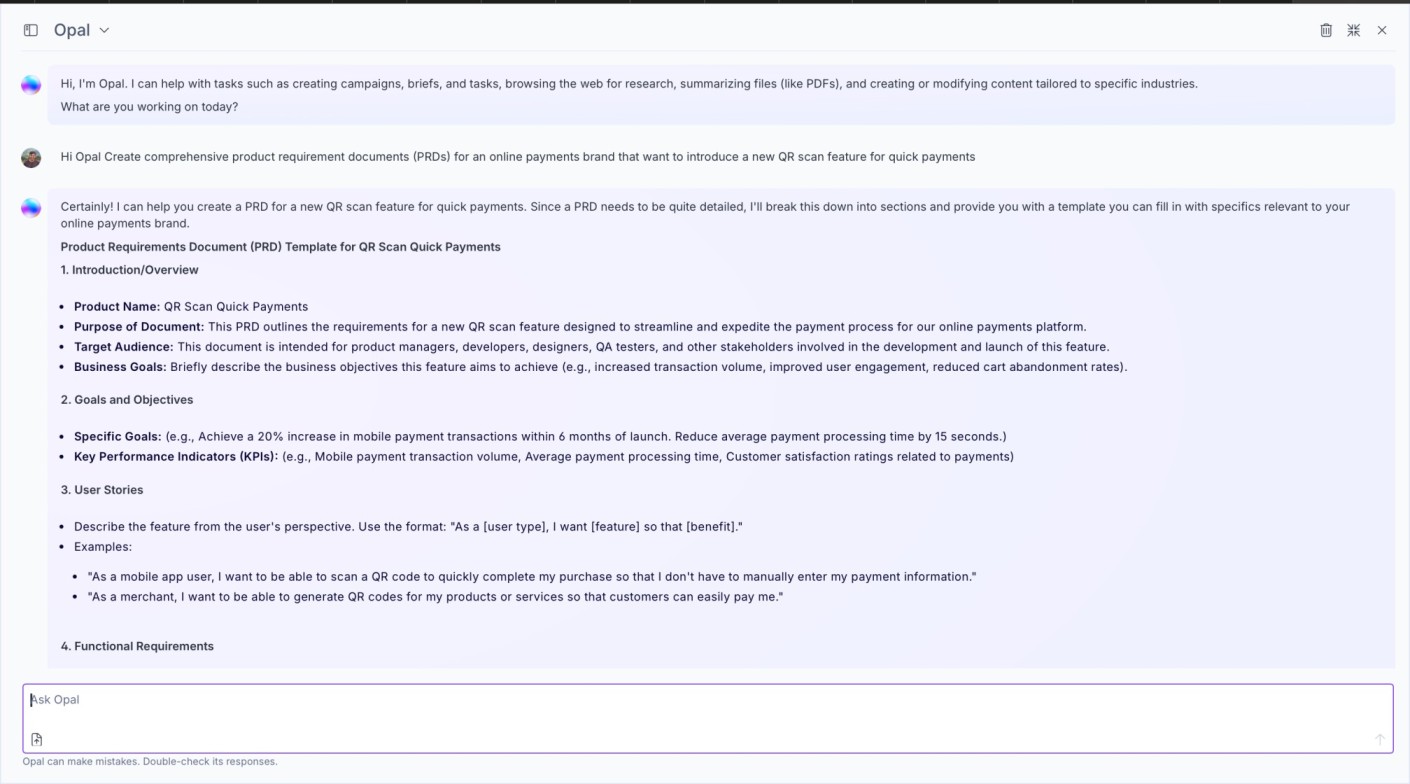
  • Create comprehensive product requirement documents (PRDs) with AI assistance.
  • Use case: An e-commerce company can use AI to scan the web to analyze customer reviews and social media mentions to identify trending product categories.

2. Design and prototyping

  • Create multiple design variations from a single concept.
  • Generate interactive images and presentations from simple prompts.
  • Transform product requirement documents (PRDs) into wireframes with tools like Gamma AI.
  • Use case: A product team can use AI design tools to transform wireframes into fully interactive prototypes in hours instead of days.

3. Development

  • AI excels in helping write new code, refactor existing code, and automate repetitive coding tasks.
  • Detect bugs and suggest fixes before they reach production.
  • Use case: A software development team can use AI coding assistants to accelerate feature development.

4. Quality assurance and experimentation

  • Generate comprehensive test scenarios based on user behavior patterns.
  • Identify edge cases human testers might miss.
  • Prioritize issues based on potential business impact.
  • Use case: A fintech company can use AI experimentation capabilities to run more tests faster and with better results.
0:00 / 0:00

5. Go-to-market launch

  • AI-assisted documentation and creation of content/assets for launch.
  • Predict initial user adoption and engagement rates.
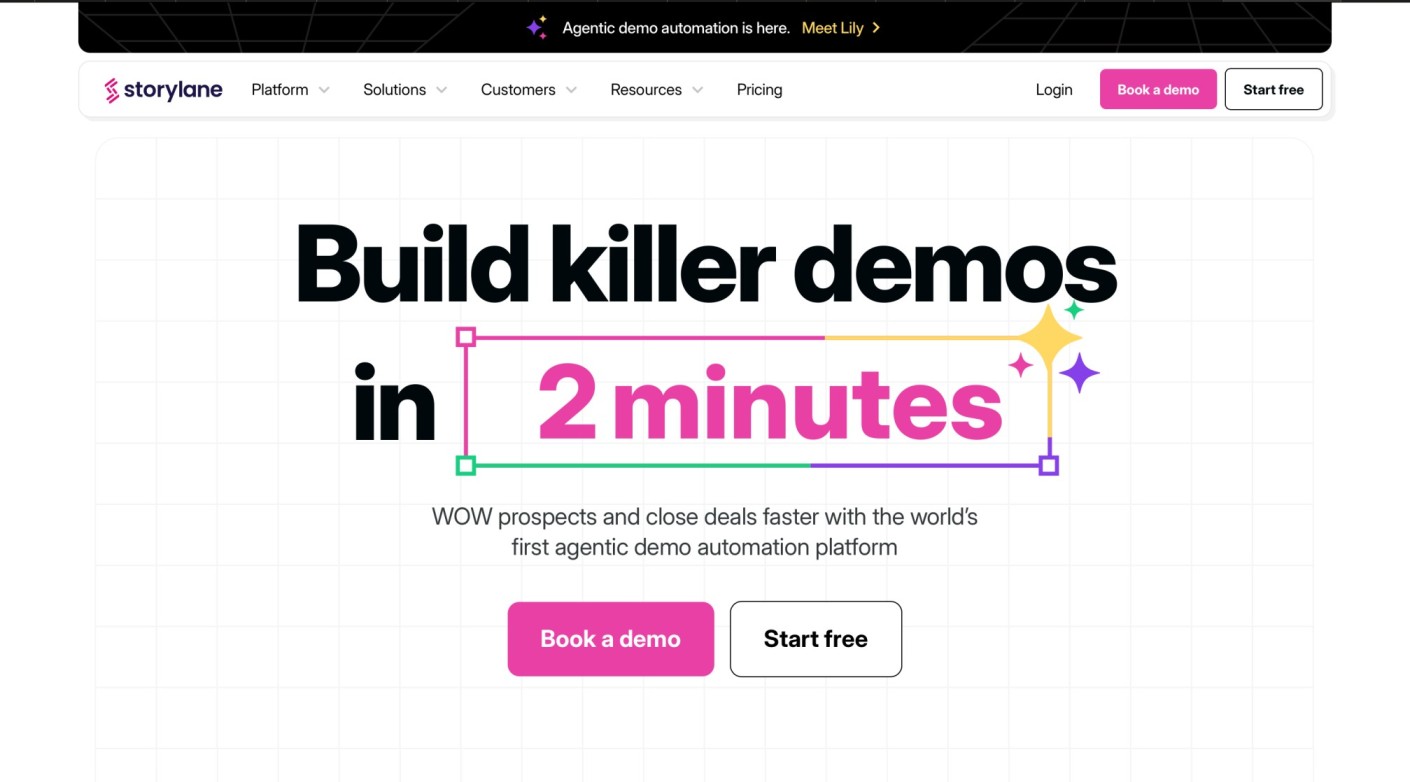
  • Use case: A SaaS platform can use AI to analyze user behavior during onboarding to optimize the experience.

Image source: Storylane

6. Continuous optimization

  • Analyze user behavior to identify improvement opportunities.
  • Generate A/B test hypotheses based on usage patterns.
  • Predict churn risk and suggest retention interventions.
  • Use case: A subscription service can use AI to identify subtle patterns in user engagement that predict churn before it happens.

Getting started with AI without disrupting workflows

Three steps.

Step 1: Identify high-effort, low-value tasks

The most effective way to introduce AI is to start where it can make the biggest immediate impact.

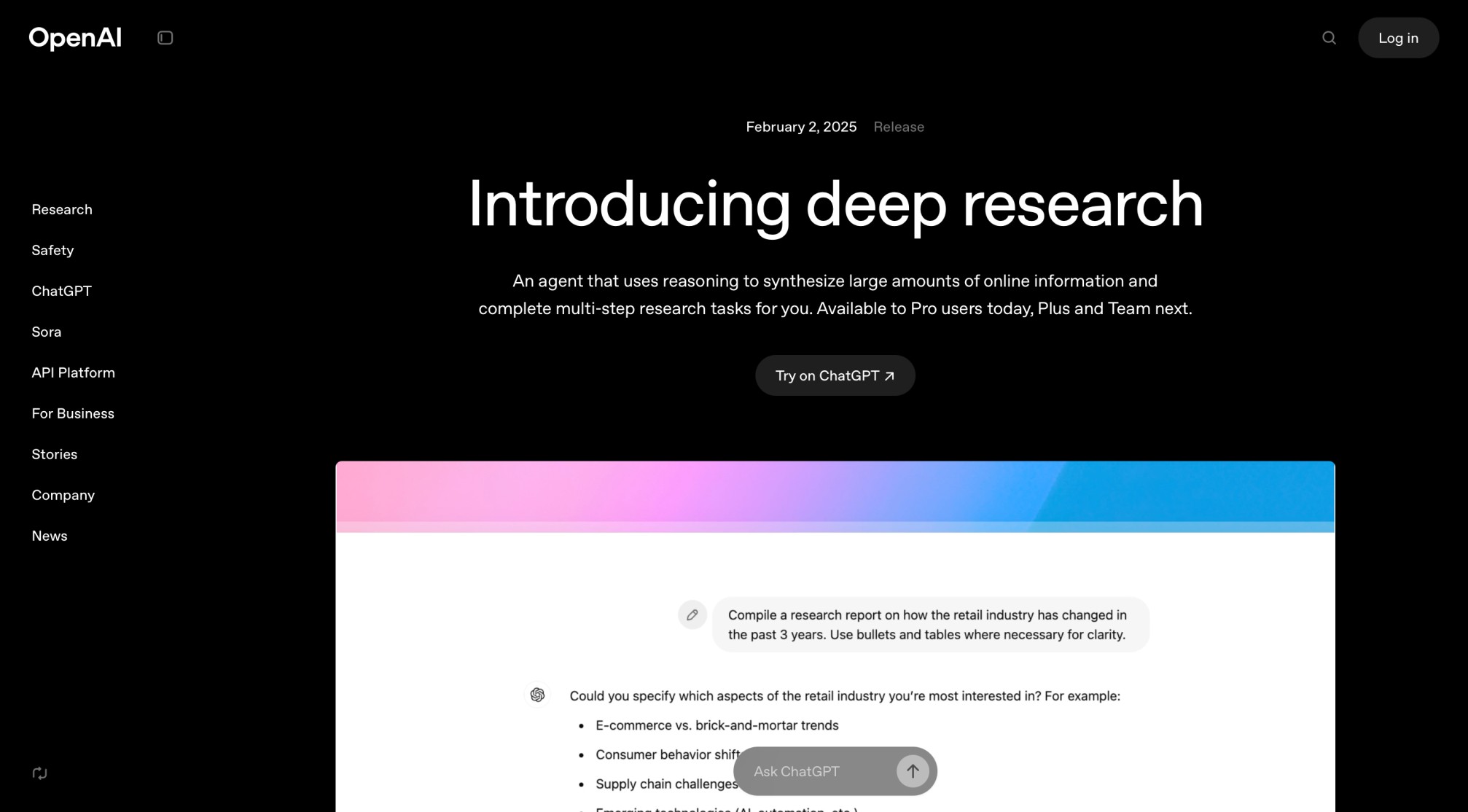
Product teams are increasingly turning to AI solutions like ChatGPT's Deep Research to:

  • Analyze massive datasets to uncover hidden patterns.
  • Compile competitive intel in minutes instead of days.
  • Discover consumer sentiment patterns across channels.
  • Synthesize industry reports into actionable insights.

The implementation is straightforward yet powerful:

  • Teams define their research objectives clearly.
  • They craft detailed prompts that specify the scope and depth of analysis.
  • The AI delivers structured, comprehensive research reports.
  • Product managers follow up with targeted questions to dig deeper.

Image source: OpenAI

Step 2: Start small and scale strategically

Begin with one phase of the product development lifecycle and expand from there.

  • Start with AI-powered market research to validate ideas faster.
  • Use AI to analyze existing customer feedback for quick wins.
  • Implement AI in internal processes first before customer-facing features.

With AI: AI-powered optimization for experiments improves the entire workflow.

Image source: Optimizely

Step 3: Use AI to generate, not dictate

Establish clear boundaries between AI assistance and human decision-making:

  • AI generates options; humans make final decisions.
  • All AI outputs undergo human review before implementation.
  • Critical strategic choices remain firmly in human hands.
  • AI supports rather than replaces domain expertise.

When you combine AI with experimentation, it creates a powerful approach to product development, one that tackles five key challenges:

1

Breaking down silos: According to Gartner, less than a third of employees are satisfied with workplace collaboration. AI-powered workflows capture ideas from everyone.

2

Maximizing limited resources: Our analysis of 127,000 experiments shows peak effectiveness at 1-10 tests per developer annually. AI enables non-technical team members to run experiments independently, freeing engineers to focus on core features.

3

Unifying customer experiences: AI prevents disconnected touchpoints by integrating data across channels. Advanced algorithms deliver personalized experiences without requiring hundreds of manual user segments.

4

Measuring business outcomes: AI connects experiment results directly to revenue and lifetime value, moving beyond surface metrics to demonstrate real business impact.

5

Enabling predictive development: The greatest advantage is shifting from reactive to predictive development by identifying issues before they affect users, predicting outcomes of new features, and spotting emerging needs before they become widespread.

The growing role of AI agents in product development

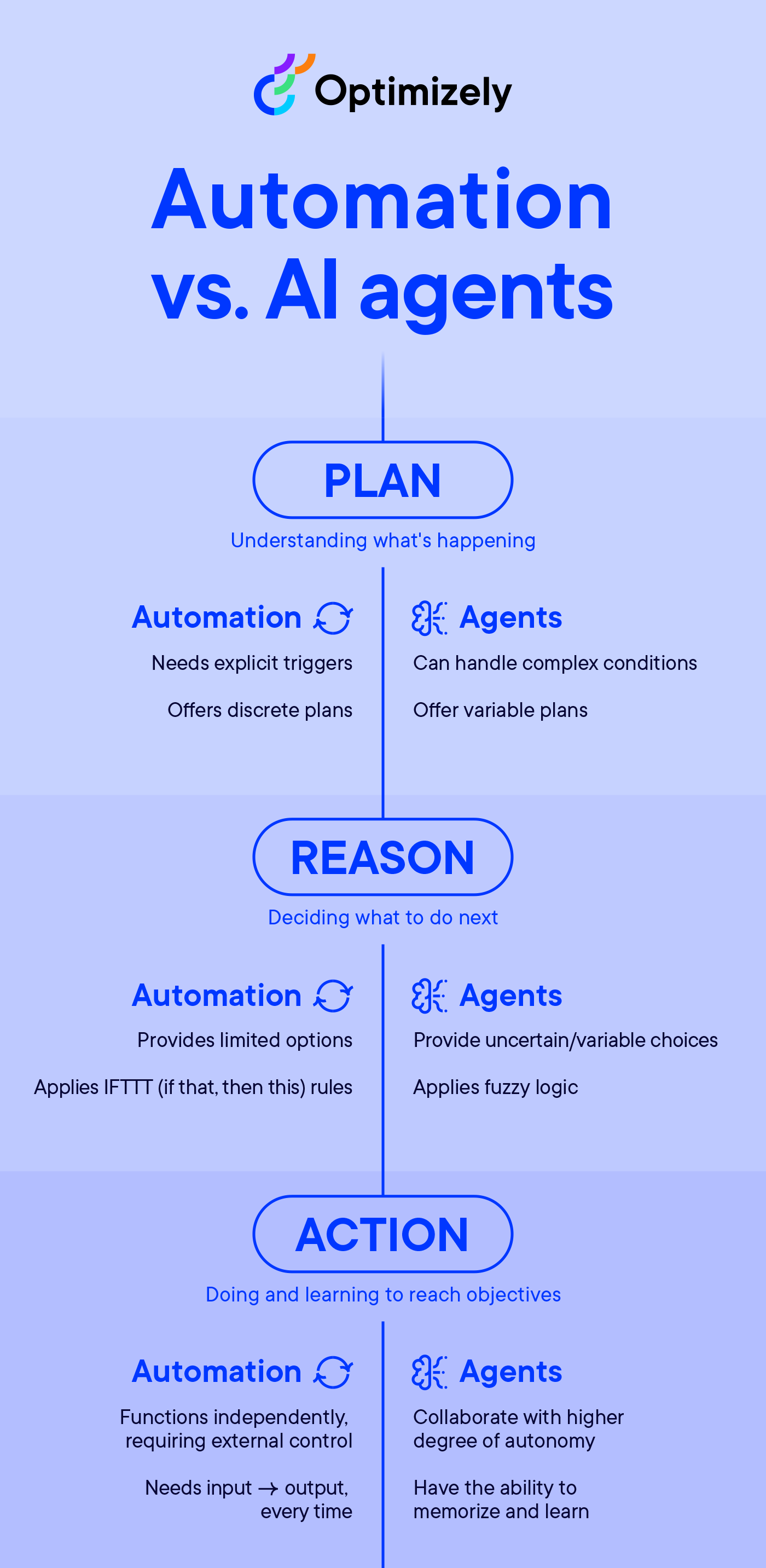
AI agents are the next big leap in how products are conceived, tested, and refined.

Shafqat Islam, President and CMO at Optimizely, predicts that by 2030, "most online interactions will be driven by AI agents."

Think of AI agents as autonomous members of your product team:

  • They independently execute specific product development tasks.
  • Make data-driven decisions about product features.
  • Continuously learn from user interactions.
  • Work across design, testing, and analytics platforms simultaneously.
  • Deliver personalized product experiences at scale.

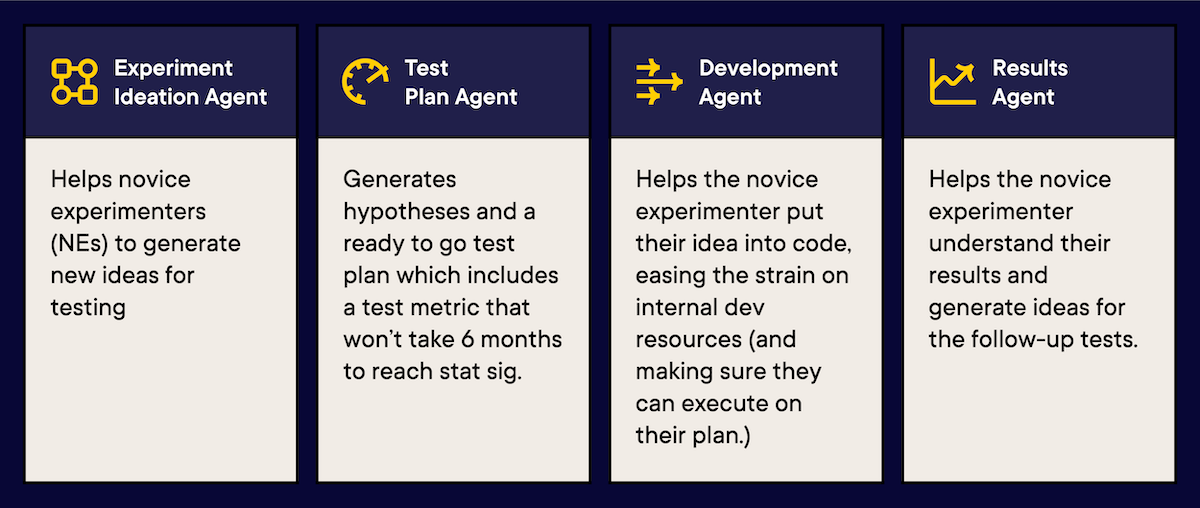
Image source: Optimizely

More impact will be seen when specialized agents start working together:

  • Insight mining agent
  • Prototyping agent
  • QA testing agent
  • GTM enablement agent
  • Experimentation advisor agent
  • Personalization advisor agent

To avoid roadblocks, maintain human oversight on critical product decisions and start with well-defined, low-risk use cases.

The future of AI in product development

The future isn't AI vs humans. It's AI-powered humans vs the rest.

Here are three practical steps to begin:

1

Start with a single phase: Target one area with the most friction - ideation, testing, or analysis.

2

Focus on collaboration: Let AI handle repetitive tasks while humans make strategic decisions.

3

Measure the impact: Track metrics before and after implementation to quantify improvements.

The success of AI in product development depends on three things: smart implementation, workflow integration, and human oversight.

Your team should remain in the driver's seat, using AI as a powerful co-pilot that amplifies their capabilities.

Optimizely Opal works alongside your team at every stage of product development. From analysis of 127,000 experiments to a 131% increase in experiments, the data shows what's possible when AI and human expertise work together.