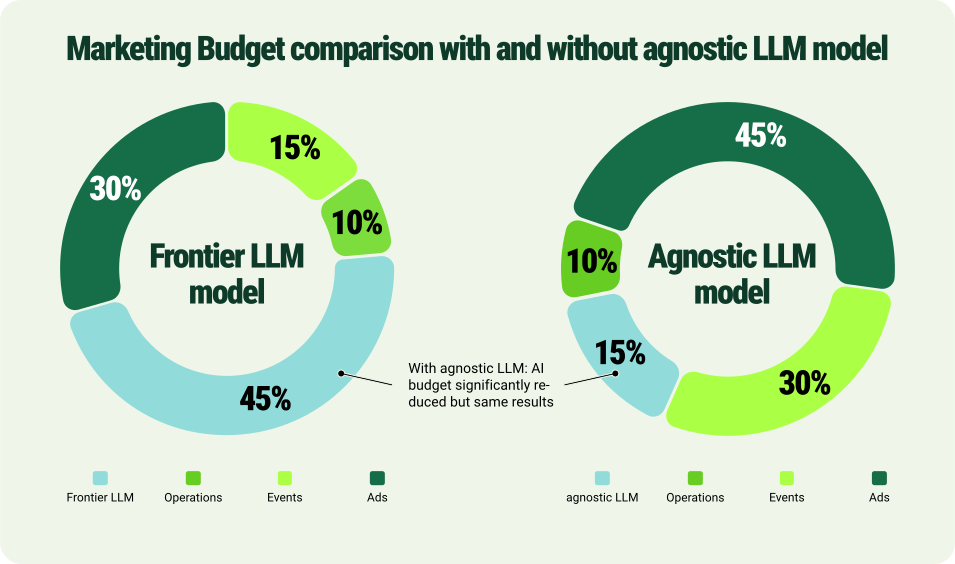
Why an LLM-agnostic approach is the key to controlling AI costs and unlocks its full value
Every enterprise conversation about artificial intelligence eventually arrives at the same uncomfortable question: What does this actually cost?
Not the license fee. Not the implementation hours. The real, compounding operational cost, the one that scales with every prompt, every automated workflow, every personalized customer touchpoint. The cost that, left unmanaged, quietly erodes the very ROI that justified the investment in the first place.
That cost is measured in tokens.
And the discipline of managing it is rapidly becoming one of the most consequential financial metrics in the modern enterprise P&L. A growing number of technology leaders call this „token economics“.
What Are Tokens, and Why Should the C-Suite Care?
Tokens are the fundamental currency of large language models (LLMs). Every time an AI system processes a prompt, generates a response, or holds context in memory, it consumes tokens. It’s small units of text that carry a direct and measurable price. At the scale of a single user query, the cost is trivial. At the scale of an enterprise running thousands of agentic workflows across marketing, sales, customer service, and operations with millions of interactions per month,token consumption becomes a serious line item.
For CFOs, this is the new cloud compute moment. A decade ago, organizations learned that moving to the cloud did not eliminate infrastructure costs; it transformed them into variable, consumption-based expenses that required new governance models. Token economics presents the same challenge, but with a critical difference: the cost drivers are less visible, harder to predict, and far more distributed across the organization.
For CMOs, the stakes are equally high. Marketing is the functional area with the most AI touchpoints, i.e. in content generation, personalization, campaign orchestration, experimentation, analytics. Every one of these use cases consumes tokens. The marketing team that fails to manage token efficiency is effectively burning budget on computational waste.
For CEOs, the strategic question is even broader: Is your organization building its AI capabilities on a foundation that allows financial control, model flexibility, and long-term scalability? Or are you locked into a single vendor's pricing and performance trajectory, hoping that one model will remain the best answer for every task?
The Hidden Risk: Single-Model Dependency
Today's AI landscape features dozens of commercially available LLMs, each with distinct strengths. Some models excel at deep reasoning. Others are optimized for speed, cost, or specific content types like long-form analysis, code generation, or multilingual output. No single model leads in every dimension, and the competitive landscape shifts with each new release cycle which, increasingly, means every few weeks.
Despite this reality, many organizations default to a single-model strategy. They sign an enterprise agreement with one provider, build their workflows around that model's capabilities and constraints, and move forward. The rationale is understandable: simplicity, speed to deployment, and a single vendor relationship.
The risk, however, is substantial. A single-model strategy creates three distinct forms of exposure:
- Cost exposure. Using a frontier model (the most powerful, most expensive model available) for every task is the equivalent of sending a sports car on every grocery run. Simple classification, summarization, or data enrichment tasks do not require the computational overhead of a frontier model. Yet without an intelligent routing layer, that is precisely what happens.
- Performance exposure. Each model has strengths and weaknesses. A model that excels at creative copywriting may underperform at structured data extraction. A model built for English-language reasoning may deliver suboptimal results in German, French, or Japanese. Locking into one model means accepting its weaknesses across every use case.
- Strategic exposure. The AI model market is in its early innings. Today's leading model may be tomorrow's commodity. An organization that builds deep dependencies on a single provider's architecture, prompting conventions, and context management approach is making a long-term bet on a rapidly changing landscape.
The LLM-Agnostic Imperative
The antidote to single-model risk is an LLM-agnostic architecture. A platform layer that sits above the models and orchestrates them intelligently, routing each task to the model that delivers the optimal combination of quality and cost.
This is not a theoretical concept. It is an engineering and business-model decision that separates platforms designed for long-term enterprise value from those designed for rapid market entry.
First, scaffolding.
Picture a building under construction. The steel scaffolding around it is not the building itself, it is the supporting structure that makes construction possible safely, efficiently, and to a precise standard. In AI, scaffolding is everything built around the raw model. It includes the instructions that shape its behavior, the memory that gives it context, the guardrails that keep it on-brand and compliant, and the tools and workflows that connect it to enterprise systems. Without scaffolding, an LLM is impressive but unpredictable. With scaffolding, it becomes purposeful.
Second, the harness.
Think of a rock climber. Strength and skill are essential, but without a harness, that capability is uncontrolled. In AI, a harness is the orchestration layer that decides which model to use for which task, manages context across interactions, and routes requests intelligently. A company with a harness can run the right model for every task. A company without one is betting everything on a single horse.