Scaling experimentation is often the toughest challenge for organizations as they start to see the tangible results of experiments. Companies start to focus on how to make the practice a reality in all aspects of their business. Determining roles, responsibilities, and workflows of an expanding experimentation program may seem like a daunting task, but it is essential to making scaling a reality.
Hopefully your organization is ready for scaling its program and success too! As the Lead Strategy Consultant at Optimizely I’ve seen numerous ways organizations create this structure. There are typical structures experimentation programs use to ensure they can operationalize the practice effectively, and below I will outline which one may best fit your org And I’ll walk through each of these structures and the benefits and drawbacks of each below:
- Center of Excellence
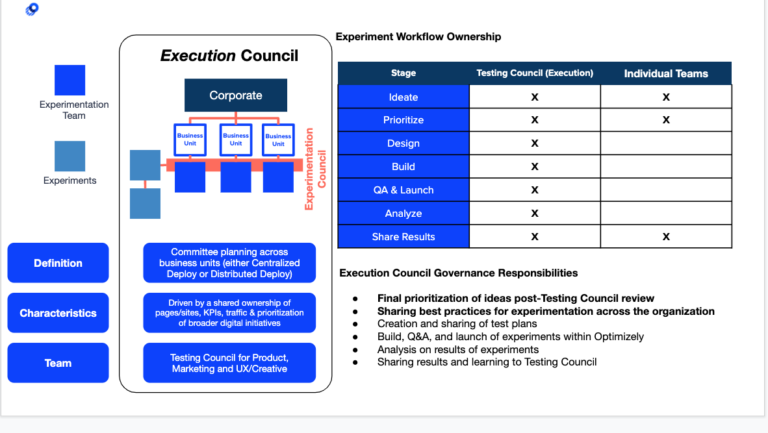
- Testing Council (Execution)
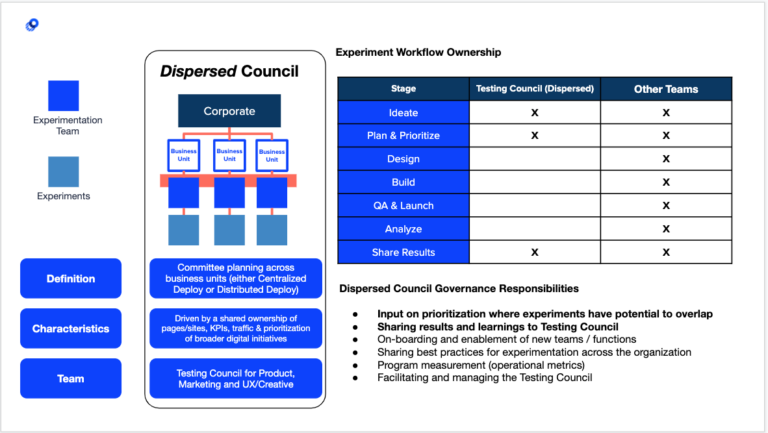
- Testing Council (Hybrid)
- Individual Team
- Hybrid
One thing I try to keep in mind and share with customers is that these structures are just starting points. Every company already has organizational structure and workflows to build their experiences and products within which experimentation needs to fit. These new structures should elicit an, “Ohh that structure looks familiar to what we are trying to do,” comment vs “We need to follow this structure to a tee.” That initial identified structure should serve as a guiding light, but not the be-all-end-all.
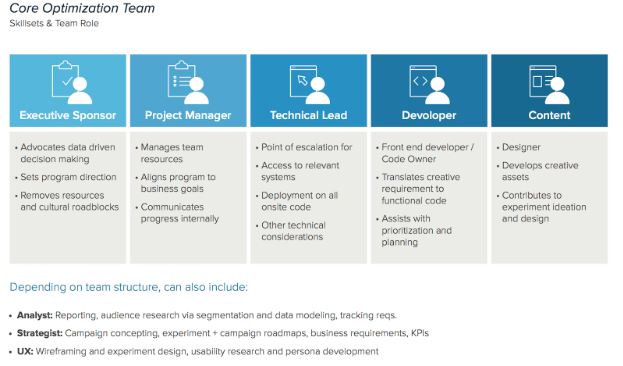
A second item I often seek to drive home is that the best experimentation programs have a central team lead the program. Getting to a true culture of experimentation is not accomplished piecemeal. There has to be at least one person fully dedicated on a daily basis. And from there ideally more members of a central team with specific subject matter expertise. This cohort may not be fully dedicated to start, but it’s definitely something to strive for.
Here are three primary structures I’ve seen across best-in-class customers I’ve had the opportunity to work with. Each can have a huge impact on an organization. Again, just as no two families are alike, so too are no two organizations. The only guiding rule here: you’ve got to make this unique to your org should you want to succeed.
Center of Excellence
I hear this term the most when companies are looking to scale and create that culture of experimentation (it’s also a practice used heavily for organization’s analytics teams to make analysis on all digital work easier to access). But the definition I use for Center of Excellence when it comes to experimentation programs is a bit tighter than how most use it.
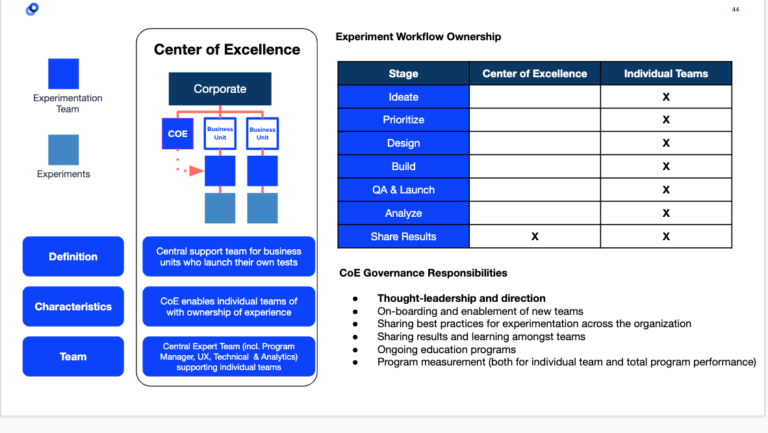
The organizations that employ a Center of Excellence are decentralized in their product and experience development. There are individual owners of those testing roadmaps aligned to the relevant products and experiences. Rarely do these overlap in ownership. This reduces the need to coordinate weekly on what testing is upcoming, prioritization, and steps to execute.
A Center of Excellence is the model where you need a dedicated experimentation team – no questions about it. Without a central team to drive on-boarding and adoption of testing, the program can fail. Since the experimentation team won’t have ownership of product / experience to test on themselves they need to focus on being the experimentation facilitator such as sharing best practices, learnings, and measuring the output and impact of the program as a whole.
A Center of Excellence could be right for you if:
- Your organization already operates in a decentralized manner in other parts of the business such as analytics
- You don’t need individual teams to be in constant contact; they own their own roadmap so it’s better to not overburden them with constant review
- You’re more mature to testing – you have a strong understanding of what experimentation means to your company and each team understand methodologies
- Having tighter centralization could inhibit velocity goals
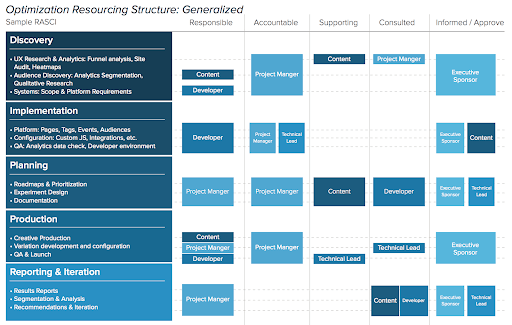
My starting point to identify the structure with an organization is to write out where ownership is for the central team / leaders as opposed to individual teams. This can make it clear who owns execution for each step of an experiment’s lifecycle.
Here’s what this looks like for a Center of Excellence (I have these in each of the following structures as well):