Look behind any great marketing program and you’ll likely find great marketing processes, from goal setting to team building to automated workflows.
And while reading up on processes may not be as inspiring as scoping out the latest and greatest campaigns, it’s just as important—possibly even more so.
Marketing processes are all the steps you take to plan, implement, and evaluate your creative campaigns. They give your team direction and set you up for success.
With that in mind, we’re going to take a deep dive into what the best planning process looks like and the tools you’ll need to bring it all together.
Key steps your marketing process should have
In this section, we’ll cover the most important steps to follow when developing processes to optimize your marketing operations:
1. Determine your primary and secondary goals
As a marketer, you’re probably really busy. Like, running around, constantly putting out fires kind of busy. And while you might feel like setting goals and conducting market research isn’t a priority, it’s really quite the opposite.
Defining your goals often saves time in the long run because you can focus your efforts on projects that have a clear purpose — and eliminate those that don’t. Plus, taking the time to define your goals leads to better outcomes.
In fact, Content Marketing Institute’s 2022 state-of-the-industry report shows that 62% of top-performing marketing departments use a documented strategy while only 11% of those at the bottom do the same.
So, clear some time in your schedule and sit down with your team to hash out some goals. These should include primary goals (those that are the most important or necessary to achieve) along with secondary goals (those that would be helpful to achieve but aren’t critical right now).
For many businesses, marketing goals typically include:
-
Driving organic traffic to your website.
-
Connecting with your customer base across multiple distribution channels.
-
Owning a majority of the market share of certain market segments.
-
Generating high-quality leads.
-
Increasing sales and revenue.
-
Nurturing leads through the different stages of your sales funnel.
-
Addressing ideal customer needs through research and testing.
-
Harboring loyalty with target customers by providing resources and education.
-
Encouraging people to take a specific action like signing up for your email list, making a purchase, registering for a course, or downloading a digital product.
-
Improving the conversion rate on your website.
-
Establishing industry authority by becoming a thought leader in your space.
-
Increasing brand awareness.
-
Boosting brand engagement on social media.
-
Acquiring new customers.
Understanding your key demographics will go a long way in helping you reach your target audience by providing meaningful customer value.
2. Compare possible marketing plans or approaches
Once you’ve identified what you want to achieve, the next step is figuring out how to do it. One of the best places to start is by comparing different marketing tactics and approaches. Ask yourself and your team a few questions:
-
What are all the different ways we could achieve each goal?
-
How have other companies achieved these same goals?
-
Have we achieved these goals in the past? If so, what worked and what didn’t?
For example, let’s say your primary goal is to drive traffic to your website. You could achieve this by starting a blog or redoubling your efforts on an existing blog. You could implement SEO strategies to harness organic traffic. Or you could run paid ad campaigns using PPC and social media.
Go through this exercise for each of your primary and secondary goals until you have an exhaustive list of all the viable plans you could use to achieve each goal.
3. Choose the best plans for your goals
Now it’s time to choose! During this step, it’s important to consider each plan carefully, thinking about the following issues:
-
How likely are we to achieve our goal with this plan?
-
How effective is this approach compared to others?
-
How difficult would this plan be to execute?
-
Does anyone on the team have experience with this approach?
-
Would this plan be enough on its own to meet our goal, or should it be supplemented with another strategy?
Once you’ve identified a few front-runners, dig into each plan a little deeper and define specific tactics that will support each approach.
Take Canva, for example. Back in 2015, traffic to the graphic design platform’s website and design blog had stagnated. To turn things around, Canva’s marketing team decided to take the approach of re-engineering their blogging strategy.
They defined the following marketing tactics to support this plan:
-
Reverse engineer their competitors’ content.
-
Find out what their readers really want.
-
Follow the data (not just their gut).
-
Pick the best headlines they can (and change them if they’re not working).
-
Create content that’s concrete and credible.
-
Add more images to their posts.
To measure success, Canva decided to implement these changes for sixty days and then compare results to the previous three-month period. Here are their results:
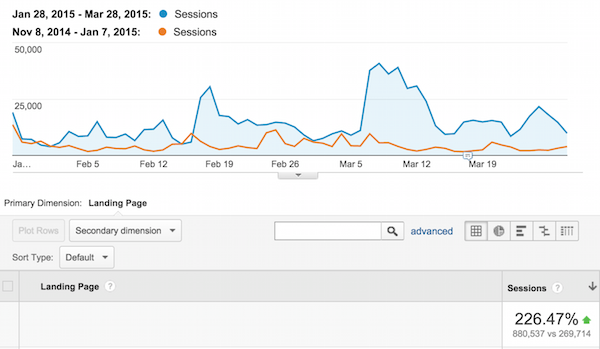 image source
 image source