Users don’t want to leave LLMs unless they really have to
Here's where impressions are basically as good as clicks. LLM platforms are specifically designed to keep users on the platform. ChatGPT users spend an average of 7 minutes and 46 seconds per session, and the entire interface is optimized to provide complete answers without requiring external navigation.
Research shows that when users interact with AI chatbots, they actually demonstrate higher engagement and longer session durations, but this engagement happens within the AI platform. Users are reluctant to click external links because it disrupts their conversational flow.
So, what we have is a kind of paradox: AI chatbot traffic tends to be higher quality when it does convert, but the conversion rates are inherently significantly lower because users prefer to stay within the AI interface.
And this is why optimizing for impressions is so important; users are reaping the benefits of your website without actually having to visit. And while this will cause headaches for website traffic, especially for more D2C brands, it’s doing wonders for brand visibility… if you’re measuring it properly.
The compound effect: AI amplifies visibility
Here's where AI-era impression optimization gets exciting: it compounds across platforms. When your content appears in Google's AI Overview, gets cited in ChatGPT responses, and shows up in Perplexity results, you're creating a multi-platform brand awareness effect that traditional single-channel strategies can't match.
The data supports this approach. Businesses focusing on AI impression optimization report increased brand awareness and improved organic search performance over time, even when direct AI traffic remains minimal. This is because AI platforms often use high-quality, well-cited content, so appearing in AI results correlates with improved traditional search rankings.
Brands that are winning are the ones covering the most surface area
The most successful brands of 2025 are optimizing for AI omnipresence. They understand that in an AI-mediated attention economy, being the source that AI platforms cite and reference is the ultimate currency.
This doesn't mean abandoning performance metrics. It means recognizing that in an AI-first world, impressions are relationships with algorithms, and those algorithmic relationships determine your brand's visibility across an entire ecosystem of AI-powered tools that users increasingly rely on for information.
When someone finally does click through from an AI platform or searches for your brand directly after seeing it mentioned by an AI, it's often the culmination of multiple AI impression exposures that made that action feel natural and trustworthy.
What should marketers do to optimize for impressions?
Look, here’s the hard truth. Your content isn’t just being crawled, it’s actually being read. And if all it took was something actually reading your content to negatively impact its performance, then you have much bigger problems.
The good news is that if you actually have a unique perspective, expertise, and an engaging way of communicating, you have a very good chance at showing up in AIO and maximizing impression share.
Here are some steps you can take to optimize for impressions (and clicks):
Be quotable, not just clickable
There’s definitive evidence that Google AIO leans towards deep pages (minimum 2 links removed from the homepage) when surfacing citations.
Developing content that serves as a reliable source for AI citations includes ensuring accuracy, providing clear attribution, and maintaining content freshness by constantly updating for relevant, current information.
Create detailed, authoritative content that addresses user questions thoroughly. AI Overviews favor content that provides complete answers rather than surface-level information.
Write like you talk, so AI can talk like you...
Conversational writing that mirrors natural speech performs significantly better than content that comes off as robotic and impersonal. Focus on creating content that answers questions in natural, conversational language patterns. This aligns with how users interact with AI systems.
Speak AI’s language, markup included
You can’t always rely on AI, LLMs, and search engines to intuitively understand what you’re talking about, so make it as clear as possible. Use structured data markup to help AI systems understand your content's context and relevance. Implement comprehensive schema markup to help AI systems understand and categorize your content effectively.
Consistency is currency. Own your identity across all touchpoints
Brands that maintain consistency across all platforms tend to perform better than those who don’t. Maintaining consistent brand and entity representations across all digital properties is important because LLMs synthesize information from multiple sources.

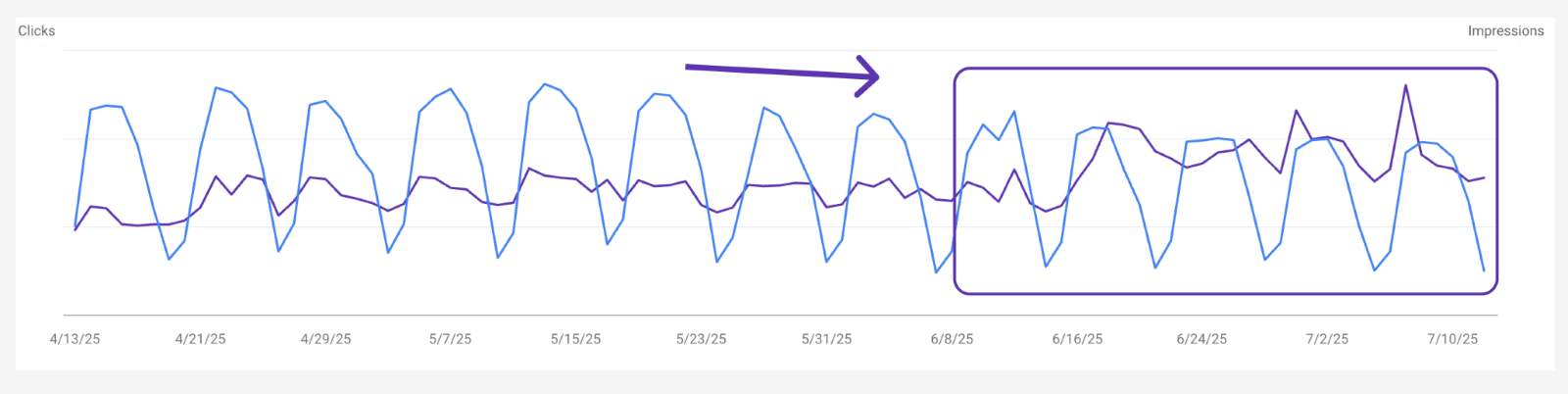 Optimizely’s impressions vs. clicks over the past 3 months