Hot take: Your website has a new job

Nazanin RamezaniNazanin Ramezani
Jul 2, 2025

AI is changing how content is discovered. Your website now serves humans and machines. An AI-optimized CMS helps you optimize for GEO, not just SEO.

Originally published July 2, 2025. Updated November 6, 2026 with a one-year-later perspective at the end of this article.

Let’s address the elephant in the room:

  • Yes, your website traffic is going down.
  • No, websites aren’t dead.

But the purpose of your website - i.e. who it’s actually serving - is fundamentally changing.

At Optimizely, we have over 9,000 customers globally, and we’re watching this shift happen in real-time across industries and regions. Human traffic is steadily declining. For many sites, sessions are dropping anywhere between 10-30% YOY. If you haven’t seen the dip in your Google Analytics yet, brace yourself - it’s coming. And while some referral sources are still holding strong, the trend line is clear: fewer people are browsing your site the way they used to.

Customer behavior is changing. At the same time, conversions are NOT being impacted. Most brands that we work with are not seeing a decline in their business; actually, most are seeing their business pick up steam.

So, what’s going on? Short answer: AI...

The old playbook assumed your website’s job was to attract visitors, tell your story, and convert traffic into leads and sales. That worked when discovery happened through search engines and direct navigation. But that’s not how people - or machines - are finding and using content anymore.

Our new reality: the discovery layer of the web has already changed. The website is no longer your company’s front door for discovery - it’s the place customers visit after discovering you elsewhere. This is the mental model most people don’t have yet.

We still think of AI as a tool, not as a traffic layer.

AI activity is quietly but rapidly ramping up. Large Language Models (LLMs) like ChatGPT, Gemini, Claude, and Perplexity visit your site daily. You may not see these user agents in your analytics, but they’re scraping and summarizing your content to inform their responses - often before a human ever clicks a link. The reality is: AI is the new ‘top of funnel’. LLMs are your new homepage. When a user asks a question in ChatGPT or Gemini, your content isn’t just passively crawled - it’s now part of an active conversation. If your content can’t be read, it can’t be ranked and it won’t be seen.

So, I repeat: your website has a new job. It’s becoming a validation layer for people, and a content source for LLMs.
Your website has a new job. It’s becoming a validation layer for people, and a content source for LLMs.

Your website now has two audiences - and one of them doesn’t click

Today, your website serves two distinct audiences:

  • Humans who arrive with high intent and demand fast clarity
  • AI agents which crawl, extract, summarize, and reuse your content elsewhere

Understanding this shift is critical - because optimizing for just one audience means failing the other. And failing either means losing visibility, trust, or business.

10–30%

Year-over-year drop in sessions on many sites

What humans still expect from your website

People still visit websites - but with far more focused intent than in the past. The homepage is no longer where discovery begins. Users often arrive after already encountering your content in ChatGPT or Google’s AI mode, etc.

In my opinion, humans will continue to visit websites for 3 core reasons:

1. Validation

Before taking action, users still want to confirm legitimacy. They find your information via AI chats, but they’ll come to your site to verify that you actually do what ChatGPT says you do.

2. Branded experiences

While generic experiences are increasingly being handled by chat, high-value branded interactions still matter - especially in premium or deeply personal verticals. Luxury retail is a good example – nobody will give up on the Apple buying journey. Spotify Wrapped. Custom configurators. Build your own -anything- journeys. Quote builders. These types of unique, branded, and highly personalized experiences don’t translate into chats.

3. Completing complex actions

From opening a bank account to signing up for an expert tax service, some workflows require more input, more trust, or more control than an AI interface can currently offer. Your site remains essential for completing those tasks - especially in regulated or high-touch industries. While I do expect more and more B2C retail shifting and becoming possible in chats, nobody is going to apply for car insurance on ChatGPT.

Nobody is going to apply for car insurance on ChatGPT.

What AI Agents are doing with your content

AI traffic doesn’t look like human traffic - and most companies don’t even see it. One of the biggest impacts of LLMs is the collapse of long-tail SEO and organic traffic.

For years, brands won by ranking for dozens of niche queries. More keywords, more pages, more content, more metadata, MORE... Now, AI agents increasingly answer those questions directly - without clicks, without attribution, and without traffic.

AI agents access your content in two steps:

1. First, they search (e.g., Bing for ChatGPT, Google for Gemini, Brave for Claude)

Yes, this is why SEO still matters (I’d argue even more than before). When a user types a question in ChatGPT, the first action is a Bing search. LLMs decide what sites to crawl through the pipelines of search engines.

NOTE: we all collectively only cared about Google search for a looooong time. Bing was a sub-bullet under a sub-bullet when talking SEO. But now Bing is a power player to optimize for since ChatGPT continues to dominate. The good news is that none of the LLMs are going to build a brand-new search engine; they are depending on the existing ones that we already know.

2. Then, they scrape.

The top URLs are scraped to find information based on the user’s prompt. This is direct API-like scraping by LLM services looking to extract relevant information. AI user agents don’t click, scroll, or browse. They extract, summarize, and redistribute.

Large language models increasingly rely on website information, but face a critical limitation: context windows are too small to handle most websites in their entirety. Converting complex HTML pages with navigation, ads, testimonials, recommendations, and JavaScript into LLM-friendly plain text is both difficult and imprecise.

To an LLM, your website is not a visual experience. It’s a structured data source. This changes how you need to write, design, and manage content on your website. And it’s why Generative Engine Optimization (GEO) is becoming as critical as traditional SEO.

How AI agents read your site

1. Search. Bing for ChatGPT, Google for Gemini, Brave for Claude.

2. Scrape. They pull the pages that come back and summarize them.

What does all this mean for you as a website owner?

In a world where content needs to be constantly updated, simplified, and structured for both humans and machines, there’s little room for complex, one-off digital experiences. Heavy integrations and sprawling UX flows slow you down.

The future of websites is modular, templatized, and dynamic. You need to be able to move fast - whether that’s optimizing a product detail page for AI readability or updating validation content for a new offering. Agility is no longer just a marketing requirement - it’s a survival strategy.

This is why your CMS is extremely critical today. Not because websites are growing—but because content is evolving. Your CMS is no longer just a content storage system. It’s your content supply chain. It’s your source of truth. It is where you create, store, and manage machine-readable content. LLMs need content with detailed metadata and schemas that answer direct questions. Think: Documentation / Q&A / knowledge base style content. This means more pages, faster.

Your CMS is no longer just a content storage system. It’s your content supply chain.

Today’s uncomfortable reality: We have an analytics blind spot

Most AI traffic doesn’t show up in Google Analytics. It’s filtered out, untraceable, or untagged. Yes, GA4 now shows you referral traffic – but that’s only capturing users who click on a link and come to your website. But you don’t know how often an AI user agent is visiting your website. Many LLMs use a mix of search-based retrieval (Bing, Brave, Google) and direct crawling. Some, like OpenAI’s GPTBot, obey robots.txt; others may not. But few log requests in a way that standard analytics tools pick up. So, while your sessions may be down, you’re being visited - even if you don’t see it.

And it gets more complicated. None of the major LLMs are currently sharing analytics. You have no insight into what customers are searching for, how often your content shows up, or how it's being used in AI responses. A few startups are beginning to simulate topic-by-topic visibility, but the dominant players have built data moats - and they won’t open them until they figure out their monetization model.

That said, this is likely a short-term gap. Just as the rise of Google Ads brought structure and insight to search, we expect a new layer of analytics and sponsored content to emerge in the AI ecosystem - soon.

Most AI traffic doesn’t show up in Google Analytics.

Conclusion: Your website strategy must evolve

The decline in human traffic is not a fluke - it’s a feature of the new digital landscape. At the same time, AI agents are emerging as a second, invisible audience - consuming, interpreting, and redistributing your content in ways traditional analytics can’t track.

This shift doesn’t mean websites are obsolete. It means they are more critical - and more complex - than ever. Your brand needs a dual strategy: one for humans, and one for machines.

  • To drive discovery through AI agents, structure your content with clear metadata, schema, and summaries. Treat your website like a clean, authoritative dataset.
  • To drive conversion and interaction for humans, simplify your journeys, optimize branded experiences, and ensure the site delivers clarity and trust in as few steps as possible.

That’s why at Optimizely, we’ve invested deeply in building a CMS that’s ready for this new reality. Our platform is built for structured content, machine-readability, and multi-channel delivery. We optimize your EXISTING content for GEO, while recommending net new content for you based on SEO best practices. Our vision is a big reason why we’ve been recognized as the #1 CMS in both the latest Gartner Magic Quadrant and Forrester Wave - alongside our feature-rich software, of course.

As the market-leading CMS, we believe it’s our job to help our customers take the content they’ve already built and optimize it for this next era. We’ve built the CMS for a world where your first impression may happen in a chat window. And we’re just getting started.

Build for humans and machines

Machines: clear metadata, schema, and summaries.

Humans: simple journeys and fast trust.

One year later: The job description got longer

We published this post in July 2025. A year later, the core idea has held up. Your website is still a validation layer for people and a content source for machines. But the past year sharpened that idea in three ways.

1. The analytics blind spot became the new normal

Last year, we called the lack of AI visibility data a short-term gap. We were too optimistic. This year, Cloudflare reported that more than half of internet traffic is non-human for the first time, a shift it ties to AI agents.

Referral data only shows a sliver of what’s happening. AI referrals make up about 1% of total site traffic, according to Conductor’s 2026 benchmarks. But that sliver punches above its weight. Microsoft Clarity found that visitors referred by LLMs to publisher sites signed up at 1.66%, compared with 0.15% for organic search visitors.

So clicks are a thin proxy. The signal that counts is whether AI systems retrieve your content and cite your brand. That’s why measurement is moving toward tracking brand mentions and citations directly, and why publishers now plan around AI visibility instead of referral volume.

The signal that counts is whether AI systems retrieve your content and cite your brand.

2. There’s no single gatekeeper anymore

We also said Bing had become a power player because ChatGPT dominated AI search. ChatGPT still sends most AI referrals, but its share is slipping, from 79.74% in 2025 to 75.96% in 2026. Meanwhile, SE Ranking data shows referral traffic from Gemini grew 63% between January and April 2026. Claude grew 386%, albeit from a tiny base.

Sources disagree on the exact numbers, and the leaderboard will keep moving. That’s the point. Tying your visibility to one engine’s index is a risky bet. Structured, authoritative content that any model can find, trust, and quote is the bet that lasts.

ChatGPT’s share is slipping

From 79.74% in 2025 to 75.96% in 2026. Gemini referrals grew 63% and Claude 386% from January to April 2026.

See the data

3. Agents went from reading your site to using it

Being machine-readable is now table stakes. Agentic search rewards brands whose content survives retrieval, grounding, and cross-checking against other sources. So the harder questions are these: Can the right agents reach your content? And can you prove it?

Agents are starting to act, too. In February 2026, Google’s Chrome team opened an early preview of WebMCP, a proposed web standard developed with Microsoft. It lets websites expose structured tools so browser agents can book, file a support request, or check out on someone’s behalf. Structured data tells search engines what a page is about. WebMCP tells agents what a page can do. It’s early days, but the direction is clear. Your website is becoming a place where agents get things done, on top of being a source they cite.

Structured data tells search engines what a page is about. WebMCP tells agents what a page can do.

Why this matters for revenue

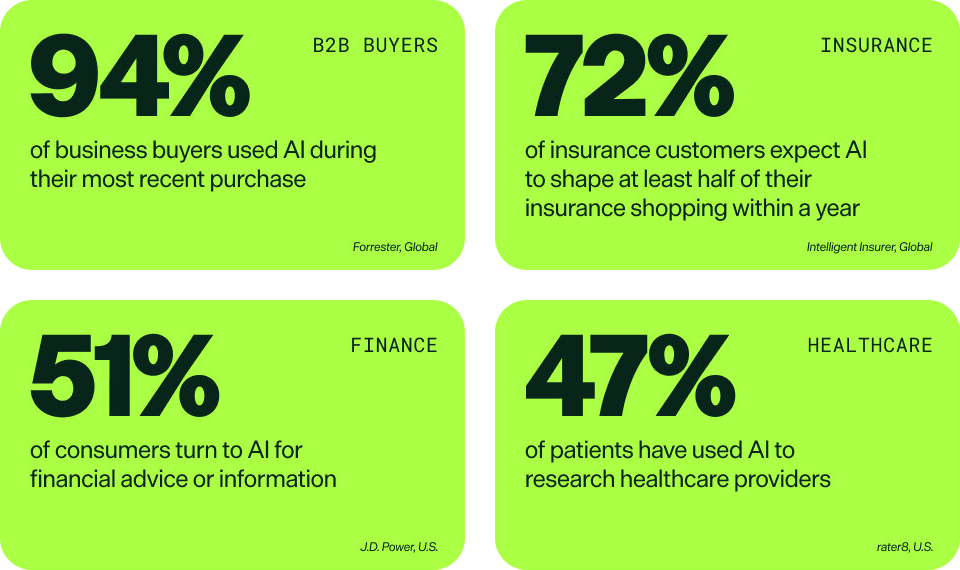
Forrester’s State of Business Buying 2026 report found that 94% of business buyers report using AI in their buying process. Those agents are stand-ins for real people. If a competitor’s site gives agents clear content and actions they can use, and yours doesn’t, the agent takes the easier path. So does the deal.

Consumers are moving just as fast. Last year, we said nobody is going to apply for car insurance on ChatGPT. We stand by that. But most insurance customers expect AI to shape at least half of their shopping within a year, and finance and healthcare aren’t far behind.

Four stat cards: 94% of B2B buyers used AI in their last purchase (Forrester); 72% of insurance customers expect AI to shape half their shopping within a year; 51% of consumers use AI for financial advice; 47% of patients used AI to find providers.

Last year’s dual strategy still stands: build for humans and build for machines. We’d add one more item to the list. Make it easy for agents to act on your site, too.

If a competitor’s site gives agents clear content and actions they can use, and yours doesn’t, the agent takes the easier path. So does the deal.