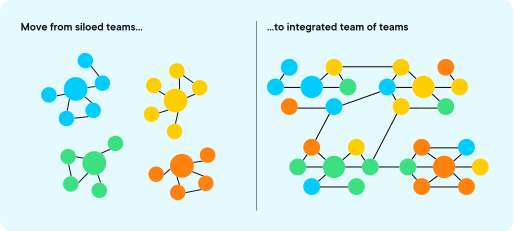
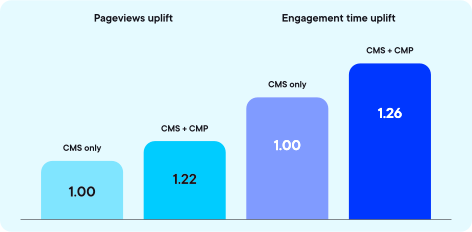
Shared workflows increase both speed and output because they:
- Remove unnecessary handoffs
- Reduce duplication and rework
- Improve clarity around ownership and progress
- Make it easier to reuse assets, templates, and insights
Organizing content for reuse
Most enterprises now manage thousands - often millions - of digital files spread across drives, legacy systems, regional folders, agency repositories, and tools that do not connect. As content volumes grow, this fragmentation becomes harder to manage and even harder to navigate.
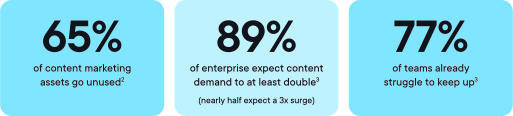
Forbes reports that 60% of B2B content sits unused. Not because it lacks value, but because teams cannot find it, trust it, or identify the latest version.
Unstructured or poorly governed assets undermine efficiency across the content operation:
- Teams cannot find what they need. Hours disappear searching, digging through folders, or asking colleagues to resend files.
- Duplication becomes unavoidable. Without a single source of truth, teams recreate work that already exists, increasing both cost and inconsistency.
- Brand and compliance risks rise. Outdated or conflicting versions circulate across regions and channels, and issues are often caught too late.
- AI systems cannot use your content. Assets without metadata, structure, or clear relationships become invisible to generative models, limiting discoverability and reuse.
The effect is cumulative. Content libraries expand, but usefulness and efficiency declines. Even well-designed workflows cannot compensate for disorganized content, because the materials themselves are not prepared for reuse, governance, or AI-driven interpretation.
Why a DAM is essential for modern content operations
Once the scale and impact of scattered, unstructured assets becomes clear, most organizations reach the same inflection point: there is no way to move faster without bringing order to the content foundation. That begins with a disciplined system of record for every asset.
A Digital Asset Management (DAM) system provides the structure that fragmented libraries lack. Instead of assets living across tools, the DAM becomes the central, governed source of truth that supports every team and every channel.
A modern DAM ensures:
- A single authoritative version of every asset.
- Consistent metadata including titles, rights, product mapping, and lifecycle status.
- Clear relationships between assets and their variations.
- Governance controls that prevent duplication and maintain version clarity.
- Schema alignment that makes assets usable across systems and channels.
This discipline matters because both humans and AI systems depend on clarity to make decisions. When generative models encounter:
- Duplicate content → diluted trust
- Outdated content → brand and compliance risk
- Untagged or inconsistently tagged content → invisible to AI
This means they cannot confidently interpret, reuse, or surface your assets. The same challenges apply to content teams navigating rapid updates, multiple markets, and growing volumes of work.
A well-governed DAM changes this entirely. Assets become discoverable, trustworthy, and ready for assembly across channels. Teams can reuse what already exists instead of rebuilding it. AI systems can understand and reference assets reliably, improving discoverability and enabling automation at scale.
Principles for maintaining a high-quality asset library
Maintaining a well-structured, high-performing DAM is not a one-time project. It requires ongoing discipline to ensure assets remain usable, consistent, and ready for both human and AI consumption.
Five practices make the biggest impact:
Prune aggressively
|
Remove outdated, duplicate, or low-value assets. Consolidate variation so only accurate, approved, and relevant materials remain in circulation.
|
Tag everything
|
Apply consistent metadata across assets: product, audience, journey stage, rights, ownership, and last verified date. Metadata is what makes content discoverable and trustworthy for both humans and AI systems. |
Schema everything
|
Ensure assets include machine readable elements such as alt text, captions, document tags, and schema.org markup. Without these cues, AI systems cannot reliably interpret or reuse content. |
Audit regularly
|
Review high-value assets categories on a recurring schedule, such as quarterly for product or campaign content. Regular audits prevent drift, reduce clutter, and keep libraries in working condition |
Govern ownership
|
Assign clear owners to asset categories so accuracy, freshness, and compliance are actively maintained rather than assumed. |
Cleaning your content house may not feel glamorous, but it is foundational. AI systems cannot use what they cannot understand, and teams cannot reuse what they cannot find. A disciplined DAM turns content from a growing liability into an asset that compounds value across every channel.
Preparing assets for reuse across channels and AI systems
Once assets are structured, tagged, and governed, the next step is ensuring they can be reused efficiently across channels, teams, and AI-driven experiences. Reuse is where content operations gain real leverage. Instead of rebuilding assets for every campaign, market, or format, teams assemble high-quality experiences from trusted components that already exist.
For reuse to scale, assets must be:
- Searchable: Teams and AI systems must be able to locate the right asset instantly. Metadata, schema, and controlled vocabularies make discovery reliable rather than guesswork.
- Interpretable: AI models depend on semantic cues such as alt text, captions, tags, and structured fields to understand what an asset represents and when it should be retrieved.
- Channel-ready: Reusable assets need formats, variants, rights information, and context that support deployment across web, mobile, social, paid media, product content, and emerging AI surfaces without rework.
- Contextually connected: Relationships between assets, such as source files, localized versions, cropped variants, and campaign usage, must be clear so teams and AI systems know which version is authoritative.
When these conditions are met, reuse becomes natural. Production accelerates, duplication declines, and AI systems can assemble, recommend, and repurpose content with far greater accuracy.
Using AI Agents to keep asset libraries reusable
At enterprise scale, reuse breaks down for a simple reason: asset libraries grow faster than teams can govern them. AI agents help by taking on the repeatable work required to keep libraries clean, consistent, and reliable as volume grows.
AI agents can support asset readiness by:
- Enriching metadata at scale (titles, descriptions, keywords, product mappings).
- Adding semantic context (summaries, usage notes, intended audience, journey stage).
- Generating channel-ready variants (crops, format adaptations, supporting fields).
- Normalizing taxonomy so tagging stays consistent and search results stay predictable.
- Supporting localization by translating or tailoring supporting fields while preserving the canonical asset.
- Flagging governance risks early (duplicates, outdated versions, missing rights, inconsistent naming).
The result is a library that stays searchable, interpretable, and ready for reuse, even as asset volume increases.
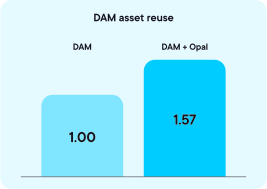
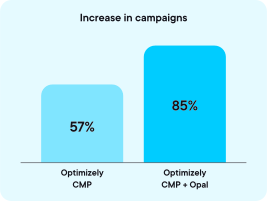
Using AI agents to clean, enrich, and govern assets increases median reuse by 57%.