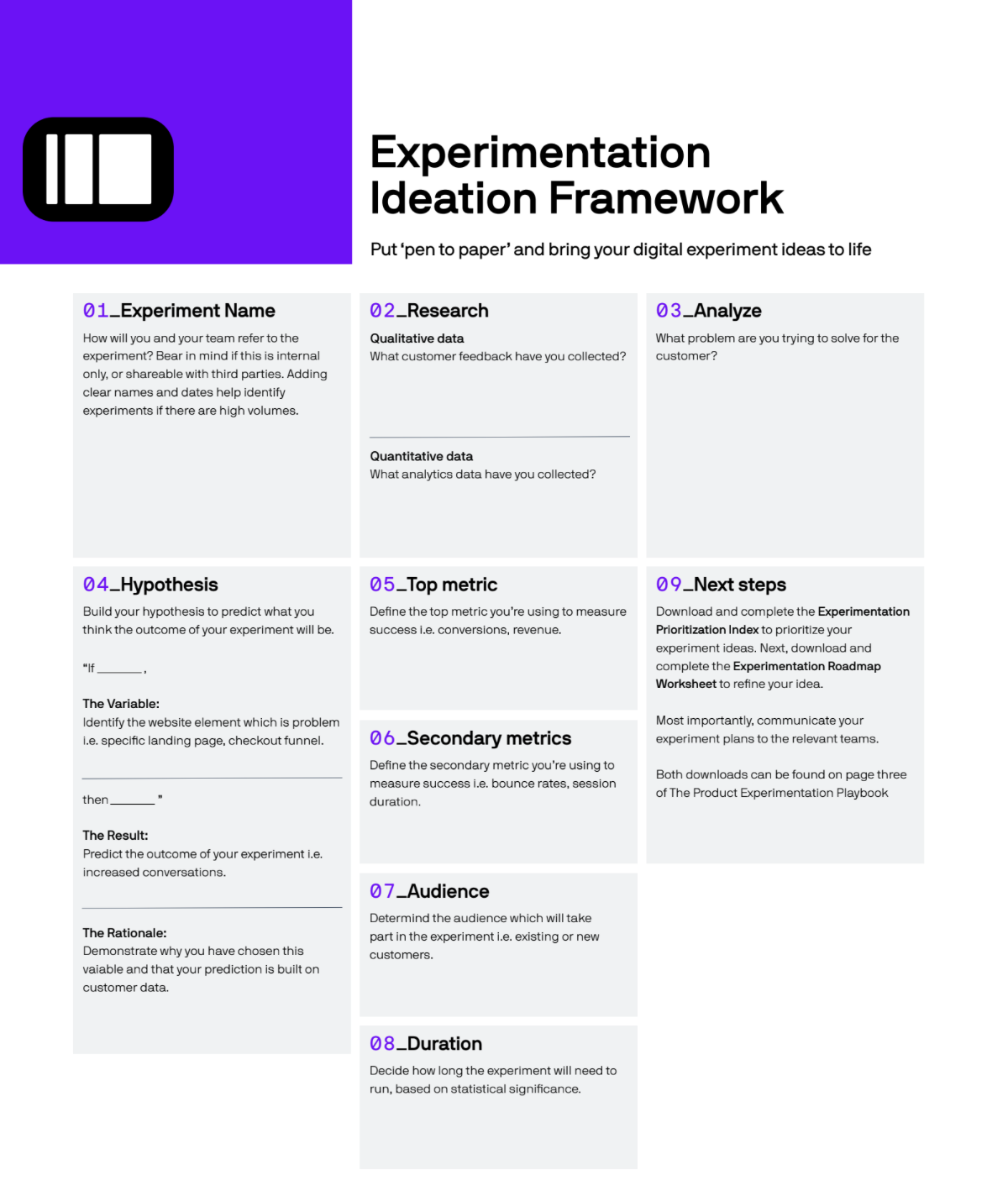
Source: Optimizely
How AI impacts product ideation
AI-powered ideation represents a fundamental shift in how we approach the creation of new software products. Unlike traditional brainstorming, AI can process massive amounts of data and generate insights that would be impossible to achieve manually. This capability provides a clear advantage by spotting patterns, trends, and associations that might remain invisible to human perception alone.
The power of AI in ideation extends beyond simple idea generation—it encompasses the entire process from initial concept to validation and implementation planning. By incorporating AI into your ideation workflow, you can accelerate innovation while ensuring ideas remain grounded in market realities and user needs.
- Idea generation: The creative brainstorming stage where you aim to gather as many ideas as possible without immediate evaluation. AI can dramatically expand the quantity and diversity of ideas generated.
- Prioritization: Evaluating ideas to determine which to focus on first based on impact and available resources. AI can help analyze factors and provide objective assessments.
- Implementation: Building MVPs (minimum viable products) to test ideas before full development. AI can accelerate prototyping and provide predictive analysis of potential outcomes.
Product ideation process
Here’s a step-by-step look into a product ideation process to help you discover and build creative ideas:
1. Define the problem
Understand customer pain points, market trends, or gaps in existing solutions to define the problem or opportunity that your product aims to address.
2. Develop concepts
Turn ideas into more tangible concepts. Focus on those that align closely with customer needs, market demand, and feasibility.
3. Validate
Test the developed concepts to gather feedback and validate their feasibility.
4. Select
Select the most promising concept(s) to further develop into a detailed product specification or roadmap.
9 Product ideation methods
Here are some effective product ideation methods:
- Brainstorming: Gather a group in brainstorming sessions to generate ideas freely without criticism.
- Mind mapping: Visualize ideas and explore connections around a central theme.
- Problem-centric ideation: Identify customer pain points and brainstorm solutions.
- SCAMPER technique: Ask specific questions to stimulate creative thinking about a product. Substitute. Combine. Adapt. Modify. Put to another use. Eliminate. Reverse/Rearrange.
- Design thinking: Engage cross-functional teams to understand user needs and ideate solutions.
- Prototyping: Build quick prototypes and iterate based on feedback.
- Customer journey mapping: Create customer experiences only after incorporating customer feedback to make the buying journey a smooth process.
- Competitor analysis: Study competitors for product ideas and insights into how you can best demonstrate the capabilities of your product offerings.
- Co-Creation workshops: Collaborate with customers and experts in interactive sessions.
These methods focus on understanding user needs and creative products to solve the challenges faced by the target audience.
Product ideation best practices
Here are some best practices for product ideation and building a successful product:
- Engage stakeholders from different departments (e.g., marketing, design, engineering, sales) to bring diverse viewpoints.
- Experiment to compare different variations of ideas and optimize product features based on real-time data.
- Ensure that each ideated concept aligns with a clear value proposition that addresses specific user needs or pain points.
- Consider technical feasibility, scalability, and resource requirements early in the ideation process.
- Evaluate the potential impact on the business, including revenue potential, cost implications, and alignment with strategic objectives.
Handling risks during the product development process
As a product manager, you have to tackle ambiguity and risks.
By relying on assumptions, it becomes guesswork if you're building the right product or feature for your audience.
Imagine walking through a dark forest for hours without checking a compass or map - makes no sense right?
This is why you need to introduce experimentation early in the development process.
Testing your hypotheses early on in the ideation process can make space for bigger and better ideas.
You can avoid assumptions about what matters. Like:
- Who the target users are
- Their needs and pain points
- What value they will get
No doubt with experimentation you can ship ideas your customers actually want to use.