
De Mandemakers Groep

From 12 seconds to one: De Mandemakers Groep's journey with CMS (SaaS)

1s

Page load time

86%

Form completion rate

19 min

Average session length

A legacy CMS forced DMG to have four environments for each of their 17 brands. This mean constant maintenance and slow-moving campaigns. After consolidating with CMS (SaaS), page load times have been cut to a second, and form conversions have risen by a quarter. Their team is now free to market, not maintain.

  • De Mandemakers Groep is moving its 17 brands off scattered systems and onto a single Optimizely CMS, giving its marketing team one home instead of a sprawling mess to manage.
  • Page load times went from 12 seconds to one. Form completions increased by 26%. Same content, same traffic, better results.
  • Every migration has paid for itself. Faster funnels have meant DMG spending its ad budget smarter, landing higher-quality leads, and seeing ROI compound when each new brand goes live.
Industry
Retail
Company
  • De Mandemakers Groep
Products used
Content Management SystemOpalOptimizely OneWeb Experimentation

Seventeen brands, one bottleneck

Tom Sanders is Head of Experience & Conversion at De Mandemakers Groep, a leading interior and kitchen supplier in the Netherlands. His centralized team of CRO specialists, web data analysts, and UX designers exists to make the company's websites work harder. But every improvement they wanted to make ran into the same wall.

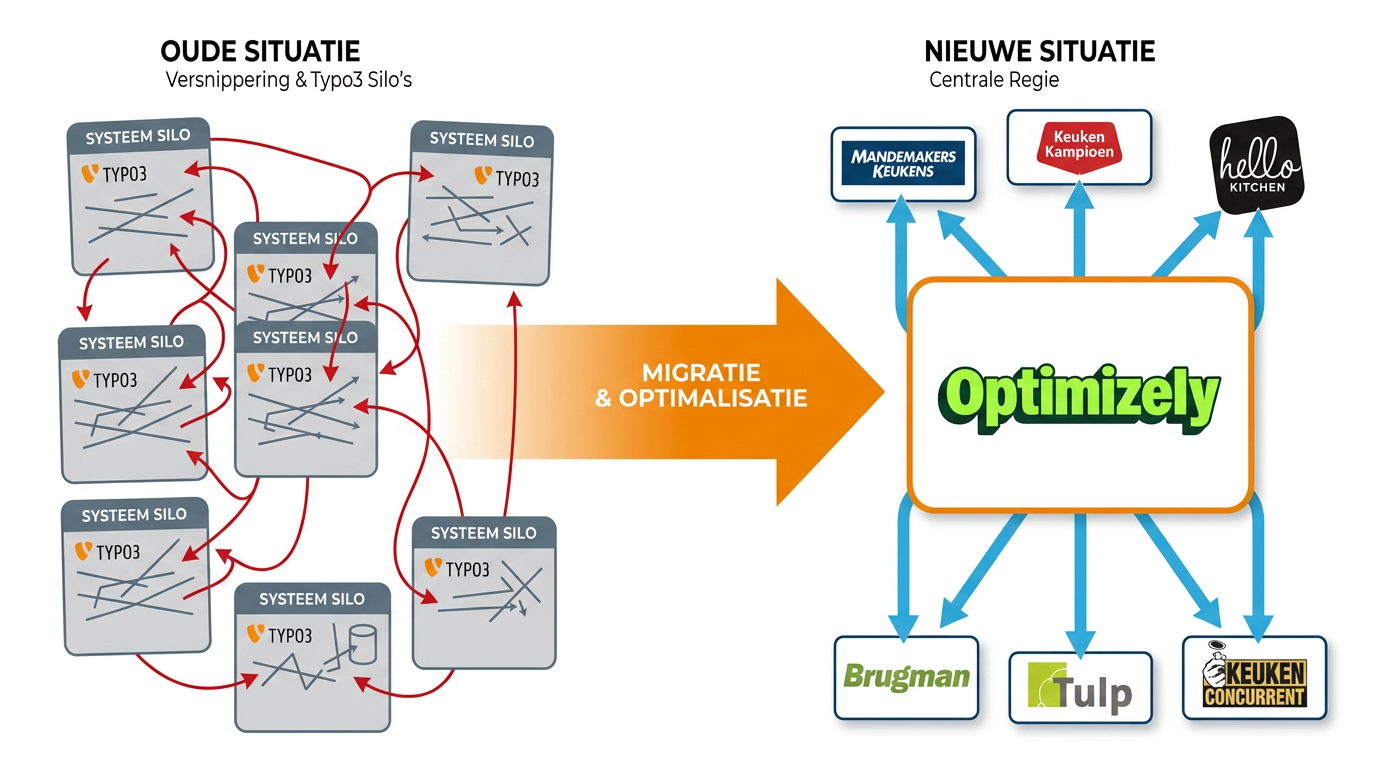
With 17 brands spread across separate TYPO3 instances, De Mandemakers Groep's digital landscape was highly fragmented. "For every brand, we had four environments to keep up to date and maintain—staging, acceptance, testing, and production," Tom explains. A campaign idea would be ready to go, then stall, because building the page meant waiting on a developer. Every change became a ticket in a queue. "Content velocity was simply too slow," Tom notes. His team was spending more time on maintenance than on the strategic marketing and conversion work they were hired to do.
Freedom from the backlog

When De Mandemakers Groep went looking for a new platform, Tom knew exactly what he needed: freedom and agility. "We wanted to keep the focus on marketing, not development," he says. "Development should be integrations or third parties. It shouldn't be the main thing marketers are worrying about."

Some vendors pitched complex, build-it-yourself architectures that meant stitching together multiple tools. De Mandemakers Groep wanted the opposite: one streamlined platform, flexible enough to let its brands shine but simple enough to scale fast. Tom knew that approach could work for other teams, but his team needed to get away from waiting on dev support just to move.

"We wanted to keep the focus on marketing, not development. Technology was getting in the visitor's way"

Tom Sanders, Head of Experience & Conversion

Optimizely CMS answered the question Tom's team had been asking. "The CMS was already there," he says. "It was mature, it had all the functionality we needed, and we didn't have to build it from scratch or stitch suppliers together."

Upgrades, hosting, batch updates: all handled. The maintenance load that had been eating his team's time simply lifted. "If you look at big players, most of the time you're still building your own CMS," Tom says. "With Optimizely, the whole backend is already there, and everything's in one platform." That mattered most for the priority coming down from leadership: keep costs low so budget could go toward work that actually moved the business forward.

Silver linings when migrating

De Mandemakers Groep took a deliberate approach, starting with its flagship brand, Mandemakers.nl. Building a future-proof foundation on Optimizely, paired with a modern, Vercel-powered frontend, meant a highly scalable setup from day one.

The timeline stretched longer than planned. On another project, that might have shaken confidence. Here, it did the opposite: the extra time let the team prepare properly, testing and folding in their own CRO learnings before rolling out further. "By preparing it really well, we could go live really quickly," Tom says. Tulp Keukens, a premium brand, launched at the end of 2025. From there, De Mandemakers Groep entered a "roll-out factory" phase, bringing a new brand live every two weeks. Six brands are migrated so far.

Tom's homemade explainer on migrating from TYPO3 to OptimizelyTom's homemade explainer on migrating from TYPO3 to Optimizely
As Tom illustrates in his diagram above, the result isn't just tidier servers. It's one environment with a shared design system, so anything built once is instantly available to every brand. For the first time, Tom's team could step outside templates entirely, using visual builders to create bespoke campaign pages without a developer in sight. The ticket queue disappeared. Marketing could finally move at its own speed.

Same content, more conversions, less spend

The results were immediate. Running on the Vercel edge network, page load times dropped from around 12 seconds to just one. "Technology no longer gets in the visitor's way," Tom says, a shift that showed up across the entire funnel, including a Real Experience Score of 99/100.

With better tools and newfound confidence, Tom's team sharpened how they measured success. Moving beyond simple visit counts to real form interaction, they watched completion on one of their busiest forms climb from 68% to 86%. Visitors are staying longer too, with average sessions now stretching to around 19 minutes. Less friction means more time for prospective customers to plan the kitchens and bathrooms they're dreaming of.

"Efficiency is the biggest gain we've had from migrating. With the same content and the same traffic, we convert significantly more people into high-quality leads."

Tom Sanders|Head of Experience & Conversion

That performance translated straight into revenue: up to 26% higher conversion rates for key brands. "Efficiency is the biggest gain we've had from migrating," Tom says. "With the same content and the same traffic, we convert significantly more people into high-quality leads." A stronger funnel meant De Mandemakers Groep could scale back inefficient ad spend without losing conversion quality, an ROI that compounds with every brand that goes live.

Capitlization on success with experimentation and AI

With migration running smoothly, Tom's team is turning its attention to the rest of the Optimizely One suite. "My team was delighted to start using Optimizely Web Experimentation," he says, and they're already building a testing roadmap to push conversion further. Beyond A/B testing, Tom sees the real prize in deep segmentation and journey personalization: the right experience for the right visitor, across every brand.

Then there's AI, where Tom gets genuinely ambitious. He's already experimenting with Opal and sees both the promise and the puzzle it presents for a 17-brand business, particularly around removing the friction of different prompts and context per brand. His vision: an AI layer built into content creation itself, with Opal, ODP, and CMP working in concert across every brand, an agentic CMS that does more for his team without more effort.

This isn't a someday wish. Tom is actively steering De Mandemakers Groep toward an agentic CMP, an agentic CMS, and an AI-forward future.

"If your focus is driving marketing results, go with Optimizely," he concludes. "We didn't want to monitor and update a complex software stack. We wanted to get on with marketing. That was our driver, and it's paid off immensely." The infrastructure that once held his team back now pushes them forward. And Tom isn't calling any of it finished: "The website is never done, which is exactly how it should be."

Agentic CMS awaits