A Virtual Teammate is a fully functioning, proactive member of your marketing team; made up of a bundle of agents, workflow agents, and skills. It's not a single AI agent you prompt. It's a teammate with its own identity, its own access rights, and long-term memory, able to act on its own, without waiting to be asked.
It shows up in your team roster, gets assigned work, joins your meetings, and gets things done before you open your laptop.
And that last bit is the whole point. Most AI you've used waits — you open it, you prompt it, you close it. But a Virtual Teammate? It's already working.
Here's what you need to know
Think of the AI most teams use today as a (very smart) temp. Brilliant on demand, but gone the second you stop talking. It doesn't know your brand, it forgets yesterday, and it definitely can't pick up a task while you sleep (sigh).
A Virtual Teammate is the opposite. It's a named member of the team who knows your brand voice, remembers every decision, and carries real responsibilities from one week to the next. Sure, it can answer questions for you but what's really special is that it can hold down the entirety of the defined role you give it.
Oh, and when a VT publishes content, updates a campaign, or analyzes an experiment, the audit trail records who did it with a name and profile — just like it would for anyone else on the team.
This isn't a feature upgrade to AI agents. It's a whole new category of marketing workforce.
Why every marketer wants a Virtual Teammate by their side
Zero surprises here: marketing keeps getting asked to do more with less. More channels, more campaigns; same team, flatter budgets. The pressure is oh-so-very real, and it's coming straight from the top.
As Gartner put it in its 2026 CMO Survey: "CMOs are being asked to deliver growth, efficiency and transformation without meaningful budget expansion… Those who succeed will make deliberate, data-driven trade-offs and treat AI as a force multiplier."
Which is exactly why teams reached for AI when they could. But access turned out to be the easy part. In Optimizely's 2026 Global AI and Marketing Study — a survey of 2,000+ B2B marketers across seven countries — 76% of marketers said they spend three or more hours every week fixing, editing, or fact-checking AI output. Only 4% said AI genuinely saves them time at every stage of the marketing lifecycle. The time AI was supposed to hand back is (sometimes, unknowingly) getting soaked up elsewhere.
And that right there, is the real bottleneck. Not access, but the process of making AI actually work as part of your team, on a schedule, inside your tools, without a developer and a whole week of set-up.
Cue: Virtual Teammates to save your day.
How is a Virtual Teammate different from an AI agent?
Everyone is talking about AI being your 'handy assistant' or your 'newest teammate', which admittedly, does sound nice on a slide. But in the real world, standalone AI agents are a long way from being actual coworkers.
Optimizely's Virtual Teammates are on a different level entirely.
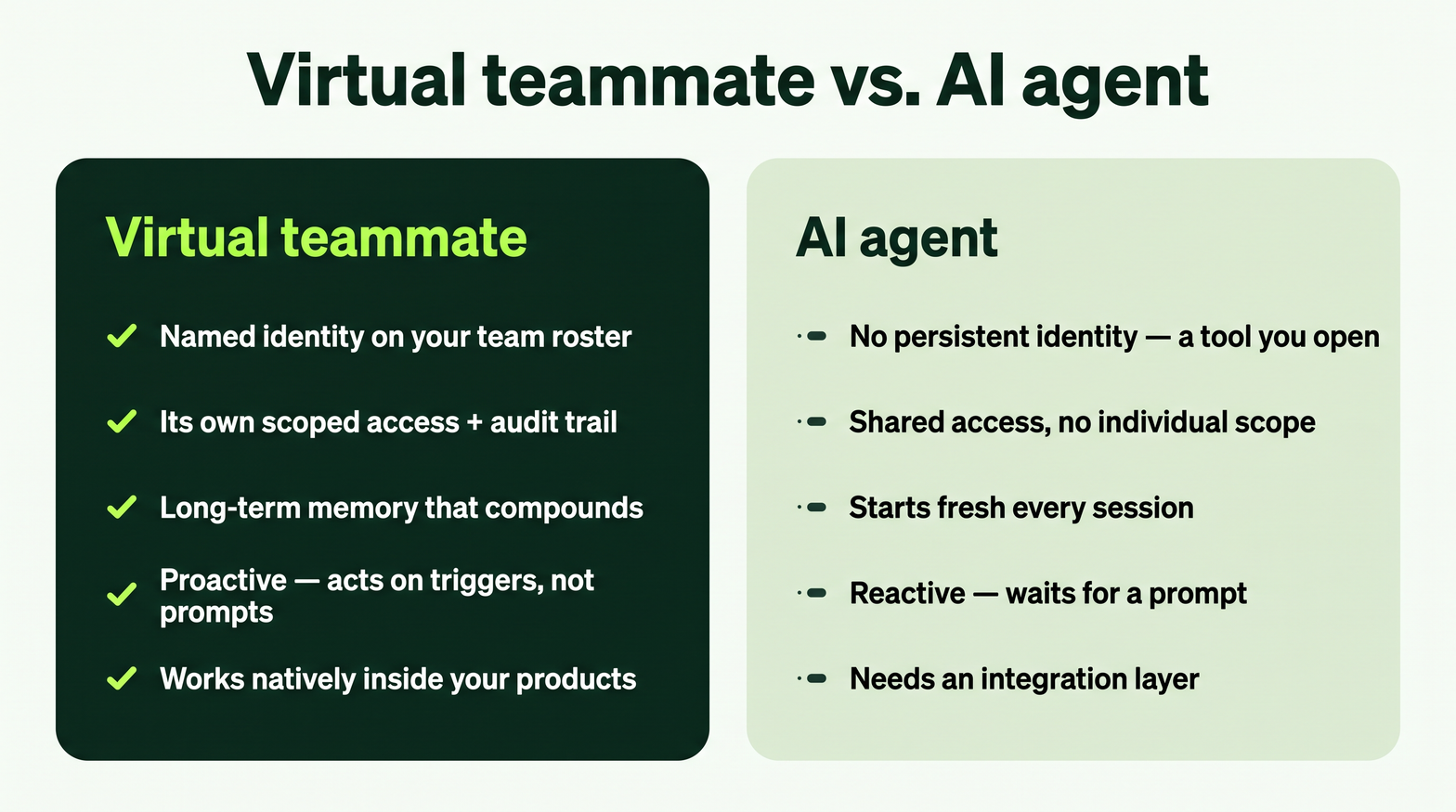
The difference is about both structure and collaboration. An agent is a single tool — something that writes code or another thing that drafts copy. You open it, you prompt it, you close it. It has no memory of what happened yesterday, no independent access to your tools, and it does absolutely nothing until you spell it out in a prompt or instruction.
A Virtual Teammate is the whole worker; it's a teammate who works with you, in the way you want, and with the tools you use.
Here are the specifics on the 5 main differences between a VT and an agent:
1) Real team identity: Every virtual teammate is a genuine user with a name, an email, and a place in your admin center. It appears in team lists and workload views. It can be assigned a workflow step. It's governed and offboarded like any other member of the team.
2) Its own access rights: Not the shared-everything model of conventional agents. Each virtual teammate has individually scoped permissions, set in plain English, with a full audit trail tied to a named identity. Autonomy, but always accountable to a human.
3) Collaborative ability: Virtual teammates are collaborative by nature. They can collab with humans in chat and on calls (yep, on the meetings that should have been an email), as well as collab with other virtual teammates.
4) Long-term memory: It remembers your brand voice, your team's conventions, your approval history, and what your CEO can't stand. That context compounds. The longer it works with you, the sharper it gets — no retraining required.
5) It's proactive by default: It acts on schedules, triggers, and events, whether or not anyone's talking to it. Work keeps moving while you're in a meeting, asleep, or on vacation. It flags a campaign going off track. It drafts the next brief based on what the last one taught it.
What can a Virtual Teammate actually do?
The best way to understand the category is to watch one at work. Here are just a few things a Virtual Teammate can do:
- Send you a nightly brief in four, quick sentences
- Join your meeting and take notes while you present
- Keep you posted while you're on vacation, without interrupting it
- Pick up an assigned task and finish it
- Remember what phrases your CEO hates and flag it before you hit send
- Brainstorm positioning with you at 11pm when no one else is around
- Watch a campaign and raise a flag the moment something drifts
- Turn every meeting you missed into a 60-second read
- Apply your brand voice without being told
- Publish content when it clears the quality bar
- Analyze experiment results and surface the one insight that matters
- Draft the next brief based on what the last campaign taught it
Read that list and one thing probably lands: this is nothing like the agent you built or talked about last week.
The big question: Is this about replacing your team?
One word, two big letters: N O!
A Virtual Teammate takes care of the sludge work (nice), but also with its define role (and self-learning capabilities), has the expertise you need to hand off when you don't have the capacity.
Never-ending messages on Slack on deadline day? Add your Virtual Teammate to the group chat. Meetings that could have been an email? Let your Virtual Teammate take that for you. Those emergency texts while you're on PTO? Not any more — your VT will pick that up so you can keep sipping that cocktail by the beach, no interruptions.
For leaders, Virtual Teammates show up where it counts: in your headcount model, your pipeline, and your growth — not buried in a productivity report nobody reads.
For the marketer, it's simpler. You ship more than you ever have, with virtual teammates being the support you've always deserved. The faster the world moves, the more good marketers it needs. Your role gets more important, not less.
How it works
Getting a Virtual Teammate up and running takes days, not the months a new hire needs to ramp. No prompt engineering course necessary, and no developer on standby.