
Rebuilding a website in the age of AI agents

Keith MatthewsKeith Matthews
Oct 6, 2026

The lessons Optimizely learned rebuilding a 1,700-page website

Can't you just vibe code this in two weeks?

If you're leading a website rebuild right now, you've probably heard some version of that question. Ask ChatGPT how long a full rebrand and replatform should take, and it'll cheerfully tell you two weeks. Ask a development agency, and you'll hear 18 months and half a million dollars. The truth, as always, sits somewhere in the uncomfortable middle.

Nobody knows that better than Michiel Dorjee, Director of Digital Experience, who just spent the better part of a year rebuilding optimizely.com from the ground up (new brand, new platform, new content model) with a team of two developers. He sat down with Naz Ramezani, VP of Product, at our latest Content & Beyond session, and separately caught up with us for a few follow-up questions once the dust had settled.

Asked how confident he's feeling a few weeks post-launch, on a scale of "macaroni logo" (his nickname for Optimizely's old brand mark) to "full avocado" (the new one), Dorjee didn't hesitate: "smashed avocado toast." Translated into something more useful for the rest of us: he puts the team at about 80% of the way to where they want to be. "It was also kind of an unlock, so that we're able to do a lot more things on the new site," he said. "It's not necessarily that this is the ultimate version of the website and we're just closing shop. We're still actively building on it."

Here's what he'd tell you if you're about to start the same journey.


1.  AI didn't build the website. It changed where the team spent its time

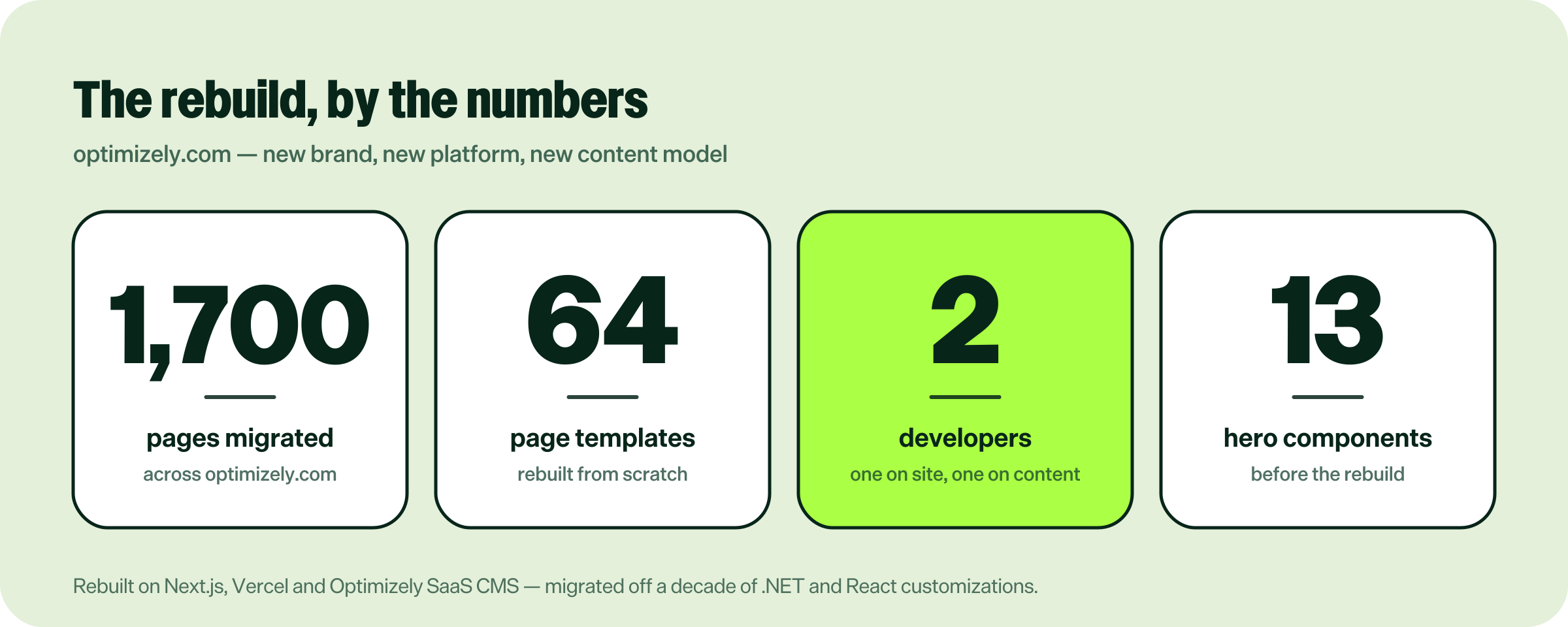
The site itself is not small: roughly 1,700 pages, 64 templates, migrating off a decade of .NET and React customizations onto Next.js, Vercel, and Optimizely's own SaaS CMS. And it happened with two developers: one building the actual site, and Dorjee running the content and migration side of things.

The clearest before-and-after example he points to isn't glamorous. It's the unglamorous slog of a full rebrand. "We didn't just migrate our website to SaaS," Dorjee said. "There was a lot of stuff that had to be updated in content, including images and text." Scanning an entire 1,700-page site for every place a piece of content, an image, or a mention needed to change for the new brand, while preserving the original meaning of each page, is exactly the kind of tedious, high-volume work AI is built for. "AI is pretty good at keeping the context of the original sentences and images and understanding what the idea is behind the content," he said. "That was super helpful to manage the project." It's also, in his estimate, the difference between needing two developers and needing an entire agency team: "I don't think we could have done it without some form of AI."

Where AI ran into a wall was image generation, specifically composing on-brand images from pre-approved components in a templated way.

It could build a landing page. It couldn't really design a landing page.

Michiel Dorjee

There's a reason for that gap: a good landing page follows visual principles (the eye tracks in a Z or an F pattern, for instance) that you can instruct an AI to follow, but it will never approach the problem quite the way a human does. "Even if you wrote the longest prompt, you're essentially trying to feed it your creativity," he said. His conclusion wasn't to keep trying to force AI into that role, but to redirect the team's energy: "You're just better off making really, really good tools for internal people to use." His stated goal for the team was never to become "the most technical team you've ever met," but the most efficient one. A beautifully engineered template nobody on the marketing team knows how to use is, in his words, a tree falling with nobody around to hear it.

2.  The design system is the real unlock for people and for agents

Before the rebuild, Optimizely had accumulated 13 different hero components across the site. Each one looked fine in isolation. Together, they were a trap: pick the wrong one for a new page and it wouldn't quite work with the rest of the template; try to change a shared button, and image rendering somewhere else would mysteriously break.

The fix was atomic design, applied strictly. "Every heading is always the same. Every button is always the same," Dorjee said. Instead of composing pre-built blocks (a heading-plus-button-plus-text "hero") for every scenario, the team broke every element down to its smallest reusable piece first, then composed pages from those pieces. The payoff isn't just fewer bugs. "If we do an experiment to improve the design of a heading, or a button, more likely, we know what to target across all pages," he said. "We don't have to create something that supports 13 versions."

That same rigor is what makes the system legible to AI, not just to marketers. Dorjee offered a live example of where an agent gets it wrong without that structure, and without brand context. Ask a generic AI model how Optimizely should improve its conversion rate, he said, and "nine out of ten times it's going to tell you: add a 'no credit card required' free trial to the website." It's solid advice for a self-serve SaaS product. It's the wrong advice for an enterprise platform like Optimizely, and the AI has no way of knowing that unless it's told. 

AI are essentially people pleasers.

"If they give you an answer that you really want to hear, it did a good job — so it's doing everything in its power to do that." Feed it the actual brand guidelines, personas, and business context, and the recommendation changes entirely. Skip that step, and "it's just using what someone put on Reddit."

That's also, in Dorjee's view, why marketing use cases are a poor fit for the fastest, least-supervised AI workflows. "I would rather prefer an AI to be slower but more accurate in the marketing use case, than faster and less accurate," he said. "There's no room to show up as a brand with a lot of mistakes, typos, and off-brand things." He frames it as a classic project triangle: fast, cheap, or good, pick two. "AI has made things really fast and relatively cheap, but not very good," on its own. The design system and brand context are what push the third point of that triangle back into reach.

3.  Don't lift and shift: rebuild the content model for humans and agents

Optimizely's resources section didn't just get a new coat of paint. It got a new name, and a new job. It went from “Insights” to “Field Notes,” and the reasoning behind that says a lot about how the team thinks about content now.

“Insights was never my first choice,” Dorjee admitted. The team had considered “Field Notes” years earlier and settled for the more generic name instead. The problem the rename solves is structural: it forced a real content model onto what had quietly become “an unshaped blob of things”: blogs, videos, ebooks, webinars, customer stories, all loosely filed under one banner with no real identity of its own. Giving it a proper name changes that. Dorjee's analogy: Apple could have called the cutout at the top of the iPhone screen “the camera area.” Instead they called it the Dynamic Island, a naming choice that signals, on purpose, that this is a feature worth talking about. “By calling it Field Notes, we're signaling content is important to the future of the company,” he said.

It's also solved a practical, internal problem. “A lot of people before said things like, why isn't events in the menu? Why isn't the blog in the menu?” Dorjee said. Giving the whole category a real identity, a destination people can name and return to the way they'd name a favorite app, made it feel natural for all that content to live under one roof. “People can say, 'I like Field Notes.' They can't really say, 'I like your resource portal.'” It's a shift Dorjee ties to how the best digital teams operate generally: companies like H&M and the BBC, he noted, don't treat their website as a marketing afterthought. They run it like a product, with the same ownership and standards. “Field Notes is a product that we deliver,” he said. “I think you're going to see more of that — how do we trickle that down into everything we do.”

The deeper shift behind all of this is who, or what, is consuming content today. With generative engines summarizing material directly in search results, digital teams can no longer measure audience reach solely through pageview tallies.

-12%

Annual dip in standard page views across CMS customers as zero-click summaries intercept visits.

8%

Average organic click-through rate when an AI overview appears, versus 15% on standard SERPs.

69k

Live user search queries tracked to quantify the drop in click-through behavior.

This divide between traditional SEO and answer engine optimization (AEO) explains why Optimizely's digital team reorganized its content strategy. When autonomous agents synthesize and deliver the answers, structured content models—atomic components, rigorous taxonomy, and interconnected glossaries—become far more vital than vanity traffic.

What we'd do differently next time

None of this happened in two weeks, and none of it happened because AI was pointed at a button and told to go. Asked what he'd build first if he started the whole project over tomorrow, Dorjee didn't pick anything flashy: "I would probably work on the forms first. Form data is always very hard for a B2B company to fully figure out — where does it go, how does it work, what do you want to do with it. I always try to tackle the hardest problem first, then everything else kind of revolves around it." The fun, visible stuff (the animation, the interactivity) comes after.

It's a fitting note to end on. A small team moved fast because it decided, upfront, what quality looked like: a real design system, a real content model, a clear-eyed view of what AI is and isn't good at. Then it used AI to move faster inside those guardrails, not instead of them.