Instructions, not clues
When your assistant "uses" a website today, it reads the page the way you would. It works out the layout, guesses which button does what, and hopes nothing shifts before the task is finished.
If you have ever talked a parent through a form over the phone, you know how this goes. "Okay, there should be a blue button near the bottom. No, the other one. Did a new screen come up? Can you read the first line, so I know what page this is?" It mostly works, until it doesn't. It is also slow, fragile, and weirdly tiring, and nobody in the conversation is senseless.
Every popup, dropdown, and form change is another chance to misread the site. That's usually what happened when your assistant stalls and hands you back a link.
Now picture the website meeting the agent halfway.
Instead of making the AI inspect a page to work out what's possible, the business publishes a list of things you can do there. A restaurant might offer "check availability" and "book a table." A store might offer "search products," "start a return," or "track an order." The business writes that list itself, which means it's current and stops at whatever the business decided to offer.
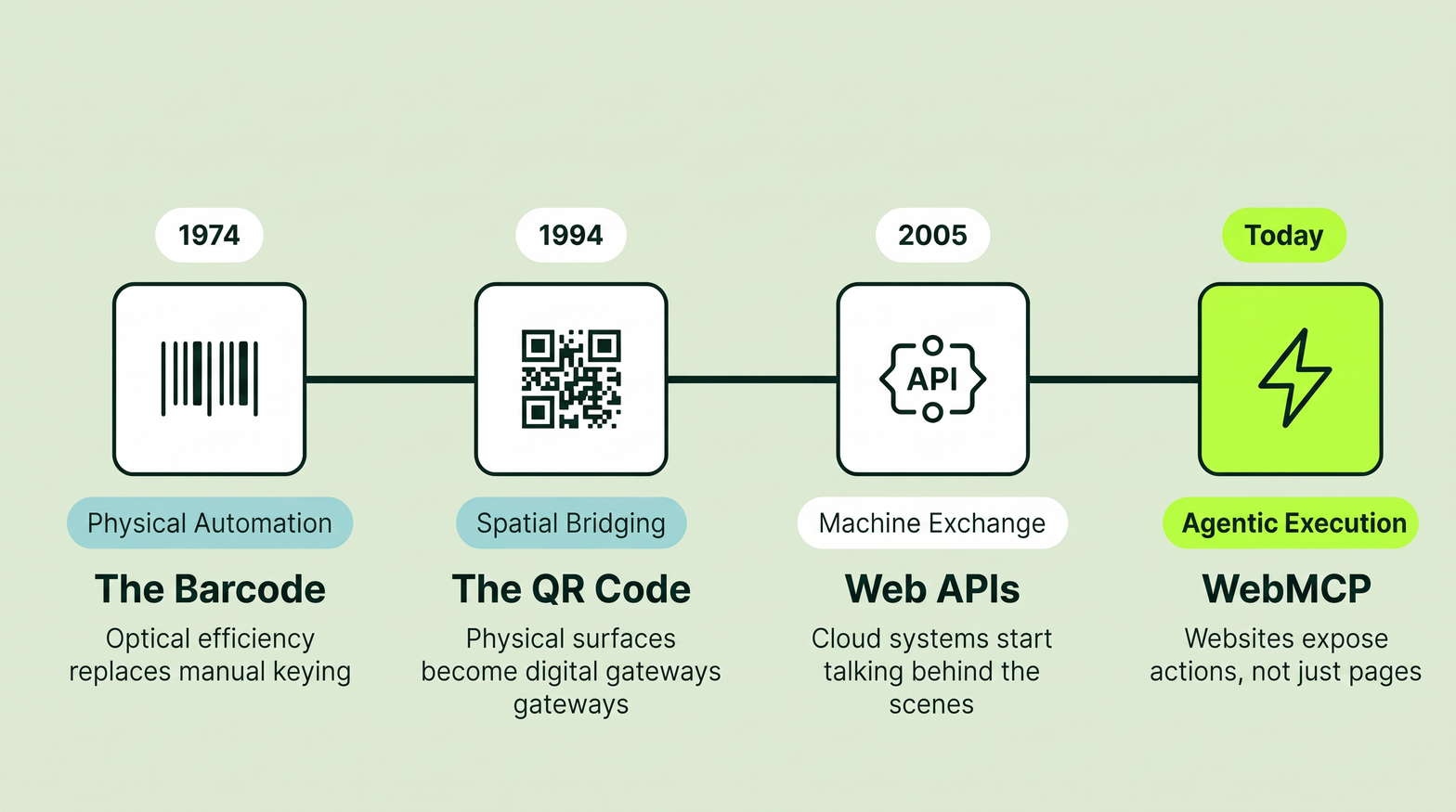
Think of it as the agreement behind the actions. The same way the UPC was the agreement behind the lines. Instead of an agent guessing what a button means by reading a page built for humans, it calls a capability the business chose to expose.
Cloudflare has a preview that can put a WebMCP interface on a site without touching the site's own code. OpenAI is currently hosting a public ten-day hackathon on WebMCP-enabled websites. This is not a research paper waiting for someone to pick it up. It is moving.
The demand underneath it is already here. People are asking their assistants to finish tasks, and the assistants keep failing at the last step.