When product met marketing: We watched. We took notes. We built.

Leah MessengerLeah Messenger
Sep 27, 2026

A product team's take on marketers as they built Virtual Teammates *for* marketers (warning: may include some harsh truths)

When product met marketing, nobody expected it to turn into a multi-month marketer personality study. But hey, here we are.

Marketing is a job spent studying other people. What they search, what they click, what they skip, which words make them act. We research the audience, we write up what we found, we recommend what should change... then we go again.

Being on the other side of that is less familiar.

But that's exactly what happened here. Over the past few months, the product managers building Optimizely's Virtual Teammates spent their time doing something slightly unusual for a product team: they talked to marketers.

Wait, what are Virtual Teammates? A Virtual Teammate isn't an AI agent that you continuously have to prompt with a specific input to get a specific output. It's an AI teammate that collaborates with you and your team, proactively keeps work moving, and has role-based responsibilities. They're always working, helping keep your site optimized, personalizing campaigns, running experiments, and more.

☝️ This meant a one-off chat or a two-hour workshop with an abundance of color-coded sticky notes would not be sufficient. This called for real, ongoing, sometimes-seemingly-endless conversations where you stop taking notes and start listening.

Basically, an immersive experience into the day-to-days of content teams, web managers, ABM specialists, digital connoisseurs, and more (AKA the people who'd eventually be managing these Virtual Teammates). It just had to be that way; the conversations had to come first, and the product had to follow.

A Virtual Teammate without genuine domain expertise isn't a teammate — it's just a chat window with a name badge, twiddling its thumbs until you ask it a question. 

A lot was learned about the wild and mysterious marketing species during this process. So, naturally, we got our talented product team to spill the beans. Here's what they told us:
 

1

Marketers will hand over the chores, but never (ever) the craft

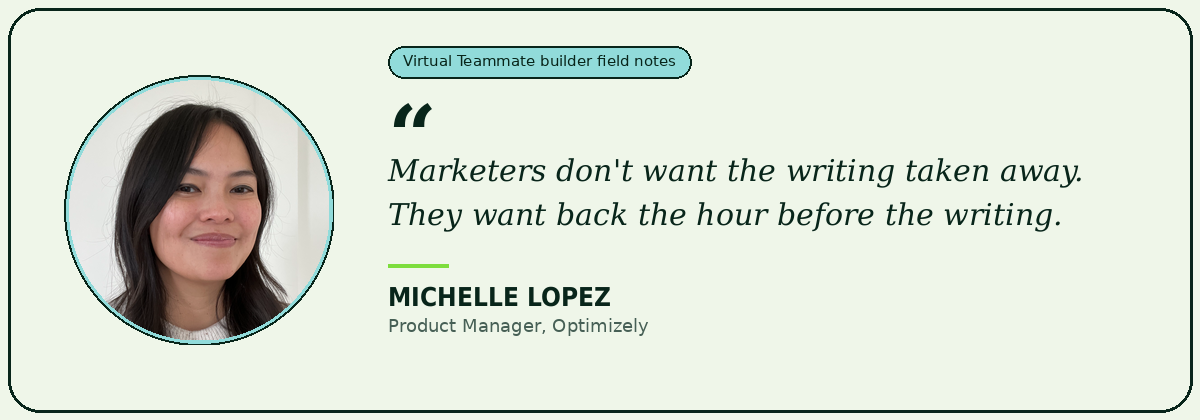
builder_card_michelle_lopez.png

Here's the assumption most people make about AI and marketing: we want help with the hard, creative, blank-page part. Write me the thing. Make me the asset. Save me from the cursor blinking at 4pm on a Thursday.

Wrong. Aggressively wrong, apparently.

Michelle Lopez was deep in those conversations — talking to content marketers for months while shaping the Content Marketer Virtual Teammate. It wasn't a round of structured interviews, but a sustained, recurring back-and-forth, circling back to the same topics until the real frustrations surfaced. The reaction to anything that touched the creative work was immediate:

Content Marketers were vehemently opposed to AI taking the 'fun' and 'creative' side of their job. Job ideas that outsourced content creation received negative feedback. The majority really hated the idea of a Virtual Teammate auto-creating content without a human in the loop.

And then, in the same conversations:

Though many admitted using AI for brainstorming and a first pass of content.

We're a complicated bunch, aren't we? But that contradiction is actually very real of us: sometimes we do draft with it, but sometimes we want to feel all the feels and see where our own writing takes us. The latter doesn't usually thrive in the SEO play for a 'What is X' page.

Despite this confessional, it's clear that marketers (namely, content marketers here) are protecting that final draft of that 'feels' content; the bit that everyone sees and judges. 

And yet — only 30% of marketers believe their brand voice is genuinely unmistakable, with one in seven admitting if you swapped their logo for a competitor's on a piece of AI content, customers probably wouldn't notice.

That's an issue, and the exact reason why marketers ideally want to hand over everything that surrounds the writing. Michelle's phrase for it is perfect: the "grunt work of content marketing."

These are time-consuming chores that nobody thinks about. Auditing the content library and finding the right assets. Project management tasks like creating briefs, finding consistent alignment between teams. That ends up eating into the time required for creative work.

So the Content Marketer Virtual Teammate doesn't sit there waiting to write your blog. It tracks your industry, watches what competitors publish, spots pipeline gaps, and turns what it finds into task briefs with suggested assets attached. It'll draft, but only when you ask it to. It nudges you about the thing you said you'd follow up on three weeks ago and didn't. (Hard relate, but don't tell my boss).


2

Trust takes about three wins, and it needs the receipts

builder_card_kathy_copeland (1).png

In my head, marketers would need a very long courtship before letting anything run without supervision. Months, quarters, a steering committee — the works. 

Anna Pleshakova in the Product team found almost the opposite:

Marketers will trust AI to do a lot, but only after they gain trust and see it succeed a few times. It's not as many times as you might think. So human in the loop is required at first, but after trust is gained, the workflow can become much more autonomous.

They do say three dates is enough to tell if you want to keep seeing someone, don't they...

But clearly, the trust has conditions, and the team could only learn what those conditions actually were by staying in the conversation long enough for us pesky marketers to stop acting like we're oh-so-confident and start saying where they're genuinely nervous about some things. 

Kathy Copeland (also in Team Product) built the Web Manager Virtual Teammate for the more technical users, and the threshold finding that shaped the whole product came from exactly that kind of sustained dialogue:

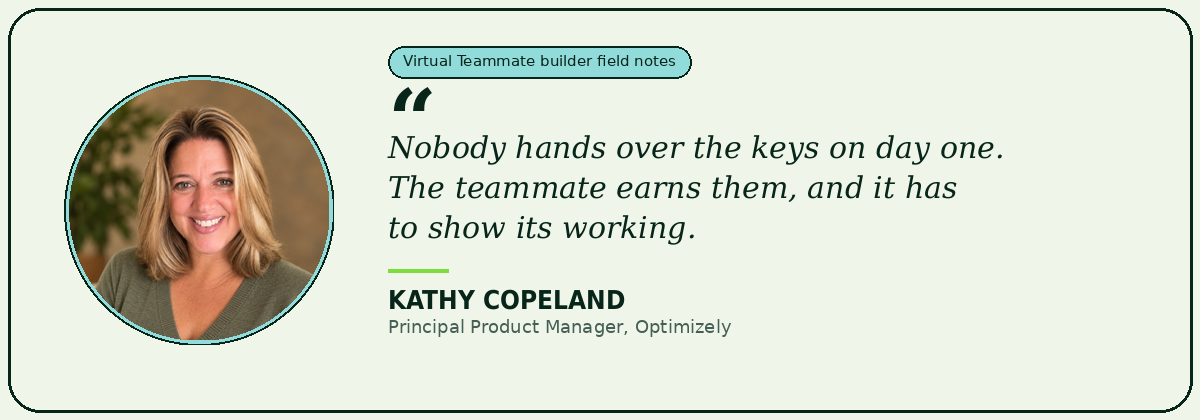
I cannot stress enough the trust factor. Until it has proven itself a member of the team, human in the loop is absolutely essential. And for the Virtual Teammate to report what it has learned regularly and provide evidence of that learning is critical in building that trust.

Evidence of learning. That phrase did a lot of work in how these things got designed and built out. A Virtual Teammate that improves invisibly is — to the person using it — indistinguishable from one that doesn't improve at all. It has to show you.

Kathy's team went further and made autonomy something the teammate has to earn numerically:

We established a threshold for learning for Web Manager where if it repeats an action up to and including that threshold, then and only then can it consider auto-fix without human in the loop.

Fix the same problem correctly enough times, and you're allowed to fix it alone. I love this because it's the same deal we give new hires. Nobody hands you the keys on day one... you get them after you've proven you won't drive into a wall.

Maheen Neha found the same pattern in the Translation Virtual Teammate, where the cost of a confident mistake is public, permanent, and a little bit embarrassing:

Human in the loop is very much in the picture, and most people agree on not directly publishing the changes, but rather pointing out the differences and approving them.

There are a lot of people who skipped the trust-building phase (read: they believed everything they saw on LinkedIn, got FOMO, and just went for it so they wouldn't be left behind), and are now having to reverse-engineer it. 

No joke, 65% of marketing leaders said they'd consider pausing their company's AI rollout for 90 days to reset the strategy. 


3

Fear's got a dollar sign attached to it

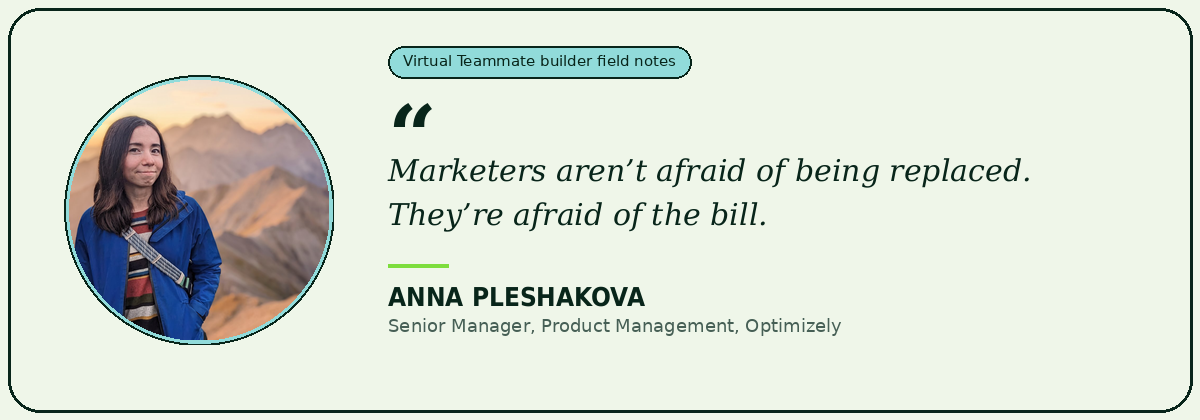
builder_card_anna_pleshakova.png

Every survey about AI and marketing asks the same question: are you worried about your job?

And, no surprises, there was a hint of that. But marketers were also worried about something else entirely. Anna found:

The primary concern is not AI doing more for you and replacing your job. It's actually mainly the associated cost.

The budget math explains why cost sits at the top. Gartner's 2026 CMO Spend Survey found CMOs now put 15.3% of marketing budgets into AI, while total marketing budgets sit flat at 7.8% of company revenue. A growing AI line item inside a flat budget means something else got cut to pay for it. Everybody in the building knows which line that was.

Kathy saw the visible half of the problem from the technical side, and framed it as a trust issue rather than a budget one:

Our customers are becoming more and more aware of credit usage and performance, so it is imperative that part of our quality guidelines include these measures. Otherwise we will be accused of 'burning credits,' and that eats away at the trust factor.

That's sharper than it looks. An inefficient Virtual Teammate doesn't just cost money — it signals that nobody's minding the store. If I can see it taking six steps to do a two-step job, we stop believing it knows what it's doing, and we start watching it (with hawk eyes) again... defeating the entire point.

Kathy also has the cleanest articulation of the design principle underneath all of this:

The ONE thing that drives the Virtual Teammate is to make the human's job easier, better, faster so that the human can do more important things. The whole purpose is to cut through the noise and help humans focus on the most important tasks.

4

"Time saved" is a vanity metric

Marketing has a long and proud history of measuring the things that are easy to measure. Impressions, sessions, tasks completed, hours saved — all that good stuff. But when it comes to monetary value? That can get stickier.

Anna called this out directly:

Having the Virtual Teammate do things for you is only effective if you can measure the impact of those changes on your site conversion rate, business revenue, and other tangible business outcomes. Number of tasks completed and time saved are not necessarily as important.

She's right, and our study explains why the metric is so slippery. Only 4% of marketers say AI genuinely saves time at every stage, and 54% say leadership underestimates the human effort AI requires.. The hours don't disappear from your to-do list, they just move to a different part on your to-do list. Out of drafting, into reviewing; out of creating, into checking. 

Saying "I saved eleven hours this month" to a CFO produces a polite nod and nothing else. Saying "these changes moved conversion rate" produces a budget.

Michelle heard the same wound from a different room:

What was consistent: the pain point of how difficult it is to tie content back to the marketing funnel, trace its effectiveness to won opportunities. In particular, lack of visibility into their CRM was a big frustration.

Two different teams, two different tools, identical problem. Everyone can see what they made. Almost nobody can see what it did. The Content Marketing Institute's 2026 B2B research puts a number on it: 80% of teams producing thought leadership measure audience engagement, and only 63% track business impact like leads or pipeline influence.

There's a related finding buried in Michelle's research that deserves its own paragraph:

Content marketing looks really different across orgs. No standard content libraries, formalized workflows, or even metrics.

Every conference talk assumes there's a standard way to run content marketing. But really, there isn't. There's your way, held together by a spreadsheet and one person who knows where everything is.


5

Memory and self-learning are the attention-grabbers

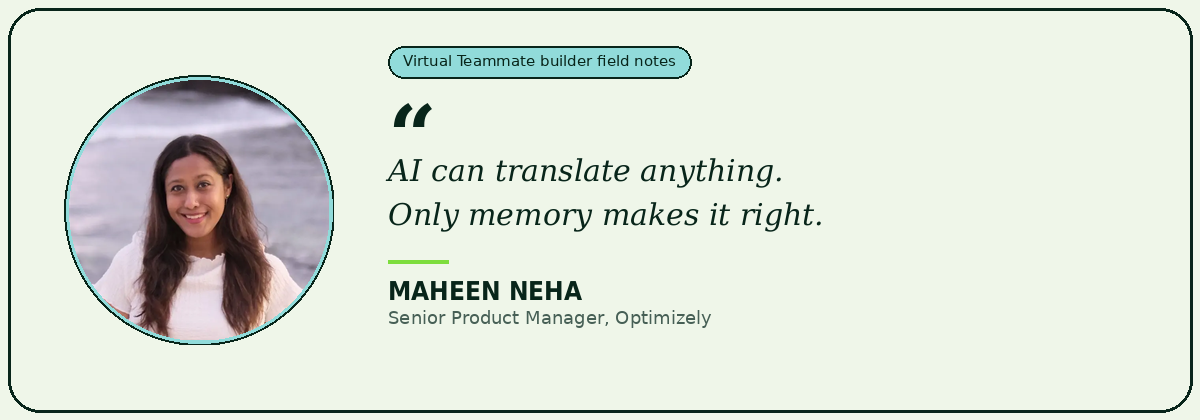
builder_card_maheen_neha.png

If you're asking what makes a Virtual Teammate different from an agent or chat window, here's what Anna has to say:

I think its number one value add and differentiator is its long-term memory and context about you, plus its proactive nature. It was interesting to learn how a Virtual Teammate's memory is architected.

This is also why the conversations had to be real and had to dive deep. A Virtual Teammate carries specific knowledge — of a role, a workflow, a set of working instincts — that a product team can only build by staying in dialogue with the people who hold that knowledge. Neha's translation work is the clearest proof of what happens when you do:

While AI can translate in bulk, if the quality and context don't match, then a long time goes into fixing and verifying those. As the Virtual Teammate gets trained and its memory improves, it knows better how to handle those changes.

She built skill after skill to hold the rules in place. Things like:

  • What never gets translated
  • Which term maps to which in CA-FR versus FR
  • Brand tone that has to survive the jump between languages

All the rules that could only be surfaced because she was in extended, real conversation with the people who held them — and patient enough to keep going until the full picture came through.

It's also hard to verify quality without being native in a language. I took websites like Honda, Sephora, and IKEA, targeted a language, translated with different AI models, then compared with their original website versions, and found out how tricky it can be.

That's a real test with real brands, and it produced a real answer: fluency isn't the hard part. Remembering your rules is.

Kathy adds the structural version of the same point:

Multiple tools are always going to be part of the landscape. The more information we can compare and analyze, consolidate, collapse, and streamline, the better. Continually finding ways to centralize the data and access to it is a critical value-add.

Another stat from our recent AI and marketing study: 81% of marketing leaders switch between two or more disconnected tools every week. And 40% named copy-pasting between disconnected tools as one of the biggest drains on their time.

That's the real job description for most marketers right now: human API. Ferrying context between systems that won't talk to each other, holding the brand rules in your head because there's nowhere else to put them.

Consider your Virtual Teammates the ones that can hold everything in one place (with minimal stress and absolutely no complaining).


So, what did we learn about marketers?

We protect the creative work and resent the admin. We trust faster than anyone expects, as long as we're shown the evidence. We worry about the invoice more than the org chart. We measure what's easy and wish we could measure what matters. And most of us are running bespoke operations held together with goodwill and a spreadsheet, nothing like the ones in the keynote slides.

None of which would have made it into the product without the conversations. An agent that simply automates tasks doesn't really need to understand any of this — not in this depth anyway. A Virtual Teammate that's supposed to function as an actual colleague — with real knowledge of the role, the creative investment, the pressure, the fear of the invoice — does. And the only way to build that is to ask, listen, and keep going until you've heard enough of the actual thing.

Find out all about Virtual Teammates and see what they can do for you.

Thanks to Kathy Copeland, Maheen Neha, Michelle Lopez, and Anna Pleshakova — for the field notes, and for the conversations that made any of this possible.