Image source: Optimizely
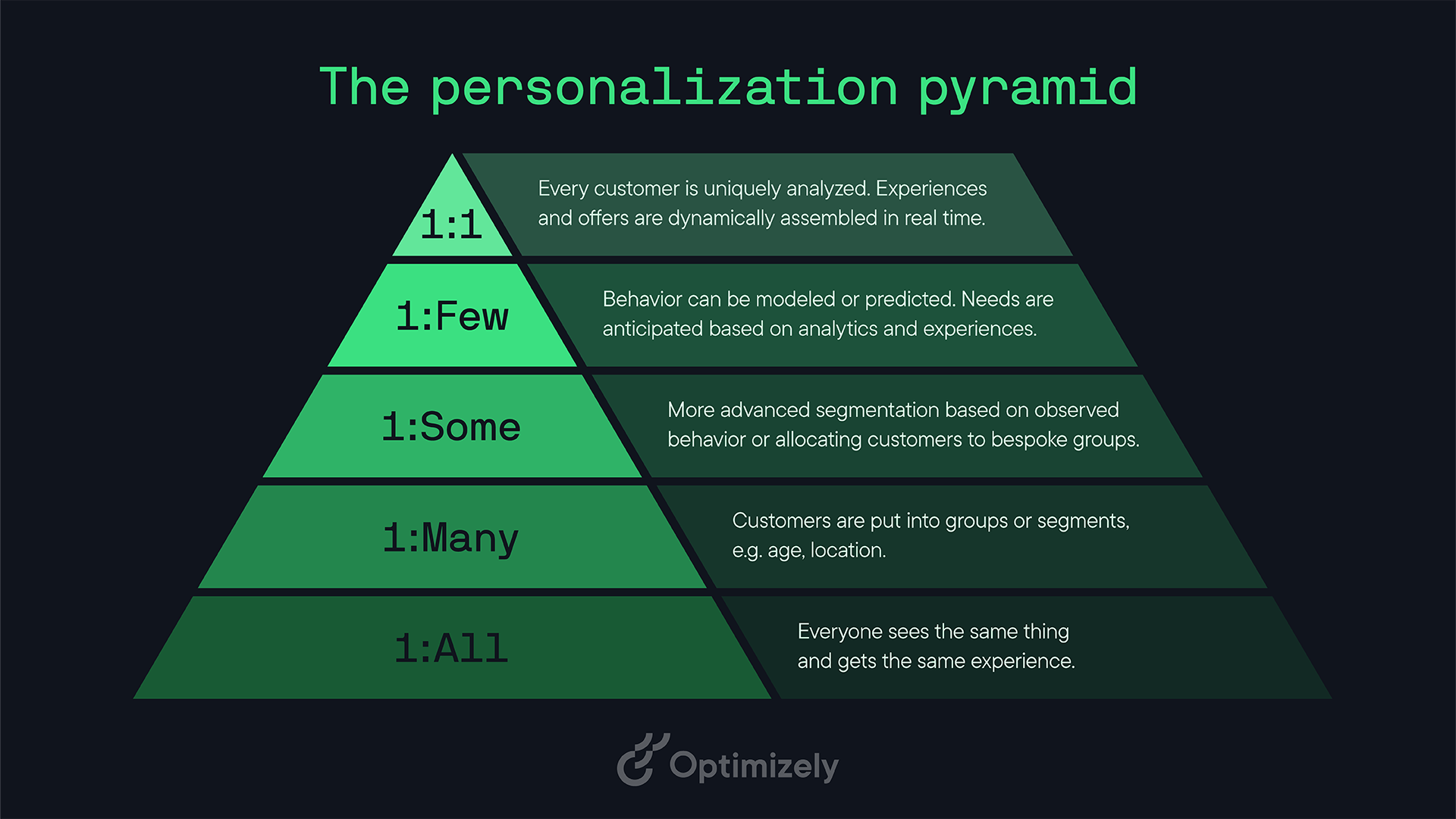
If you're mapping out where your program sits today, the personalization pyramid is the right mental model.
At the base are your broadest audience segments. Everyone in that tier gets a broadly similar experience. This is where most programs start, and where a lot of them stay longer than they should.
As you move up the pyramid, experiences become more differentiated. Segments get sharper. Content gets more specific. The data you're drawing from becomes richer because you're combining more sources.
At the top sits true 1:1 personalization. For a long time, this was aspirational. The data existed in theory, but the infrastructure to act on it in real time, at scale, did not.
AI has closed that gap. 1:1 personalization is no longer a vision reserved for companies with hundred-person data teams. It's achievable now, and the pyramid is how you get there systematically.
What are the different types of personalization and when do you use each?
From an implementation perspective, there are generally two methods of executing personalization:
Rules-based personalization
Rules-based personalization uses predefined logic to dynamically route the user experience. Think of it as a flowchart: if a user does X, show them Y.
It's reliable, auditable, and fast to implement. A financial services company might use it to show different content to existing account holders versus prospects. A SaaS platform might use it to surface different onboarding paths based on the user's role.
Algorithmic or AI personalization
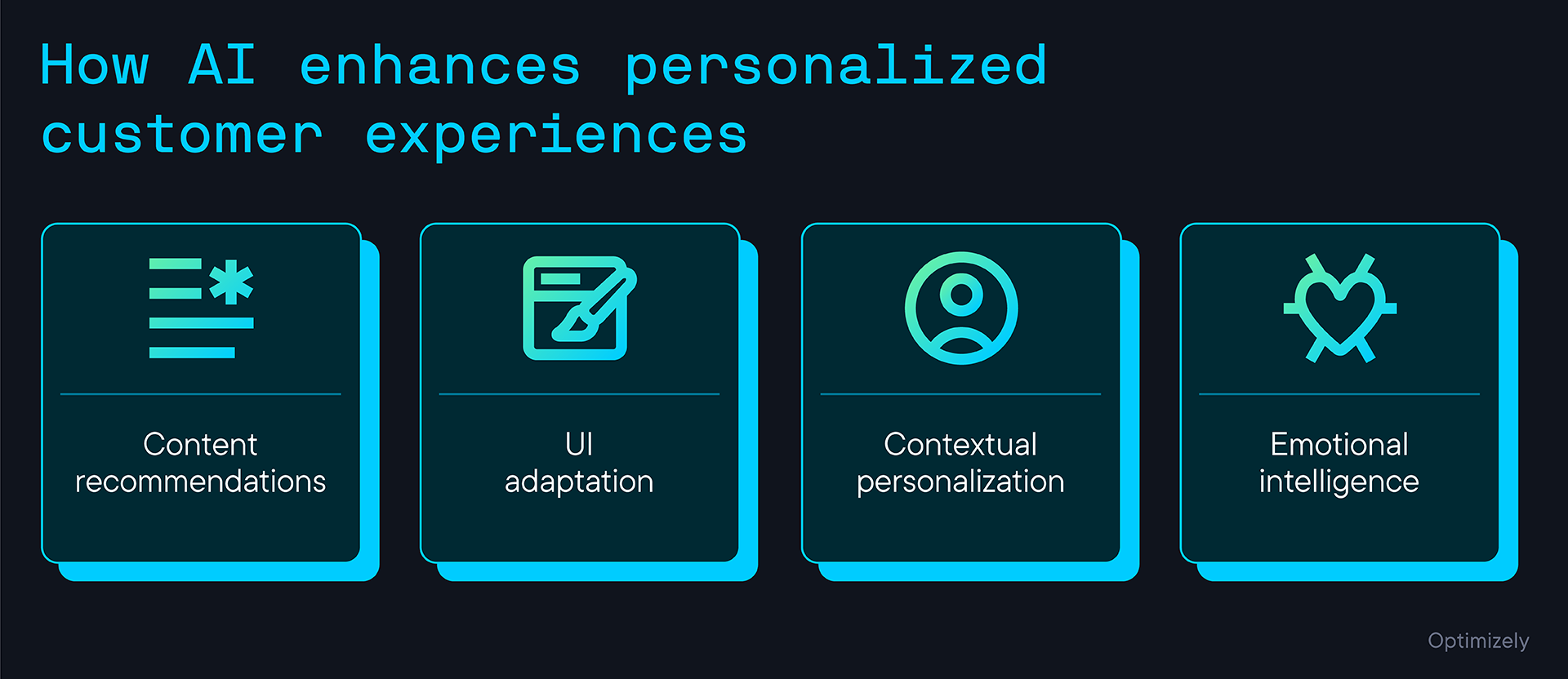
AI-powered personalization uses machine learning to read real-time behavior and context, then adapt the experience accordingly without a human manually updating the rules.
This is where personalization stops being reactive and starts being predictive. Examples include content recommendations for a media company, next-best-action prompts in a B2B SaaS product, dynamic pricing in travel, and personalized care pathways in healthcare platforms.
AI is the engine that surfaces signals and scales execution. Human strategy is what decides what those signals mean and what to do about them.
For a much deeper dive into the different types of personalization, check out our breakdown of when to use rules-based and AI to deliver those BADA$$ personalized experiences.
Spoiler alert: Most mature personalization programs run both. Rules-based handles the defined, high-confidence scenarios. AI handles the edge cases, the emerging patterns, and the moments where the data tells a story before a human would have noticed it.
Customer journeys have become too complex for either approach to handle alone. Stable segments are shifting. Channels are multiplying. The combinations of who someone is and where they are in their journey create more permutations than any rules library can keep up with.