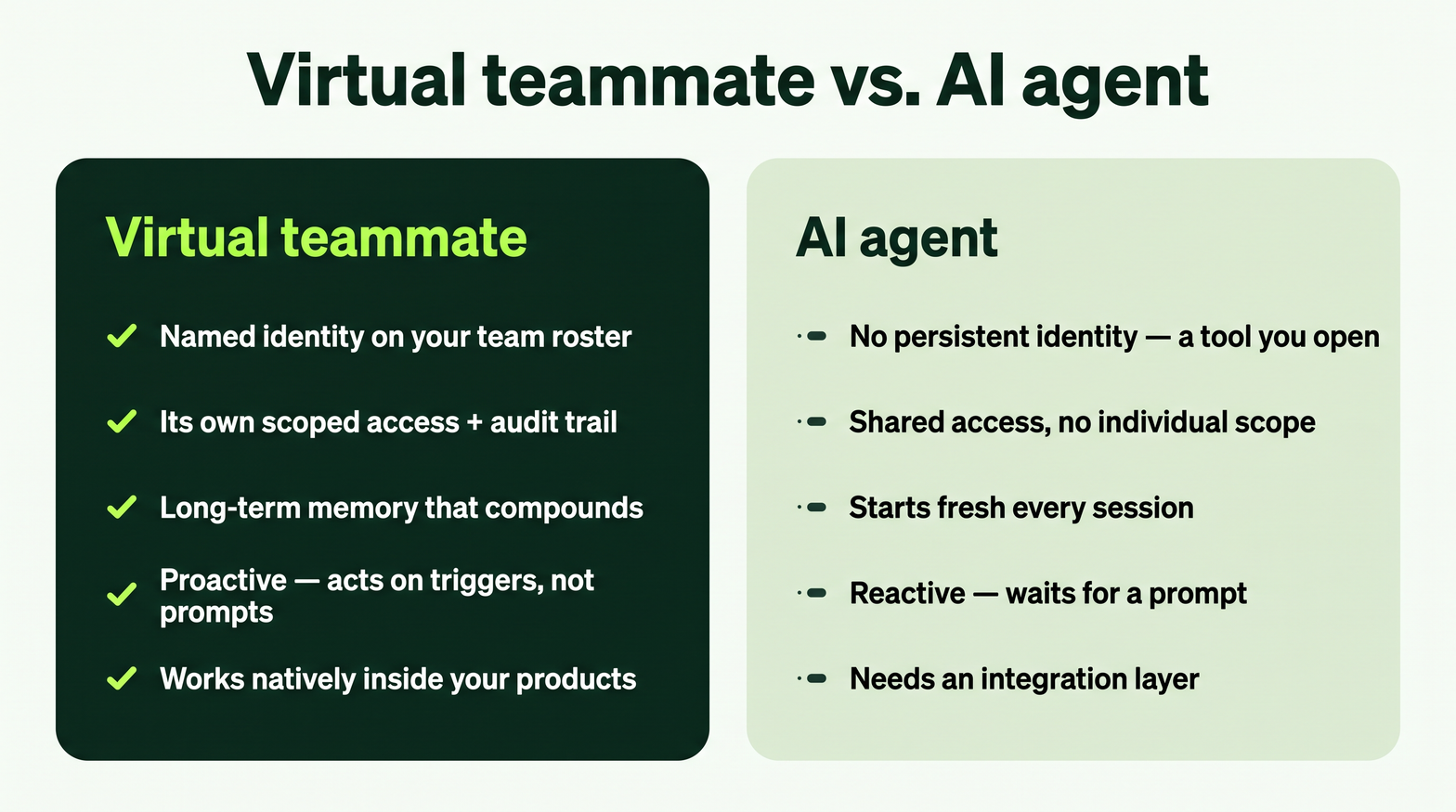
There is a massive a big gap between a tool that waits for you to tell it what to do, and teammate who is already working when you open your laptop.
But as the martech landscape floods with "agentic" hype, the line between these two concepts is getting intentionally blurred by vendors. Every chatbot has rebranded as an agent, and every agent claims to be a "teammate".
It is creating a major credibility gap. Marketers are being promised autonomous coworkers, but what they are actually getting are disconnected utilities that require constant babysitting, prompting, and correcting.*
To build an agentic operating model that actually delivers results, you need to know exactly what you're deploying. So here's the real breakdown: standalone AI agents versus Optimizely's Virtual Teammates (yep, real virtual teammates), side by side.
*This is no joke, we did the math in our recent Global AI and Marketing Data Study: 76% of marketers spend over 3 hours a week fixing AI output, with 5% using over 7 disconnected tools in that time too.
The structural breakdown
This isn't just a semantic pivot. It's a real difference in architecture, security, and execution. Standalone AI agents handle isolated, one-off tasks. Workflow agents handle more complex tasks that require some multiplayer action. Virtual Teammates hold down ongoing, collaborative roles.
In fact, Virtual Teammates are made up of specialized agents, workflow agents, tools, and skills, bundled up into a real identity that can be customized and given personalities. And guess what? They're ready and waiting to take on expert tasks like no AI has done before.
Here's how they stack up across 10 specs that actually matter to a marketing org:
|
|
Standalone AI agents |
Optimizely's Virtual Teammates |
|---|---|---|
|
Identity and presence |
No persistent identity. A temporary session you open, prompt, and close. |
First-class OptiID user. Shows up in your team roster, workload views, and audit logs. |
|
Access rights |
Shared-everything API credentials or single bot logins. |
Individually scoped permissions per Virtual Teammate. |
|
Initiation model |
Works based on a strict input -> output model. You put in a specific input to get a specific output. |
Proactive. Acts with or without a prompt, with ongoing collaborative interactions with humans and other virtual teammates in order to complete a task. |
|
Memory scope |
Starts fresh every session. |
Persistent long-term memory. Org-specific information, previous work, and past decisions compound over time. |
|
Setup and deployment |
Depending on the vendor, this could require a range of knowledge, from basics of agent building to more technical concepts or coding for configuration. |
Ready to use out-of-the-box with plain-English customization and pre-built role templates. |
|
Collaboration |
Single-player. Sequential handoffs. |
Multiplayer. Humans and Virtual Teammates collaborate in parallel inside shared workspaces. |
|
Meeting presence |
Not applicable. Cannot participate in live sessions. |
Meetings: full real-time participation. Teams/Slack: transcript-based summary & actions. |
|
Product access |
Isolated. Can requires complex API integrations to touch your core content systems, unless using Optimizely's agents that are native to the platforms you're using. |
Native. Built straight into Optimizely Content Marketing Platform, CMS, and Experimentation instances. |
|
Bottom line impact |
Hard to track. Shows up in soft, "productivity reports" at best. |
Shows up in the headcount model, pipeline metrics, and growth. Real P&L visibility. |
|
Primary use case |
On-demand tasks: drafting copy, quick QA, rapid lookups, simple translations. |
Ongoing roles: proactive auditing, campaign coordination, always-on optimization. |
Virtual Teammates vs AI agents: The deep dive
🥽 Goggles on, we're diving into the key differentiators between a Virtual Teammate and an AI agent (so you can correct the people talking about any AI in a "teammate" way).