With over 75% of consumers more likely to consider buying products from brands that personalize, marketing personalization strategies have never been more important for fostering deeper customer connections in an increasingly fragmented online ecosystem. Marketers are confronted with new challenges as they seek to refine and enhance their personalization efforts.
Personal problems: How digital leaders are thinking about personalization in 2026
Dive into our survey of over 1,000 executives for fresh insights and actionable strategies.
Introduction
75%
of consumers are more likely to consider buying products from brands that personalize.
But how prepared are we, really?
To figure out what's on the minds of marketing leaders trying to personalize experiences for their audiences, we conducted a survey that sourced fresh insights from over 1,000 marketing, ecommerce, and IT executives worldwide.
The state of personalization
High time to step it up
Modern consumers expect their digital interactions to be tailored to their individual preferences, even before landing on your website. The companies that have figured this out are pulling ahead. The ones still treating personalization as a future priority are falling behind.
86% of executives report that their marketing strategies often demand more advanced personalization than their current capabilities allow. And only 31% are confident their personalization efforts are improving their bottom line. That gap is not a capability problem. It is an execution problem.
Companies are responding: 62% of executives have increased their personalization budget compared to last year. The question is no longer whether to invest. It is whether the investment is going in the right places.
The fork in the road
Just 26% of executives report having a unified definition of personalization throughout their organization. If your team cannot agree on what personalization means, it is very difficult to agree on whether it is working.
- While 64% of executives say their teams have begun implementing real-time personalization strategies, only 9% have reached full implementation.
- 21% of execs have no personalization strategy whatsoever.
Think of your customer base as a pyramid. At the base are your broadest segments, seeing near-identical experiences. As you move up, experiences need to reflect how individual customers are actually behaving. At the top, your program should be predicting what a customer needs before they ask for it. Most programs are still operating at the base. The leaders are at the top.
Bloated personalization toolboxes
To assist with personalization efforts, executives are reportedly using an average of 6 tools, including 39% who use 7 or more.
Having a plethora of tools at your disposal might seem advantageous at first glance, but it most often results in fragmented systems and disjointed workflows. When tools are not well integrated, data flow becomes isolated, inconsistent, and unreliable.
This fragmentation makes it challenging to get a holistic view of the customer journey, and executives often find their teams spending more time managing these tools than actually using them to enhance customer experiences.
Personal tip: Audit your personalization tools for audience management capabilities. Does your personalization platform integrate with the tools and platforms where your data lives? Does it give you a full view of the customer and more efficient management of your audiences?
What's at stake
Virtually all execs with a marketing personalization strategy (99%) are measuring their efforts’ ROI, specifically across three key categories:
- Sales per customer (49%)
- Time spent on site/page engagement (45%)
- Customer retention (44%)
But no single metric is used by even half of executives, suggesting broad uncertainty about how to track success. Which may explain why only 31% are confident their efforts are improving the bottom line.
43% of executives fear that an ineffective personalization campaign will result in reduced future marketing budgets. Running programs without clear proof of impact is not just a measurement problem. It is a budget risk.
Personal tip: If the efficacy of your personalization campaigns are keeping you up at night, consider how experimentation can help. Multi-armed bandits are great since they show the best-performing option in real-time and automatically direct traffic to the best experience. This approach not only optimizes engagement but also continually refines your strategy to ensure your campaigns are always aligned with user preferences
First party data is the foundation, not a fallback
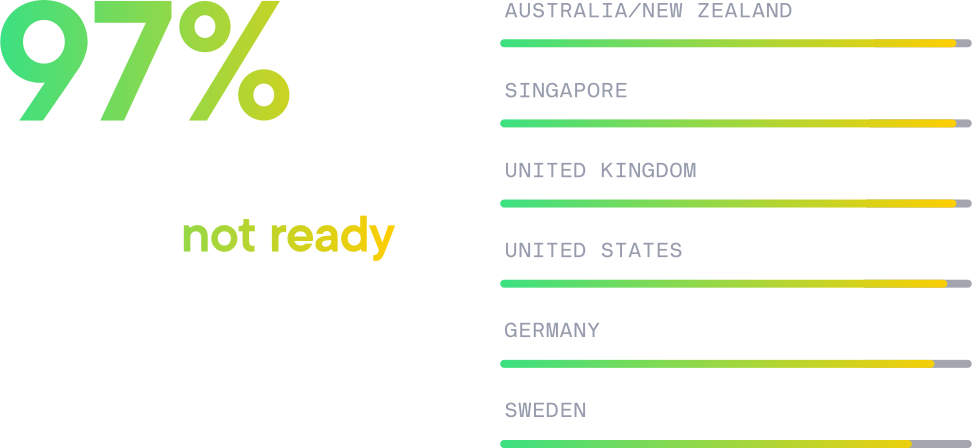
For years, third-party cookies were the default infrastructure for digital tracking and personalization. It would even be careless to ignore the striking 97% of executives who, in just May of last year, reported feeling unprepared for such a foundational shift in the data they rely on.
However, the companies seeing the best personalization outcomes today did not wait to be forced into change. They built privacy-first, consent-based data strategies because it produced better results.
First-party data is cleaner and more accurate because customers chose to share it. That makes it a better input for personalization than anything collected through third-party tracking, and it holds up regardless of what happens to cookies next.
To support their personalization efforts, companies currently use user preferences (22%), past behaviors (21%), and nuanced personal information (21%). The programs doing this well are not waiting for customers to land on their site to start building a picture. They are using every consented interaction across every channel to build profiles that reflect who the customer is right now.
First-party data is the right foundation to build on.
AI is not what's next. It is what's now.
Machine learning, augmented reality, and virtual reality were once the technologies executives were betting on for personalization. AR and VR have not delivered on that promise. And AI has moved well past the prediction stage.
Teams using AI across the full personalization and experimentation lifecycle are seeing 78% more experiments created, a 9% lift in win rates, and a 24% increase in personalization campaigns launched. The programs hitting those numbers are not using AI occasionally. They have built it into how the work gets done, across ideation, execution, and analysis.
What the best programs have figured out is that you do not have to choose between personalization that feels genuine and personalization that scales. Manual segmentation was never built for that level of complexity. The customer who just had a frustrating support call should not be getting an upsell thirty seconds later. The returning visitor whose behavior looks nothing like their last visit should not be dropped into a segment defined three months ago. That is where AI earns its place. The personalization manager still decides what is worth building and why.
Personal tip: One potential boon for your efforts could be experimentation, which executives already recognize as providing benefits including:
- Identifying mistakes (40%)
- Allowing for data-driven decisions (40%)
- Testing strategies before they run them (39%)
- Personalizing customer experiences (39%)
- Discovering which personalization strategies work (39%)
Currently, only 26% of executives are investing in experimentation for personalization use cases. And although more than half (59%) plan to do so, this gap represents a prime opportunity for forward-thinking companies to be proactive in gaining a competitive advantage.
Conclusion
The data from this survey tells two stories. One group of companies is still working through fragmented tools, undefined strategies, and uncertain ROI. Another group has moved past that. They have unified their data, built on first-party foundations, and connected personalization to experimentation so that every cycle produces something the next one can build on.
The next few years will be about how well you can execute it and how clearly you can prove it is working.
As companies continue to step up their personalization game, those who successfully navigate these challenges will be better positioned to meet rising consumer expectations, build stronger customer
The Optimizely Survey was conducted by Wakefield Research (www.wakefieldresearch.com) among 1,000 Marketing, E-commerce, and IT Executives, with a minimum seniority of Director, at companies with a minimum of 100 employees, in 6 markets: US, UK, Germany, Sweden, Australia/NZ, Singapore, between May 2nd and May 14th, 2024, using an email invitation and an online survey. Results of any sample are subject to sampling variation. The magnitude of the variation is measurable and is affected by the number of interviews and the level of the percentages expressing the results. For the interviews conducted in this particular study, the chances are 95 in 100 that a survey result does not vary, plus or minus, by more than 3.1 percentage points in the global sample, 4.4 percentage points in the US, and 9.8 percentage points in the remaining markets from the result that would be obtained if interviews had been conducted with all persons in the universe represented by the sample.