Opal in Optimizely Campaign: How to get started with intelligent agents for your email marketing

Opal, Optimizely’s agent-based AI platform, is now available directly in Optimizely Campaign.
This gives you access to a team of intelligent AI agents that support you with analysis, ideation and quality assurance – right where you plan and run your email and omnichannel campaigns.
In this article, you’ll learn more about:
- Opal, AI agents and credits
- Available Opal capabilities in Campaign
- Campaign-specific agents you can use from day one
What is Opal – and how does it help me as a Campaign user?
Opal is Optimizely’s agent-based AI platform that now supports you directly inside Optimizely Campaign. With Opal, you can create, configure and optimize AI agents that help you plan campaigns, create content, and understand and improve your results – always in the context of your Campaign data, your brand and more.
For Optimizely Campaign, this means:
You can complete many common day-to-day Campaign tasks faster, more consistently and with better decision support. All without the need for extra tools or needing to copy-paste content between tools.
How to access Opal
To use Opal with Campaign, you need an Opti ID login and access to Opal.
Here’s how it works:
Log in with Opti ID: Sign in as usual via Opti ID. On the following screen, simply select Opal.
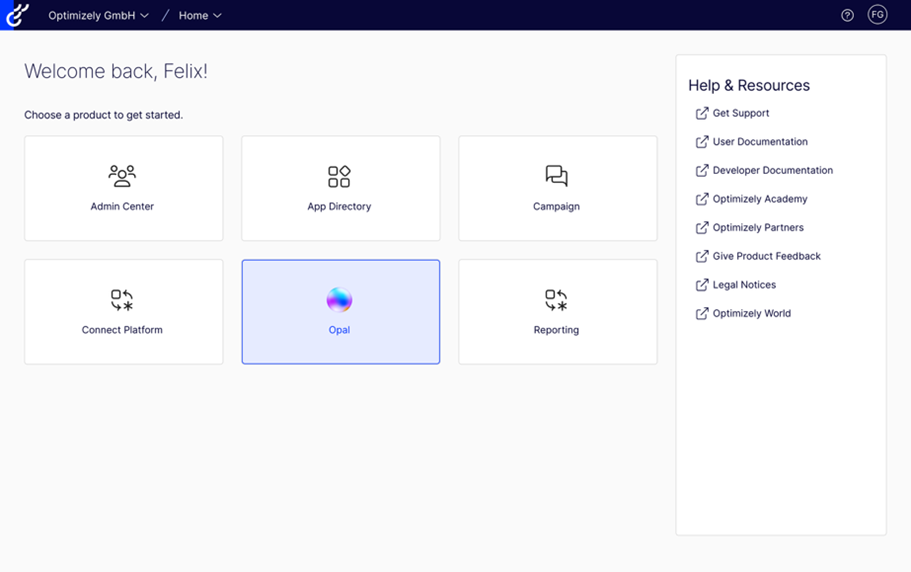
Select the right client:
In the dropdown in the upper right corner, choose the client you want to work with. This gives Opal the right context for your Campaign data from the selected client.
Make sure the correct organization and Campaign client is selected in Opal. If you work with multiple clients, it’s worth taking a quick look before you get started.
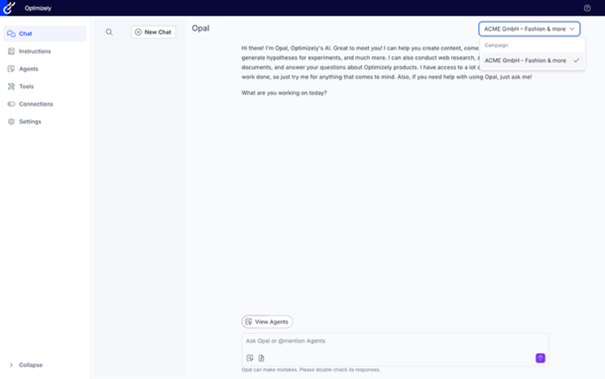
Now you can start asking questions right away! Tip: Opal is also happy to help you learn how to use Opal itself.
Language hint: Opal responds in the language you use in chat – whether that’s German or English or any other language!
All about agents, instructions, tools and credits
In our Support Center, you’ll find everything you need to know about Opal – how to get started, how to use Opal, how to set up instructions, and how to use and create agents yourself.
Check out the Support Center here.
Agents in Opal
Agents are intelligent assistants within Optimizely Opal. They use instructions and tools to complete tasks for you. Each agent has one or more specific jobs, such as creating content, analyzing campaign data, or automating parts of your workflows.
Think of agents as capable team members: Tools allow agents to perform actions (for example: browse the web, analyze data, extract subject lines). Instructions define what they should do with the data (for example: how to write, which brand voice to use, which structure to follow).
In Opal Chat, you can talk to agents in natural language. Opal will automatically select the right agent based on your request and ask clarifying questions if multiple agents might be suitable. You can also use agents directly by clicking the “View Agents” button or mentioning an agent with @ and its name in chat.
Out of the box, Opal already provides a large number of agents you can use across all Optimizely products. You can find them directly in Opal via “Agents” in the menu , in the Support Center, or in the Agent Directory on our website.
Helpful information for admins:
As an admin, you can create, activate, deactivate and adapt agents at any time. You’ll find all related information in our Support Center here.
Instructions & tools
With instructions you define the context that Opal should keep in mind for every chat – for example, how Opal should respond, your brand’s tone of voice, information about specific products, or structural rules such as how emails or articles should be formatted.
More details about instructions can be found here.
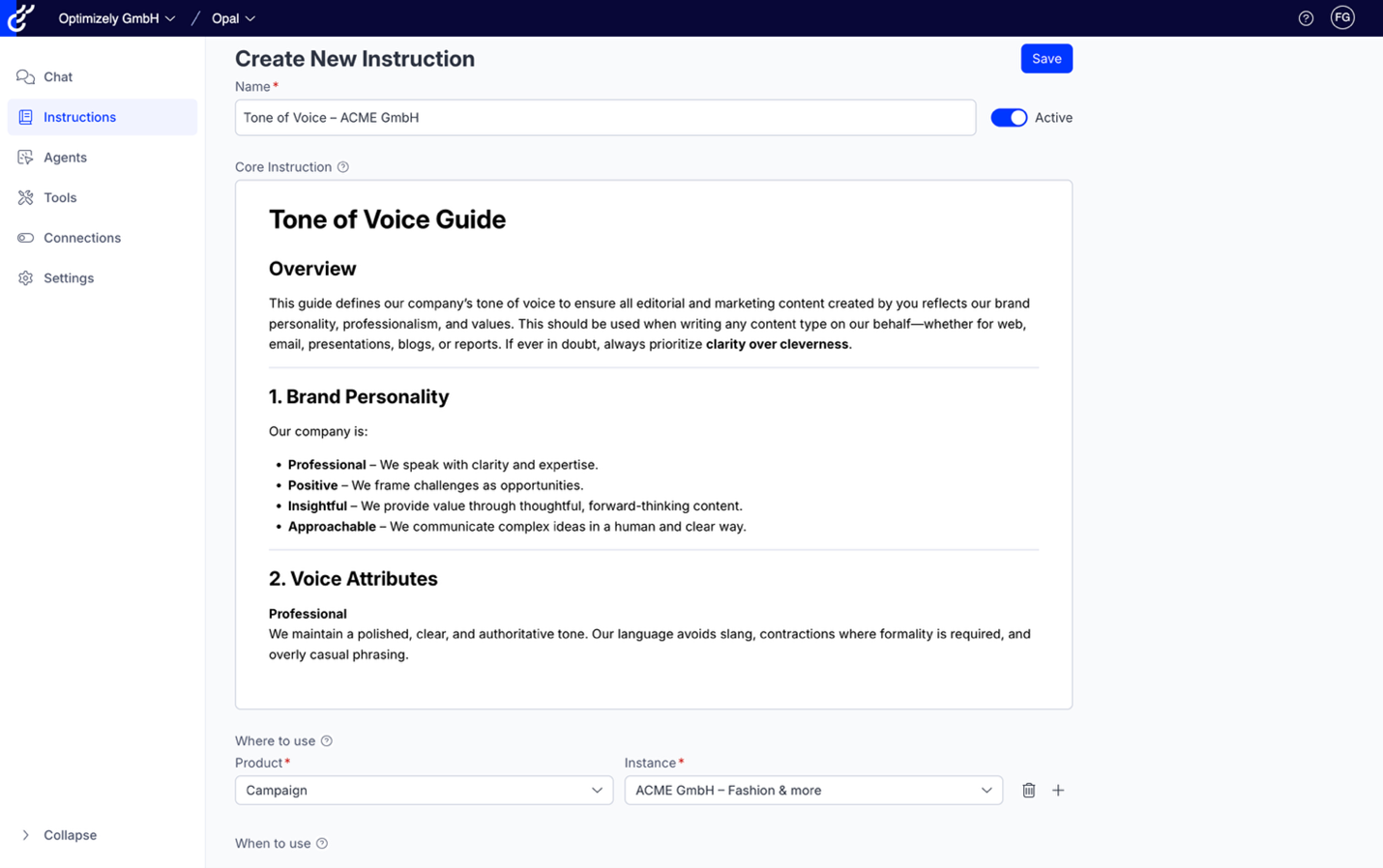
Admins can create instructions for the selected client. They can define multiple instructions, enable or disable them as needed, and use templates for common instructions such as tone of voice.
More information about creating, adjusting and managing instructions for admins can be found here.
Tools
Tools are what make Opal particularly powerful: they allow Opal to perform actions on your behalf. Each tool has a specific purpose, such as creating a campaign, reading campaign data or content, or generating images. Tools automatically connect your natural language request to specific actions, so you don’t need to know the underlying systems or commands. Think of tools like parts of a Swiss army knife – each piece has a very specific job.
While using Opal, you don’t need to manually call tools: Opal understands the context of your request and automatically uses the most appropriate tool. You can still mention specific tools directly in your prompt if you want to guide Opal.
Alongside system tools (available for all Optimizely products), we provide a wide range of tools specifically designed for working with Campaign. Find more information about tools and workflow agents here.
Opal credits
Opal is based on credits (similar to tokens in large language models). Every action an agent performs consumes Opal credits. The number of credits depends on the complexity of the agent and the task. Simple text tasks (like short translations) use only a small number of credits, while more complex agents consume more.
To make it easy for you to get started, all Campaign accounts on Opti ID receive:
- 200 free Opal credits per month, and
- a one-time bundle of 10,000 Opal credits, valid until 13 February 2026.
Credits are shared across products: if you use Opal with other Optimizely products in addition to Campaign, they all draw from the same credit pool.
If you have questions about credit packages or additional volume, please contact your Optimizely representative.
Find more details on how credits work and how admins can monitor usage here.
Opal in Campaign
To make it easier to get started, we’ve grouped typical use cases into multiple levels. You can think of Opal in Campaign as either an Advisor, an Assistant, or a Creator.
The first two levels are now available in Optimizely Campaign.
Opal as an Advisor
Opal acts as your creative sparring partner in chat – and can be helpful even without deep campaign data. You ask questions, and Opal responds with suggestions, explanations or analyses.
Examples of questions you can ask:
- Which subject line approaches typically work well in my industry?
- What are the current trends in B2B SaaS email marketing?
- Analyze the following competitors:
Best suited for: campaign ideas, content angles and A/B test ideas, market and competitor questions, and quick interpretation of campaign results.
Opal as an Assistant
Opal can also act as a context-aware assistant that understands and processes your Campaign data.
General analysis: “What stands out to you about the performance of our recent newsletters and how would you improve them?”
Campaign checks: Review subject lines, preheaders and copy for clarity and tone, and generate variants (Use @subject_previewtext_ideation to trigger this agent).
Campaign drafts: Ask Opal for suggestions for a welcome series or reactivation campaign that you can then implement in Campaign.
Translation & adaptation: Translate existing mailings into another language and adapt tone or target audience (You can trigger this agent directly with @translation_mail_content).
Coming soon: Opal as a Creator
We’re already working on enabling Opal to perform actions directly in Campaign on your behalf, such as creating emails, building audiences, or setting up campaign journeys. These capabilities will be delivered in a later release.
Examples: how to use Opal in your Campaign day-to-day
Here are a few examples of how you can use Opal:
Quick performance check of your latest newsletters: “Summarize the performance of our last three newsletters and give me three concrete optimization suggestions.”
Spam & quality check before sending: “Check this newsletter for potential spam risks and give me concrete improvement suggestions.”
Drafting a welcome journey: “Outline a 4-step welcome journey for new newsletter subscribers with high-level content ideas for each email.”
Email translations and tone refinement: “@translation_mail_content Translate this email into English and adapt it for a more formal B2B audience.”
Further resources & best practices
You can find all resources mentioned in this article here:
- Webinar recording (German) – “Working smarter: how to use Opal Agents in Campaign”
- Support Center: Opal overview
- Opal credits & reporting
- Agent overview & admin information: Find all the agents on our website or in our support center.
- An introduction to instructions in our support center

- Last modified: 12/18/2025 8:53:24 AM