Optimizely Opal (easily) helps improve AI visibility: Here's how

Most marketing teams are “doing GEO” with 10 different tools, 20 perspectives, 30 different spreadsheets, and zero idea what’s going on.
Now, don’t get me wrong, I love all the tools in the martech stack we’re using for our own GEO, but I love them even more when I don’t have to go into them to use them.
And that is exactly where Optimizely Opal comes in.
All of a sudden, those 10 different tools are operating as one unified stack that I don’t even have to think about.
Spoiler: it could (very easily) be the same for you. Let’s talk through it.
How Optimizely Opal makes my job as a GEO strategist way easier
- Connectors: Optimizely Opal run your entire stack as effectively as you
- Out-of-the-box agents: Ready and raring to go, no set-up required
- Custom agents: Build your own (for everything else)
- Research surfacer: Know what’s being cited before your competitors do
- RAG and product information: GEO starts with accuracy
Connectors: the whole GEO stack, one interface
Optimizely Opal doesn't replace the tools your team already uses. It just makes it way easier to use them at once through one thoughtful interface that just gives me what I need without any additional noise.
Through model context protocol (MCP), Optimizely Opal connects to any tool that exposes a server so your team can query data, trigger actions, and pull insights without switching platforms.
Translation: this means no more trying to figure out GA4 to surface analytics.
Some other examples of how Opal connects with specific tools:
- Profound to reference all your GEO prompt data and opportunities
- GA4 to pull all your web analytics and data
- Ahrefs or SEMrush for keyword and SEO insights that impact AI visibility
- Conductor to identify areas of strength or weakness when it comes to website performance
- Marketo to incorporate behavior signal trends across all your personas
- Salesforce to take into account buyer intent from your actual customers
And because Opal supports MCP servers broadly, this list isn't closed.
This means virtually any tool in your martech stack seamlessly integrates with Opal, and Opal can be the ridiculously easy-to-use interface for those tools.
Out-of-the-box agents (no setup required)
You don't need to build anything to get started. Optimizely Opal ships with a set of pre-built agents purpose-built to maximize AI visibility.
Here are some examples of Opal’s GEO agents and how they work:
GEO Auditor
Give it a URL. It checks LLM crawler accessibility, Core Web Vitals, schema markup, content structure, and citation readiness. Then, it outputs a prioritized action plan. Content structured for AI retrieval is 40% more likely to be cited in generative responses.
GEO Schema Optimization
Schema is one of the highest-leverage GEO signals. FAQPage, HowTo, sameAs, the markup that tells LLMs what your content is and why it should be trusted. This agent generates and applies it automatically. No developer ticket required.
SEO Metadata Optimization
Good SEO is good GEO (not my words, but Google’s). Titles, meta descriptions, and alt text all optimized at scale, without manual review cycles.
Content Refresher
Here's an uncomfortable truth: a lot of your best-performing content is quietly becoming a GEO liability. Outdated stats. Deprecated features. Off-brand language. Terminology that LLMs are learning to distrust. The Content Refresh Agent flags all of it so your team has a clear, prioritized queue of what to fix before it costs you citations.
FAQ Creation
FAQ schema is among the most cited content formats in generative search results. This agent creates structured Q&A content formatted for featured snippets and AI-generated answers.
Profound Citation Gap Analysis
This agent connects to Profound's AI search tracking data, analyses competitive citation performance by topic, and recommends five to eight specific blog topics to close citation gaps. It turns raw Profound data into a content brief your team can act on immediately.
GEO Recommendations
Audits content for LLM discoverability, retrievability, and understandability, then delivers actionable recommendations directly inside your CMP workflow.
Custom agents (for everything else)
When you need something more custom, you can create the agents your team needs with your brand context, your connected tools, and your workflow logic baked in, right in Opal’s (code-free!) agent builder. Here are few examples of custom agents that we've built:
Competitive GEO Analysis
Audits competitor pages for GEO best practices, compares them against your own, and surfaces where you're behind or ahead. Replaces hours of manual analysis with a repeatable workflow you can run weekly.
GEO Topic Generator
Not sure what to create next? This agent identifies content opportunities based on what AI systems are actually citing in your category, not just what's trending on Google. It closes the gap between "we have a content calendar" and "we have a content calendar that builds AI visibility."
Automated GEO Reporting
Rather than pulling Profound data manually each month, this agent runs on a schedule: queries topic performance across AI visibility metrics, summarizes trends, flags topics to watch, and delivers a formatted report directly to your team. Teams using this agent are saving 2–3 hours of reporting time per month. Every month.
Content Auditor
Scans your full content library against both brand guidelines and GEO compliance signals. It leaves structured comments on flagged items inside CMP so editors have a clear, actionable queue. At scale (we're talking 300+ articles), this agent recovers roughly 150 hours of manual review time.
Research Surfacer: know what's being cited before your competitors do
GEO changes every day and it’s almost impossible to keep up. So, let Opal do it for you.
Opal's Research Surfacer (note: this is not an official release, just a cool name I came up with for the conversations I have with Opal) lets you plug in the publications, influencers, newsletters, and domains your team follows most.
When something relevant to your topics, competitors, or keyword clusters surfaces, it gets flagged in context.
Practical use cases include:
- Surfacing emerging topics from industry publications before competitors pick them up
- Pulling the latest analyst research into a brief automatically
- Flagging when a topic you cover is getting heavy citation traction in AI responses — so you can double down while it's still relevant
This is how you stop reacting to what's being cited and start anticipating it.
RAG and product information: GEO starts with accuracy
Here's a GEO problem that doesn't get talked about enough: if the AI tools your buyers use have outdated information about your product, no amount of schema markup or GEO will fix it.
Optimizely Opal's RAG (Retrieval-Augmented Generation) capabilities connect it to your source-of-truth systems, your DAM, your product documentation, and your sales enablement materials. The result: every piece of content Opal helps create or refresh draws from what's actually true about your product right now... not six months ago.
What this means for you:
Always-current product context: Product updates, pricing changes, and positioning shifts flow into Opal's knowledge base. When your GTM evolves, your content reflects it.
DAM integration: Approved assets, messaging, and collateral in your DAM are accessible to Opal directly. Writers aren't hunting for the right logo version or the approved product screenshot. It's already there.
Documentation connectivity: Connect Opal to your product documentation like API docs, help center content, release notes and it becomes your GTM alignment layer. Marketing, sales, and content teams all pull from the same source of truth.
The GEO use cases Opal covers (agent or not)
Agents are one part of the story. But GEO is more than running audits and generating topics. Here's where Opal fits across the full picture:
|
GEO use case |
How Opal covers it |
|
Auditing pages for AI search readiness |
GEO Auditor Agent |
|
Schema markup and structured data |
GEO Schema Optimization Agent |
|
Identifying content gaps vs. competitors |
Profound connector + Citation Gap Agent |
|
Topic ideation informed by citation signals |
GEO Topic Generator Agent (custom) |
|
Content production and editing |
Native AI content creation in Opal |
|
FAQ and Q&A content creation |
FAQ Creation Agent |
|
Refreshing outdated content |
Content Refresh Agent |
|
Brand and GEO compliance at scale |
Content Audit Agent (Custom) |
|
AI visibility reporting |
Automated GEO Reporting Agent (Custom) |
|
Staying current on cited research |
Research Surfacer |
|
Keeping product information accurate |
RAG + DAM + documentation connectors (Custom) |
|
Traditional SEO signals |
Semrush + Conductor connectors |
|
Traffic and conversion performance |
GA4 connector |
|
AI citation tracking and share of voice |
Profound connector |
|
Workflow governance and human review |
Human-in-the-Loop Escalation Agent (Custom) |
Every row is a problem teams are currently solving with a separate tool, a manual process, or not at all. Opal covers the full table.
How WE use Optimizely Opal for GEO and improved AI visibility
Optimizely Opal provides you with all the tools and agents you need (or could possibly dream up) to execute on a GEO workflow, with limitless possibilities.
But with limitless possibilities come infinite responsibilities.
Orchestrating all the tools at your disposal to actually achieve outcomes that impact AI visibility is daunting enough, so here’s a 4-stage plan on how we typically do this:
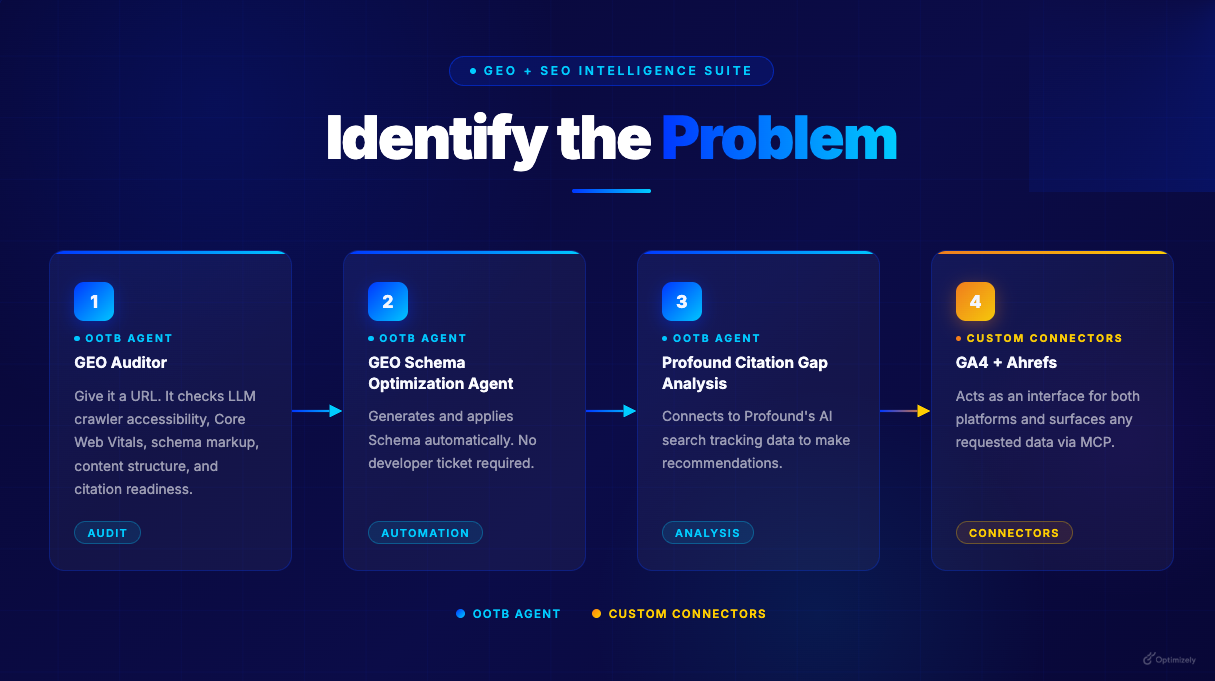
Step 1: Identify the Problem
Before you chase AI visibility, you need a clear-eyed read on where you actually stand.
This is the diagnostic stage. No spin, no optimism bias, just an honest, data-driven picture.
Sometimes the problems are apparent, like a big fat dip in your profound reporting (or, worse, no data at all because you're not even showing up).
Sometimes they're not, like understanding how much your competitors are being talked about and where people (or bots) are talking about them.
No matter the starting point, here are some of the tools and agents we use when trying to uncover GEO opportunities
Step 2: Research the Solution
Once we've identified the problem (hint: it's almost always that we're not showing up enough), it's time to understand why.
- What are our competitors talking about?
- What is our audience talking about? How do we know? Where do we even find that information?
- Do any of the above bullet points align with our own GTM messaging framework?
- Do we have enough content to cover what we want AI to show us for?
- When was the last time we even updated the content that we do have?
- Is the content good?
- Are our pages optimized for maximum LLM visibility?
...you get the point.
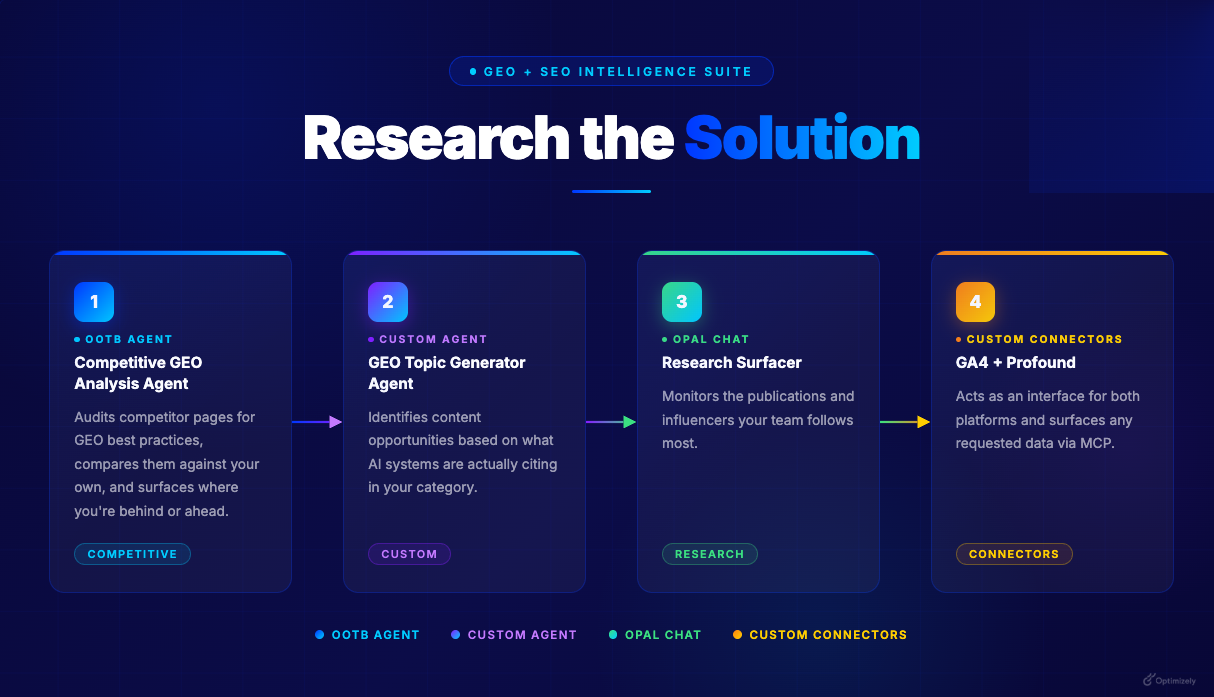
This stage is about getting sharp on what competitors are doing well, on which topics and formats AI systems are actually rewarding, and on the conversations that are shaping your category right now.
The goal is to turn raw data into a clear, prioritized view of where your effort will land hardest.
Here’s some of what we use to do the right research:
Step 3: Execute Action Items
Research is not a deliverable.
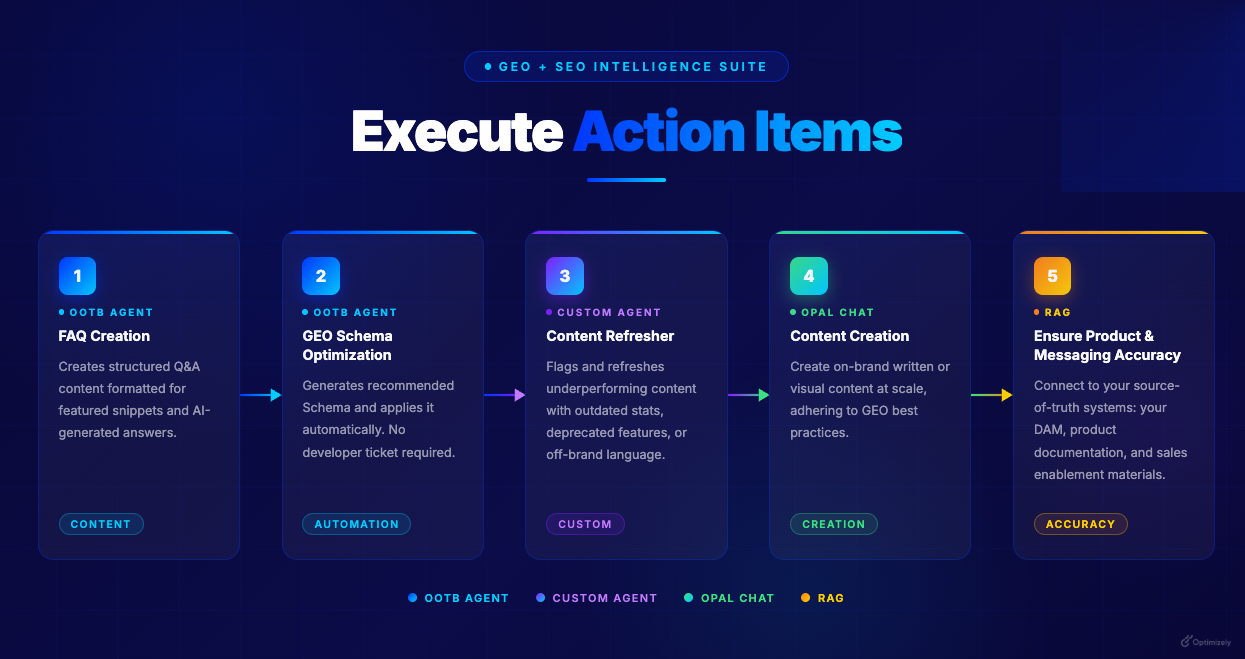
It’s time to convert everything you've learned into something you can actually ship. This means creating and optimizing content at scale, fixing what's broken, refreshing what's gone stale, and making sure every piece of output is accurate and on-brand.
Sometimes it's as simple as dropping an FAQ section on a key page.
Sometimes it's as simple as deploying appropriate schema.
But sometimes it's realizing that your customers' pain points aren't even being addressed by any of your content.
And sometimes it's the really painful realization that you haven't created any authoritative content for one of the prompts your tracking in forever.
Here are just some of the tools we use to action execute (re: create) content that moves the needle:
Step 4: Measure the Results
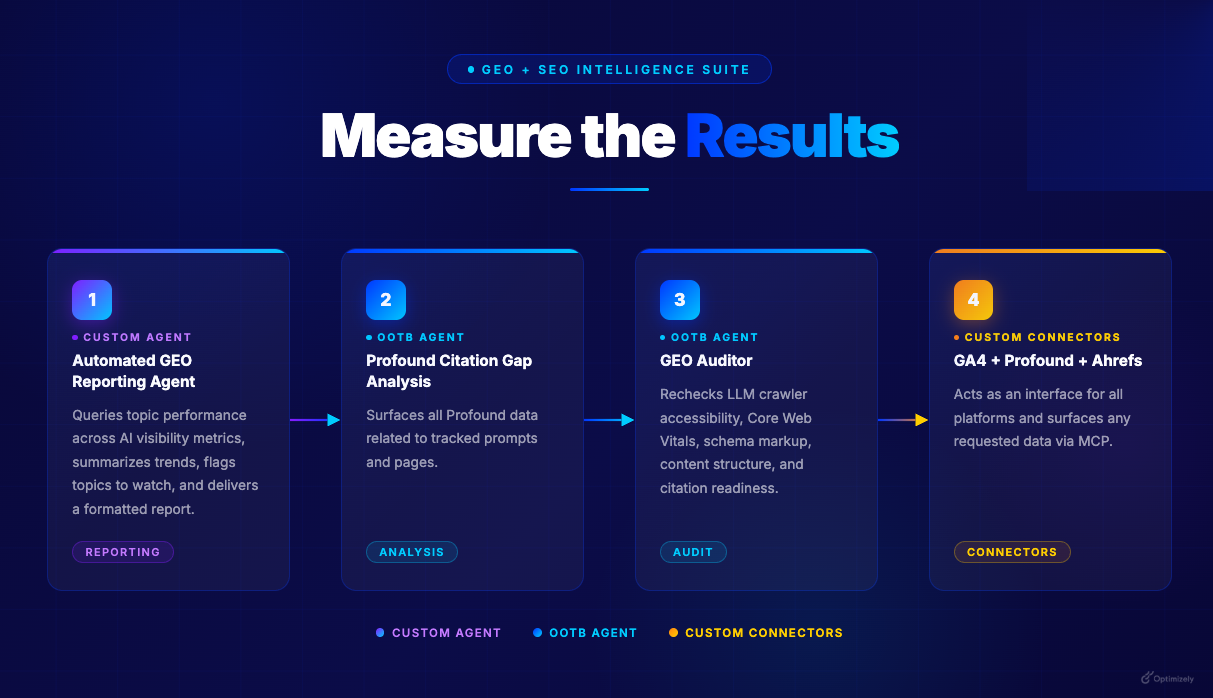
The loop only closes when you look back. This stage pulls all AI visibility metrics, citation trends, technical health, platform analytics into one place and gives you a single, honest view of what moved and what didn't.
Now that you know what worked? Do more of it.
Now that you know what didn't? Try something else.
Here's some of what's at our disposal to measure, prove, or refine results:
The AI-generated outro
AI visibility isn't a campaign. It's a capability — and it compounds over time. The teams building durable AI search presence aren't running one-off audits. They've built GEO into the workflow: into how content is created, reviewed, published, and measured.
Optimizely Opal is built for that. Out-of-the-box agents get you moving in minutes. Custom agents let you build for exactly your team's workflow. Connectors bring your existing stack into one interface.
You don't need five tools, twenty-four thousand tabs open, and a spreadsheet. You just need Optimizely Opal.

What I love doing most is collaborating with teams who have fun overcoming complex obstacles and solving problems. My approach to marketing and leadership is always...


- Last modified: 3/23/2026 9:40:56 PM