Introduction

Multiple choice time: What’s the bigger nightmare scenario?

A) Forgetting someone’s name literally as they’re saying it to you
B) Calling someone by the wrong name altogether
C) Someone you don’t know already knowing your name for no reason
D) All of the above

You can forgive your CEO for greeting you with a “heyyy... buddy!” because she forgot your name. But there’s no coming back from being called the wrong name. You now either have to awkwardly correct her, or just go by the wrong name for the rest of your career.

And do we need to explain the creepiness behind choice C?

Me thinking MEME - Dwight

👆  This is why executing personalization without being pushy is so important.

This is why executing personalization without being creepy, without being pushy, and without getting it wrong is so important.

Only 26% of executives reported having a unified definition of personalization throughout their organization.

Defining personalization

What is personalization?

Personalization is a process that creates a relevant, individualized interaction between two parties, designed to enhance the recipient's experience. 

Specifically for websites and apps, it often encompasses building or adopting a personalization engine that is capable of unifying data solutions, content marketing workflows, experimentation frameworks, and analytics suites. 

Here at Optimizely, we describe personalization as delivering relevant experiences to the right person, at the right place, and at the right time. 

Consider ordering coffee at your local café. On your first visit, they take your order. By your next visit, they will remember your name and usual order. Soon, they recall details like how hot you prefer your drink. Eventually, they anticipate your arrival, having your favorite drink ready based on the time you usually visit. 

It's the same principle in the digital world, only on a massive scale. Every click, search, and interaction creates a digital footprint that can be leveraged to deliver personalized experiences. 

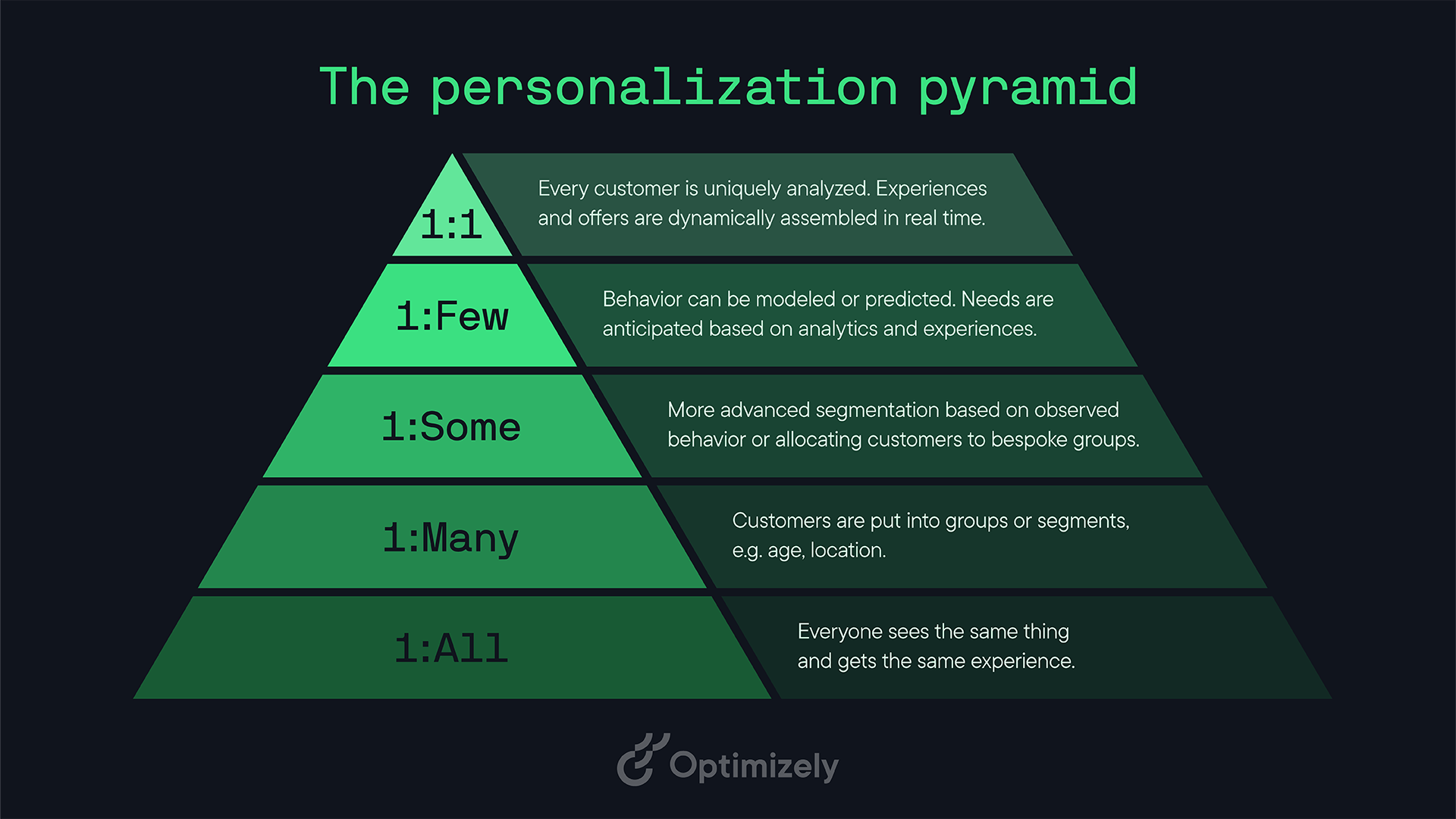
If you're still having trouble understanding what personalization means for your organization, try visualizing the entirety of your customer base as a pyramid. 

Here, we'll help... 

Introducing the personalization pyramid

If you're mapping out where your program sits today, the personalization pyramid is the right mental model.

At the base are your broadest audience segments. Everyone in that tier gets a broadly similar experience. This is where most programs start, and where a lot of them stay longer than they should.

As you move up the pyramid, experiences become more differentiated. Segments get sharper. Content gets more specific. The data you're drawing from becomes richer because you're combining more sources.

At the top sits true 1:1 personalization. For a long time, this was aspirational. The data existed in theory, but the infrastructure to act on it in real time, at scale, did not.

AI has closed that gap. 1:1 personalization is no longer a vision reserved for companies with hundred-person data teams. It's achievable now, and the pyramid is how you get there systematically.

What are the different types of personalization and when do you use each?

From an implementation perspective, there are generally two methods of executing personalization:

Rules-based personalization

Rules-based personalization uses predefined logic to dynamically route the user experience. Think of it as a flowchart: if a user does X, show them Y.

It's reliable, auditable, and fast to implement. A financial services company might use it to show different content to existing account holders versus prospects. A SaaS platform might use it to surface different onboarding paths based on the user's role.

Algorithmic or AI personalization

AI-powered personalization uses machine learning to read real-time behavior and context, then adapt the experience accordingly without a human manually updating the rules.

This is where personalization stops being reactive and starts being predictive. Examples include content recommendations for a media company, next-best-action prompts in a B2B SaaS product, dynamic pricing in travel, and personalized care pathways in healthcare platforms.

AI is the engine that surfaces signals and scales execution. Human strategy is what decides what those signals mean and what to do about them.

For a much deeper dive into the different types of personalization, check out our breakdown of when to use rules-based and AI to deliver those BADA$$ personalized experiences.

Spoiler alert: Most mature personalization programs run both. Rules-based handles the defined, high-confidence scenarios. AI handles the edge cases, the emerging patterns, and the moments where the data tells a story before a human would have noticed it.

Customer journeys have become too complex for either approach to handle alone. Stable segments are shifting. Channels are multiplying. The combinations of who someone is and where they are in their journey create more permutations than any rules library can keep up with.

0:00
0:00
/
0:00

VP, Solution Strategy Nicola Ayan discusses the challenges of implementing personalization

What are the biggest challenges companies face when implementing personalization?

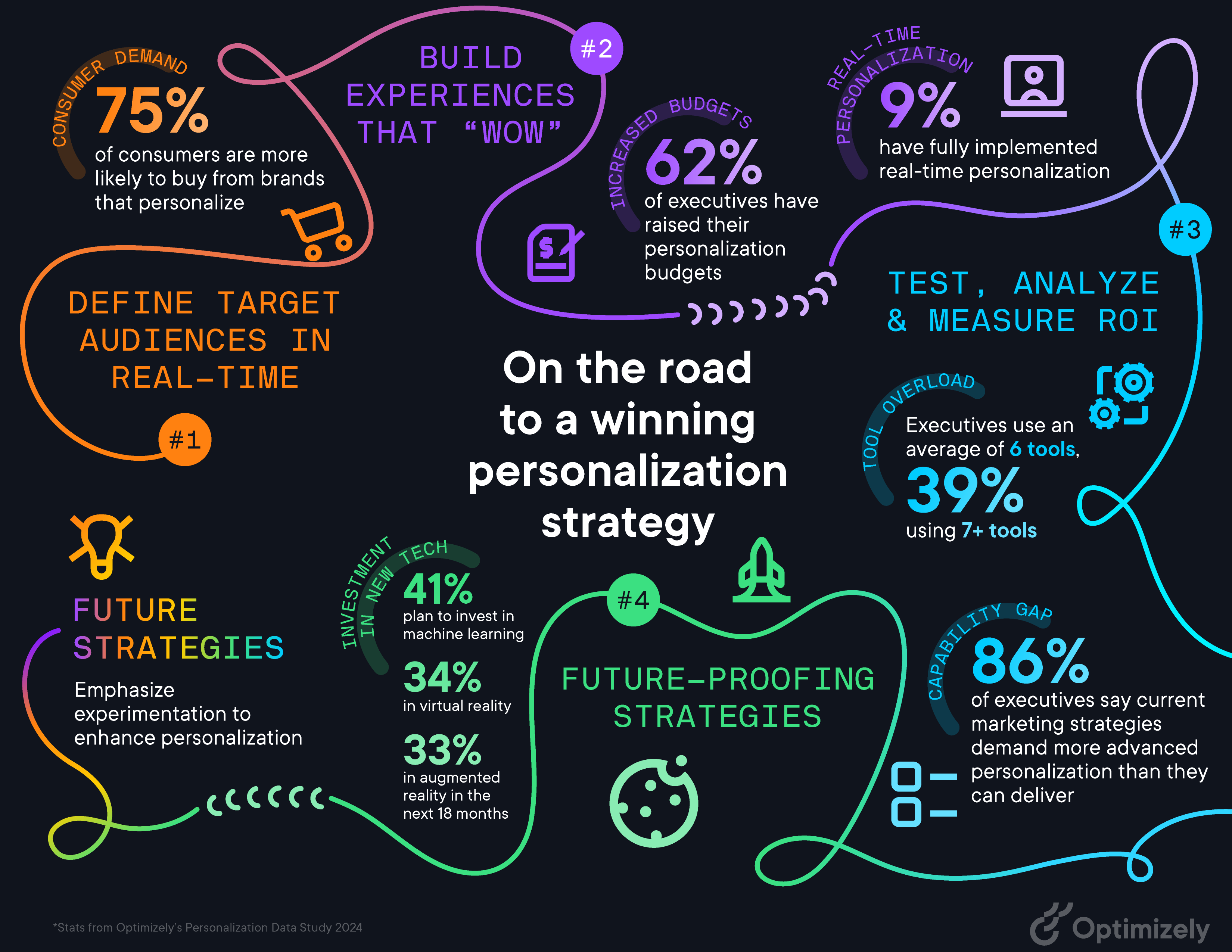
When Optimizely surveyed top marketing, ecommerce, and IT executives worldwide, here is where the respondents noted the biggest challenge areas were:

  • 43% worry that ineffective personalization will jeopardize future budgets
  • 40% find it difficult to scale their personalization efforts
  • 39% struggle to implement personalization in real-time
  • 36% say disjointed workflows are holding them back

So, it kind of sounds like many companies are struggling with adopting a proper personalization infrastructure, right?

Personalization fails when the infrastructure underneath it is fractured. Data lives in silos. Teams work in isolation. The tools don't talk to each other. And the programs that do get built can't prove their value quickly enough to survive the next budget cycle.

Key challenges in implementing personalization strategies

  • Defining personalization
  • Scaling content creation
  • Managing data and privacy concerns
  • Measuring the impact of personalization
  • Building your personalization engine

Challenge 1: Getting everyone to agree what personalization means for your organization

Not to get too meta about it but defining personalization is itself a personalization problem.

What it means for a B2B software company running account-based experiences is categorically different from what it means for a healthcare portal personalizing patient content, or a media publisher surfacing editorial recommendations.

This is why so many programs stall before they start. If your commercial team, your product team, and your data team are all working from different definitions, you will build in the wrong direction, regardless of how good your technology is.

Check out our guide on how to define personalization for your organization if you're still stuck.

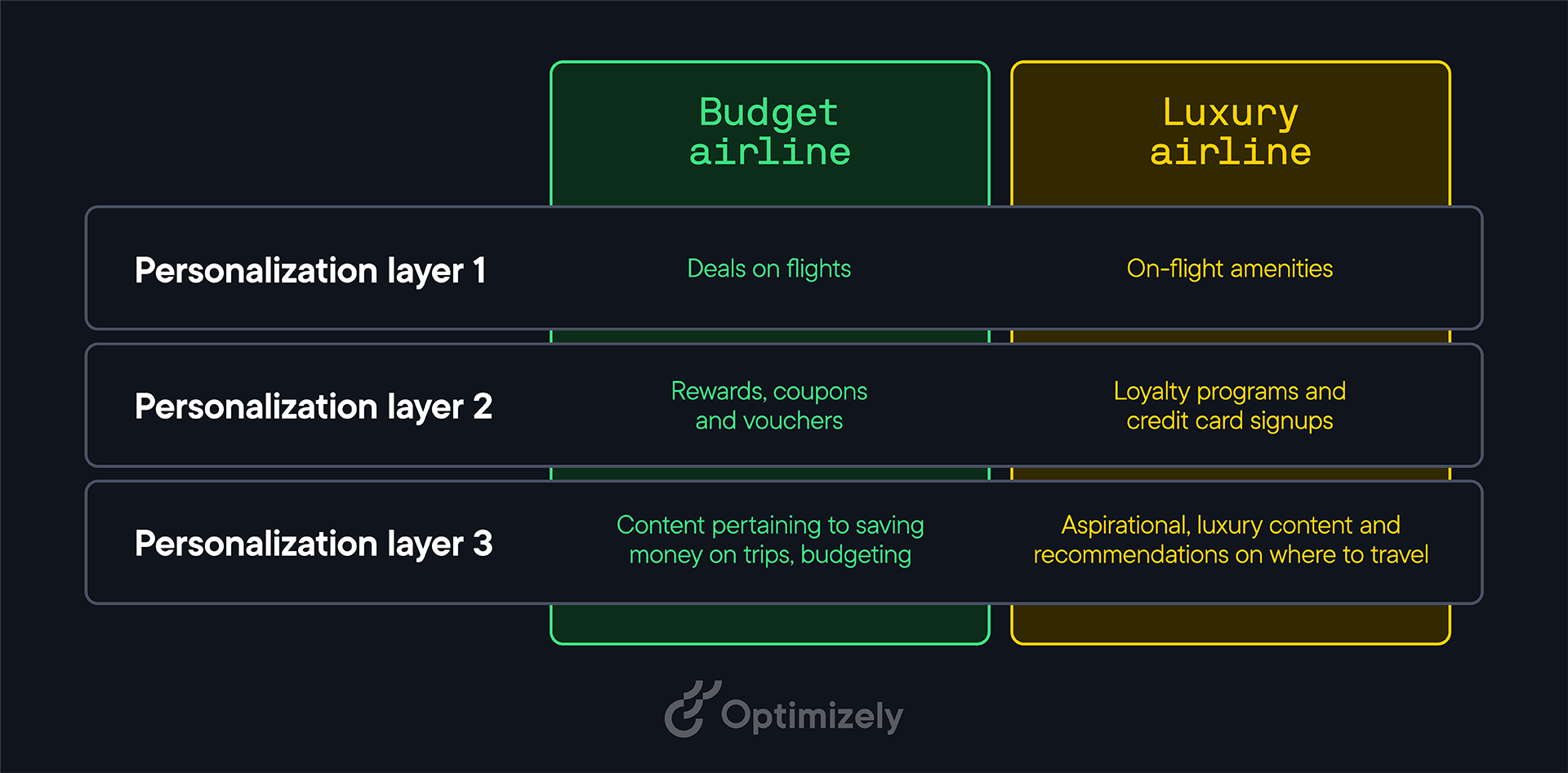
Here's an example of how drastically the shape of personalization can shift between 2 companies in the same industry;

Challenge 2: Scaling content to create personalized experience you want to deliver

Personalization is where content meets data.

It’s tough to create an optimized customer experience with a limited library of content. There’s really no point in trying to personalize if you’re going to surface the same 5 blog posts to every customer on your site.

Scaling content creation is easier than you think. With the right content marketing platform, you can facilitate workflows that drastically reduce the amount of time it takes to create content, easily collaborate on ideation and strategy, publish with ease, and even leverage AI for content creation.

Check out our guide on scaling content creation for personalized experiences.

Challenge 3: Managing data and privacy concerns

Bringing together data from a million different sources sounds about as fun as... bringing data together from a million different sources.

Unifying your data through a customer data platform (CDP) will ensure your data is consistent across customer profiles no matter where it's collected.

On top of that, you need to be super transparent about how and what data you’re collecting from your customers can be ensured of data privacy. Even though 78% of consumers cite they are likely to engage with a personalized offer tailored to their interests, 77% of consumers also cited that data privacy policies are important to maintaining brand loyalty. It’s important to strike a delicate balance that respects boundaries.

Be sure to offer them ways to opt out of data capture, not only for the sake of customer loyalty, but also so you don’t get walloped with massive fines.

Challenge 4: Measuring the impact of personalization

One of the biggest challenges with personalization is knowing whether or not it's working how you want it to.

A/B testing and experimentation are common ways of overcoming personalization challenges when you can’t quite figure out exactly what your audience wants, or if what they want isn’t abundantly clear.

If you're crushing your ROI goals, then hats off to you, but what happens if you're not? How do you know what to change and what not? That's where experimentation comes in.

Now, it just so happens that Optimizely provides a solution for all these challenges in one unified platform, but you probably already guessed that being the astute B2B marketer you are.

Challenge 5: Building a personalization engine

Your personalization engine is the full set of tools that execute your strategy. Like any engine, one faulty component can bring the whole thing down.

Whether you're running a unified platform or a connected stack, here is what that engine needs:

  • Seamless integration with your existing CMS and CRM, so data flows without manual intervention
  • Scalability that keeps pace with audience growth and increasingly complex personalization requirements
  • AI and machine learning that make real-time adjustments based on behavior, not just static profile attributes
  • First-party data infrastructure that complies with current privacy regulations and is built to handle future ones
  • Robust A/B testing and experimentation so every personalization decision can be validated
  • Analytics and reporting that make ROI visible, not buried in a place someone has to query manually

For way more goodness, check out our in-depth guide on personalization engines.

Planning your personalization strategy

36% of executives said disjointed workflows are holding them back. Before you touch a segment, a rule, or a piece of content, you need a shared workspace where the people responsible for personalization can work together.

Personalization crosses departments. Your data team builds the profiles. Your content team builds the experiences. Your product team controls the surfaces. Your analytics team measures the outcomes. If those four groups are working in separate tools with no shared view of the program, the strategy exists only on slides.

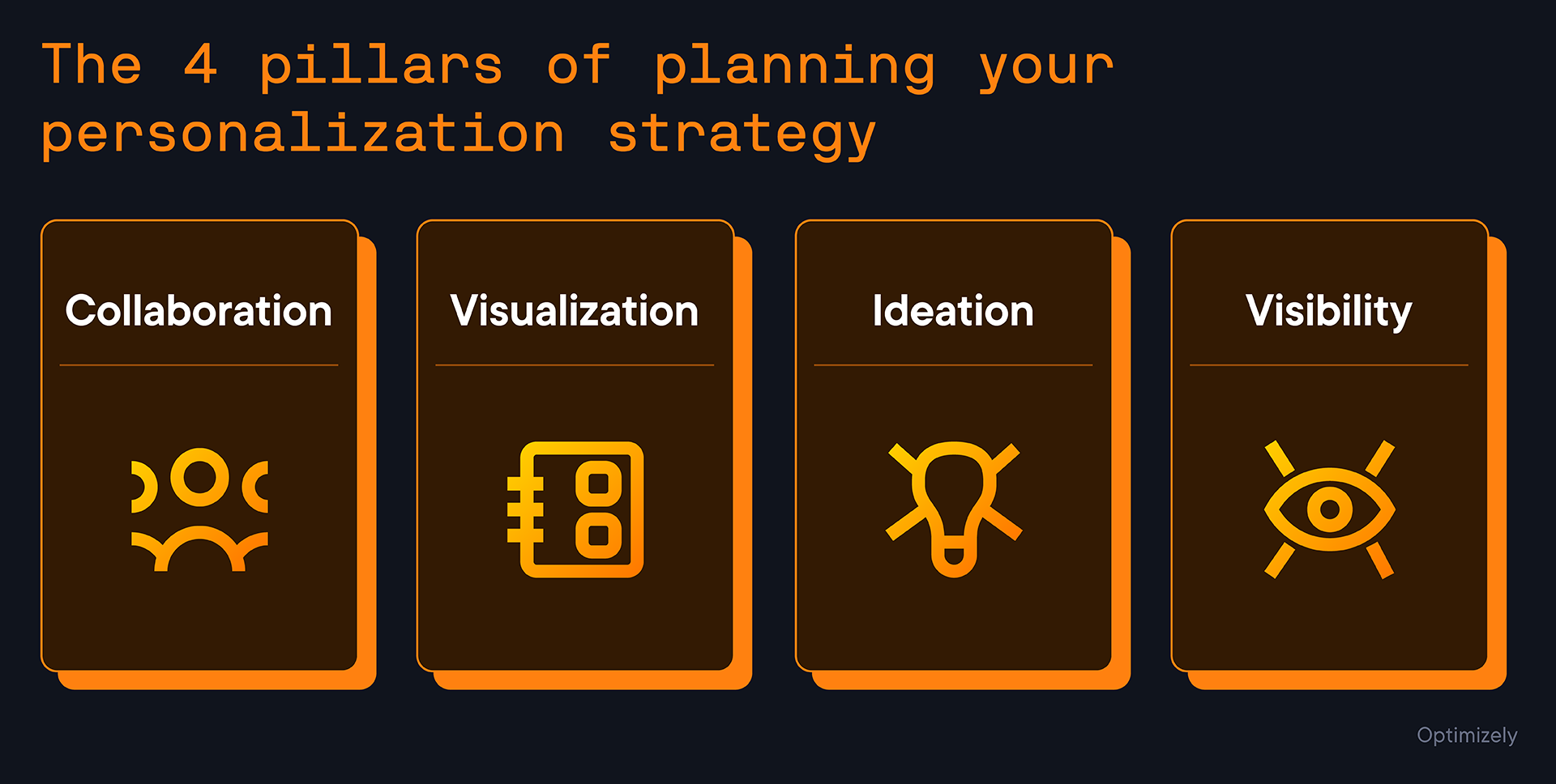
Your planning environment should cover four things:

  1. Collaboration

    How is everyone with a stake in this program communicating and planning together in real time?

  2. Visualization

    Can you see the full program, across all channels and segments, from a single view?

  3. Ideation

    Personalization is iterative because customer needs are fluid. How is your team capturing and prioritizing new ideas as the data evolves?

  4. Visibility

    Is your strategy accessible to everyone who needs it, or is it buried in a folder only your team can find?

Once you have a way to actually work with your team, it's time to get started.

Start with your personas

You likely already have your ideal customer profile built out. Use it. Before you touch any data, start ideating campaigns against those personas. This gives you runway before you've collected a single new data point, and it forces your team to think in terms of audiences rather than channels.

Understand your broadest audiences

Again, you already probably have a sense of who your customers are. You likely have a solid understanding of the segments they belong to such as:

  • Prospects vs. customers
  • First-time buyers vs. repeat buyers
  • Desktop vs. mobile
  • User locations
  • Typical age group

As you gather more data and insights, you can refine your approach and create more granular personalization strategies.

Identify opportunities

This is where most personalization programs leave significant value on the table, and it's where AI changes the picture entirely.

The instinct is to go looking for new data. The smarter move is to connect the data you already have. Your CRM knows which accounts are close to renewal. Your product analytics knows which features drive retention.

Your content platform knows which topics correlate with conversion. Separately, each of those signals is useful. Together, they tell you which moments in the customer journey are worth personalizing, in which order, and with what content.

That is where the ROI lives. Not in collecting more data, but in surfacing insights from the data you already have that have been invisible because they lived in silos.

AI can surface correlations across your first-party data that no analyst would have found manually, and it can do it before the opportunity has passed.

How do you create personalized experiences without needing a developer for every change?

The experiences you build rely on intent-based signals, persona-based signals, or a combination. Intent-based signals tell you where someone is in their journey. Persona-based signals tell you who they are. Understanding how both interact is what drives the actual experience.

Understanding how users interact with which content will ultimately drive the entire personalized experienced.

Data integration

Integrating your first-party data, creating audience segments, and building as complete a picture of your customers as possible is the foundation. The more signals you bring together, the more precise the personalization can be and the more permutations you can serve without adding manual effort.

Your AI layer sits on top of this data. It reads it, finds patterns in it, and acts on it in real time. What it cannot do is substitute for strategy. The decisions about what signals matter, which audiences to prioritize, and what outcomes you're optimizing for are still human.

Building your experiences

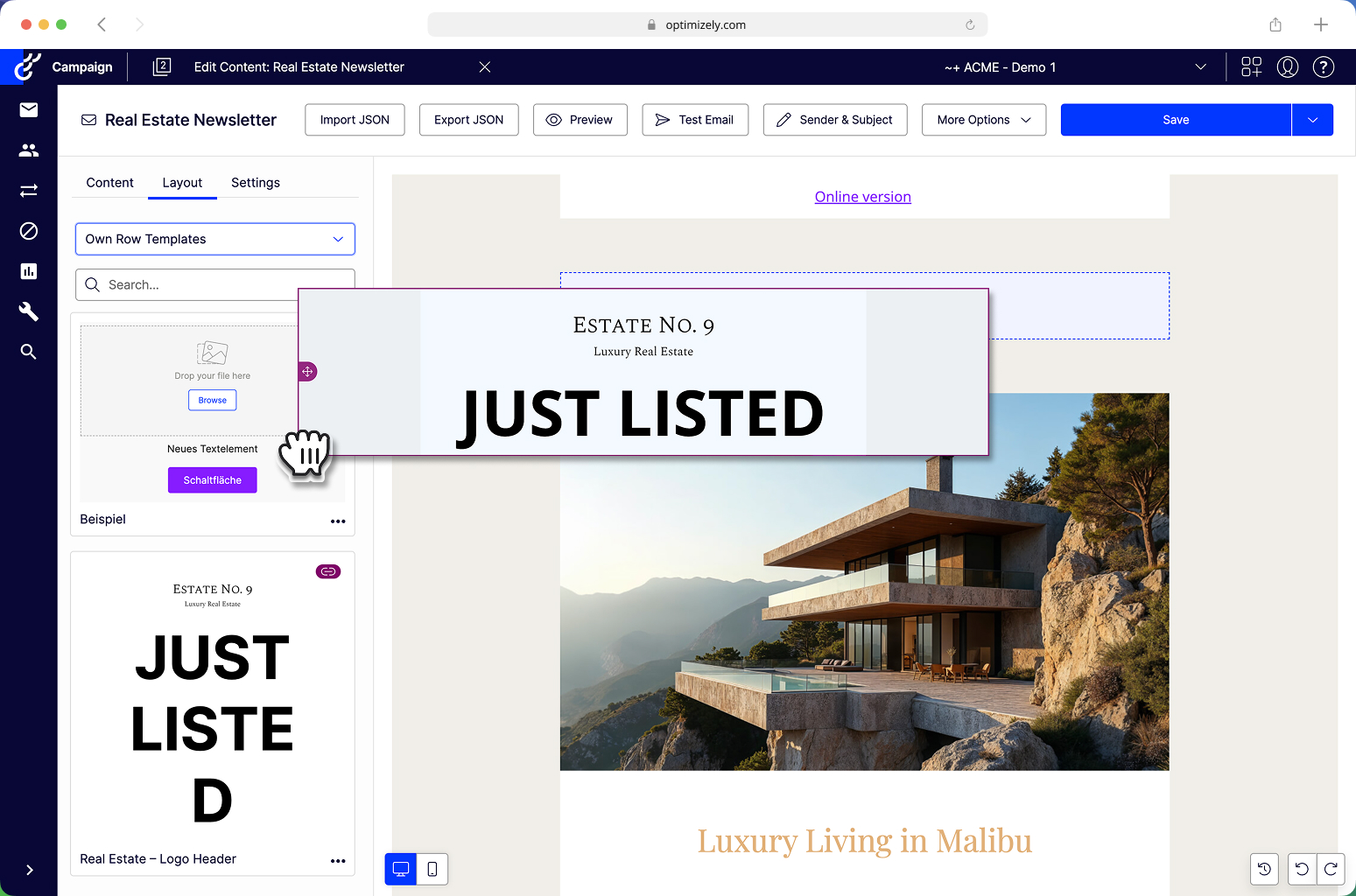
Most marketing teams do not have unlimited development resources, and the personalization programs that depend on engineering bandwidth tend to move slowly. A no-code or low-code visual experience builder lets your marketers move at the speed of the data rather than waiting for a development sprint.

A visual editor also lets you see changes the way your customers will see them, in real time, on your live site. That feedback loop matters when you're iterating quickly.

Delivering personalized experiences at scale

Alright, enough with planning and building. Now it’s time to put your personalization strategy into motion.

You’ve put all the pieces of the puzzle together and now it’s time to deliver high-performing experiences to the right people at the right time.

We’re officially in the R.L. Stine Goosebumps phase of personalization where you allow your users to choose their own adventure. Hopefully you’re leading your customers to somewhere other than deep into the jungle of doom.

Real-time segmentation

You’ve created the blueprints, and now it’s time to put the experiences in action with real-time segmentation.

For example, what happens to the web experience as a whole when a customer clicks on a “learn more” button that goes to one individual page? Does that one action then surface other relevant content or product recommendations?

Real-time segmentation relies on customer profiles, but it’s important to note that your customer profile is still a work in progress each time they visit your site.

AI-powered customer journeys

An AI-driven personalization layer makes your website proactive rather than reactive. Instead of waiting for a customer to signal intent through an obvious action, the AI reads patterns across the full history of their behavior and adapts accordingly.

When you factor in location, device, session context, purchase history, and data from other channels, the number of possible experience permutations becomes impossible to manage manually. AI handles the permutations. Humans define the guardrails, set the objectives, and review the outcomes.

The human-in-the-loop is not a limitation of AI personalization. It is the design. Strategy, judgment, and brand decisions belong to your team. Execution and scale belong to the machine.

AI can also run multivariate testing automatically, keeping the best-performing experience active and rotating out underperformers without waiting for a human to pull the report. Segments update in real time. The system gets smarter the more it runs.

Symmetric experiences

Your customers move between your website, your mobile app, your email program, and your sales touchpoints. Personalization that resets every time a customer changes channels is not personalization. It's a series of disconnected experiments that can actively damage trust.

A consistent experience across every channel, informed by a unified customer profile, is what turns personalization into something that feels like the brand actually knows you. That coherence is what builds loyalty.

Analyzing your results

Each audience and experience you’ve created will be accompanied by a set of desired goals and outcomes. Measuring the impact of your personalization might be the most important aspect of your strategy.

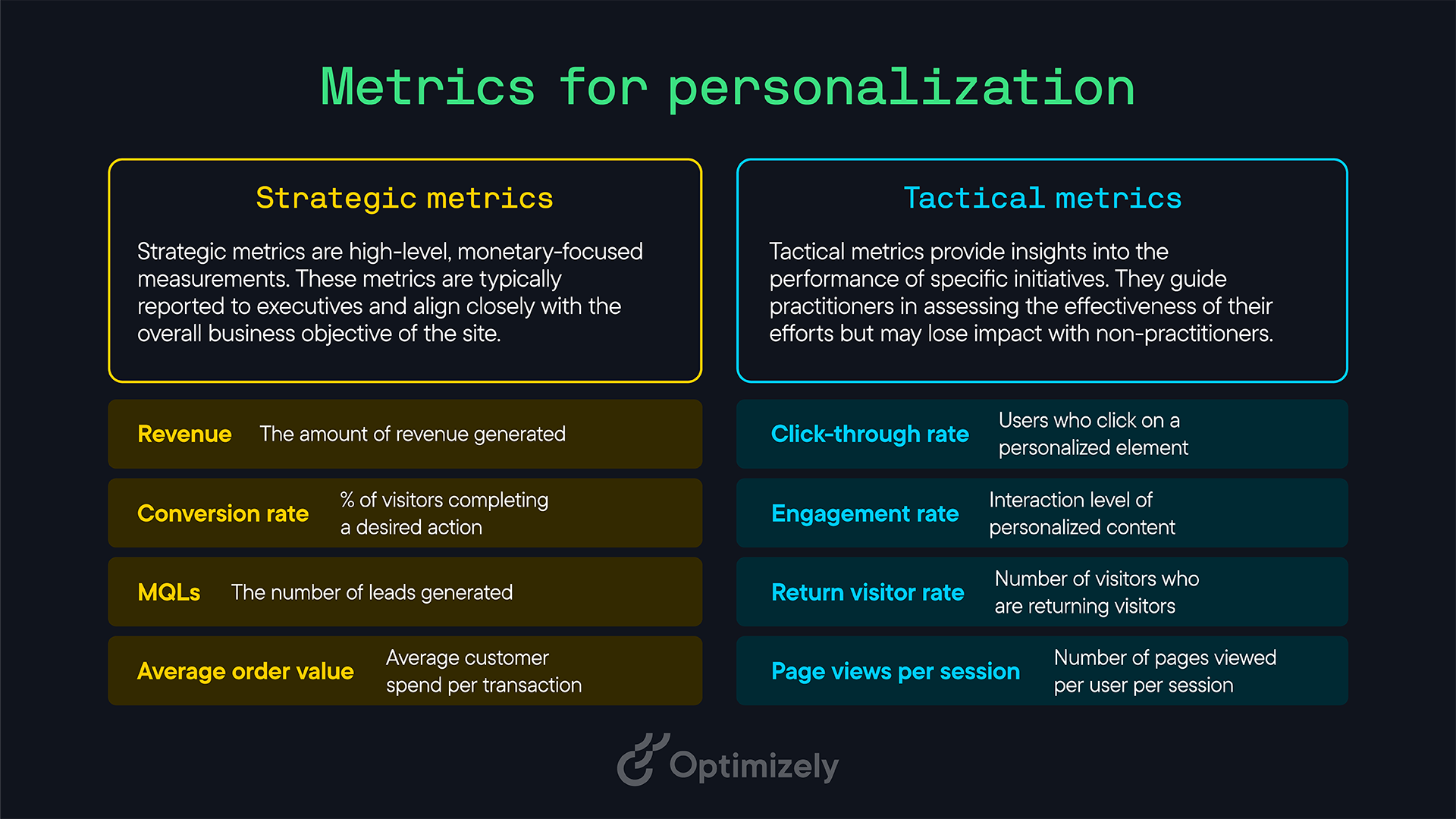
Metrics for personalization can be broken down into two different buckets: strategic and tactical metrics.

Strategic metrics

These are high-level measurements that focus primarily on the monetization aspects of personalization. These metrics include:

  • Revenue
  • Conversion rate
  • MQLs (marketing qualified leads)
  • Average order value
  • Pipeline generated

Jaded B2B marketers will tell you that these metrics are all the executive leaders really care about.

But we’re not jaded here at Optimizely.

Tactical metrics

These metrics provide insights into specific initiatives and focus primarily on performance. Some of the most valuable metrics here are:

  • Click through rate (CTR)
  • Engagement rate
  • Return visitor rate
  • Page views per session
  • Time on site
  • Bounce rate

Bringing lots of data points together into one cohesive report is about as fun as it sounds. And remember when we mentioned earlier about how executives were legitimately concerned about analytics and reporting?

Welcome to the life of a marketer.

That’s why it’s so important to have a customer data platform (CDP) that integrates with all your other tools as part of the assembly line that is your personalization engine.

With a robust analytics tool, you’ll be able to demonstrate:

  • Results and impact
  • Return on investment (ROI)
  • Insights
  • Journey analytics
  • Guidance
  • Data exports
  • Program reports

Why does personalization need experimentation to be worth it?

Without experimentation, personalization is really just customization. Which isn't really all that personal.

Experience optimization is what separates a program that is running from a program that is learning. The data and insights your personalization strategy generates need to be validated through experiments that test your assumptions, surface what's working, and build the evidence base that justifies continued investment.

It is also how you prove ROI in a way that survives scrutiny. Not just "we served different content to different people," but "we ran a controlled test, and the personalized experience outperformed the baseline by this much, and here is what that means in revenue."

We're not just saying that because we're the best experimentation platform on the market. We'd say it even if we weren't. (But it's irrelevant, because we are.)

As you build out your program, remember that personalization can go really wrong. A bad experience remembered is worse than no personalization at all. But a well-run program, with the right infrastructure, the right team alignment, and the right experimentation discipline behind it, compounds. Every test makes the next one faster. Every validated insight reduces the cost of the next decision.

Wrapping up

If you take two nuggets of information away from this guide, they are:

  1. There's no more effective way to make your brand look dumb than to get personalization completely wrong
  2. Not getting personalization wrong requires a carefully coordinated team aligned with the same strategy, tools and vision

Personalization is beyond just an expectation; it's an absolute requirement. Messing up personalization is just as catastrophic as confidently calling someone by the wrong name.

Don't create memorable experiences for all the wrong reasons.

Ensure you've done your homework, you know who your customers are, you know what they want, you know how to deliver what they want, and you have the tools to simplify the process. Yea, it's that easy.

Best of luck, buddy!

Frequently asked questions about building your personalization strategy

Sign up for our marketing newsletter

Optimizely will store and process your personal data as described in our privacy notice. You can opt out at any time.